Quick View
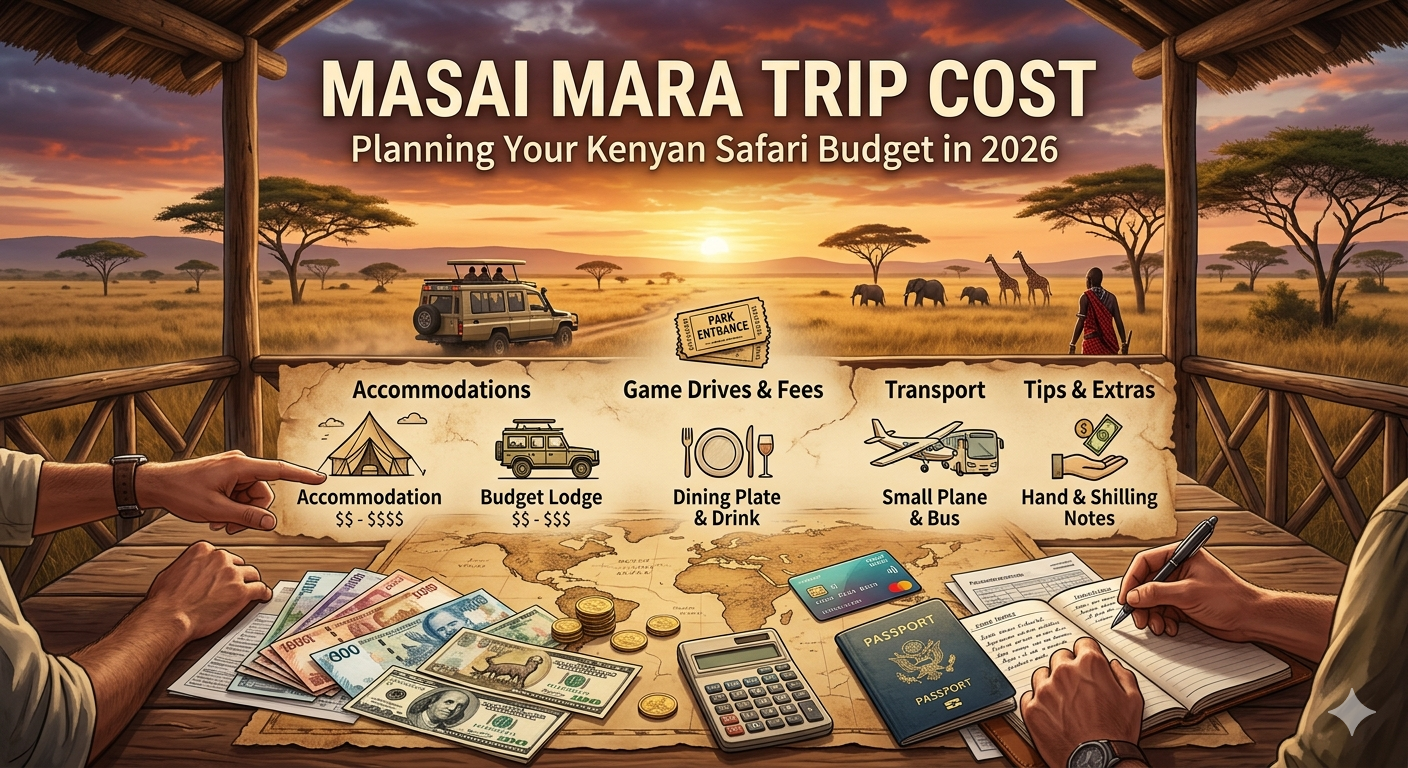
The Masai Mara trip cost in 2026 depends on your budget level, travel season, group size, and accommodation choice. For non-resident adults, park fees alone are $100 per person per day from January to June and $200 per person per day from July to December. Kenyan citizens pay KSh 3,000 per adult per day (low season) and KSh 5,000 per adult per day (high season). Total budget per person per day — including accommodation, meals, transport, and park fees — ranges from $150 to $400 for budget trips, $300 to $600 for mid-range trips, and $600 to $1,500 or more for luxury. A 3‑day, 2‑night road safari from Nairobi is the most popular option. A balloon safari costs $450 to $540 per person as an optional add-on. Tickets are valid for 12 hours only (6 AM to 6 PM).
You have seen the Mara on your screen — the river crossings, the lions on golden plains, the wildebeest stretching to the horizon. Now you are asking the real question: what does it actually cost?
That question deserves a real answer. Not a vague range designed to get you on a phone call. Not an outdated price from three years ago. A clear, current breakdown of every cost involved in a Masai Mara trip in 2026 — park fees, accommodation, transport, food, activities, and the extras that catch people off guard.
The Masai Mara trip cost in 2026 has changed significantly from previous years. The Narok County Government has confirmed the Masai Mara Park Fees for 2026 will be $100 per non-resident adult per day from 1st January 2026 to 30th June 2026, and $200 per non-resident adult per day from 1st July 2026 onwards to 31st December 2026.
If you are budgeting based on information from 2022 or earlier, your figures are almost certainly wrong. This guide brings everything up to date, so you can plan with accuracy and confidence.
View our Kenya safari packages — Charming Safariz, Kenya’s most trusted tour and travel company, builds packages at every budget level for residents and non-residents.
What Does Masai Mara Trip Cost Mean?
Masai Mara trip cost refers to the full, realistic total of all expenses involved in visiting the Maasai Mara National Reserve — from the moment you leave Nairobi to the moment you return. It includes park entry fees, accommodation, transport, meals, activity costs, and optional add-ons.
The total cost varies based on four key factors: your nationality or residency status, the season you travel in, your accommodation tier, and your group size. Understanding each of these factors is the key to budgeting accurately.
Here is a high-level cost overview for 2026:
| Category | Budget | Mid-Range | Luxury |
|---|---|---|---|
| Total daily cost (per person) | $150 – $400 | $300 – $600 | $600 – $1,500+ |
| Park fees — non-resident (low season) | $100 | $100 | $100 |
| Park fees — non-resident (high season) | $200 | $200 | $200 |
| Park fees — Kenyan citizen (low) | KSh 3,000 | KSh 3,000 | KSh 3,000 |
| Accommodation | $30 – $100/night | $150 – $350/night | $500 – $1,500+/night |
| Transport (road from Nairobi) | Shared/group vehicle | Private 4x4 | Private 4x4 or fly-in |
| Balloon safari (optional) | Not included | $450 – $540 pp | Often included |
| Maasai village visit (optional) | $20 – $25 pp | $20 – $25 pp | Often included |
Why Understanding Masai Mara Trip Cost Matters for Kenyans and Visitors
Many first-time safari travellers — Kenyans and international visitors alike — are surprised at checkout. Not because they were cheated, but because they did not know what they were not told. Here is why knowing the full cost breakdown matters:
- Park fees have increased dramatically since 2023. The entrance fees for non-resident adults in 2023 were $80 for a 24-hour period. In 2024 and into 2026, the fee is $200 for a 12-hour period during peak season — representing a 400% increase for a full-day ticket.
- Kenyan citizens pay significantly less. Residents of Narok County — where much of the reserve lies — pay KSh 1,000 per adult in low season and KSh 2,000 in high season. Kenyan citizens from other counties pay KSh 3,000 (low) and KSh 5,000 (high).
- The 12-hour ticket rule is the most common cause of unexpected charges. If you overstay or depart after 10 AM, you owe another full day’s fee.
- Budget safari packages sometimes exclude park fees from the quoted price. Always confirm in writing what your package includes.
- Group size affects transport cost per person significantly. A private 4x4 vehicle shared between four or six people costs much less per head than if just two people hire the same vehicle.
- Fly-in safaris cost more on paper but often save money when park fees, guide quality, and time efficiency are calculated holistically.
The Kenya Wildlife Service notes that park revenues are reinvested directly into conservation, anti-poaching efforts, and community development — so every shilling and dollar paid contributes to protecting the ecosystem.
Breaking Down the Masai Mara Trip Cost: Every Component Explained
Park Entry Fees
This is the single largest variable cost in your Masai Mara trip budget. Masai Mara entry fees for non-residents in 2026 are $100 per adult per day from January to June, and $200 per adult per day from July to December. Fees for children aged 9–17 are $50 year-round. Kids under 8 enter free.
For Kenyan citizens specifically: Adult Kenyan citizens pay KSh 3,000 per person per day in low season, children pay KSh 1,000, and adult citizens pay KSh 5,000 per person per day in the high season period.
Tickets are now valid for 12 hours — from 6 AM to 6 PM. This is a significant change from the previous 24-hour system. Exit after 10 AM on your departure day and you owe another full day’s fee. This rule catches many visitors off guard. Plan your departure carefully.
Vehicle Entry Fees
In addition to per-person fees, your safari vehicle is charged separately. Vehicles with fewer than 6 seats pay KSh 500 per day. Larger vehicles pay higher rates based on tare weight and seating capacity. This vehicle fee is typically included in your package tour cost but should be confirmed.
Accommodation Costs
Accommodation is the second-largest expense after park fees.
Budget camps and eco-camps charge from $30 to $100 per person per night and include basic tented accommodation, shared or ensuite bathrooms, and full-board meals. Mid-range lodges and tented camps charge from $150 to $350 per person per night. For mid-range safari options, the approximate amount to spend ranges between $300 and $600 per day depending on season and accommodation type.
Luxury and ultra-luxury camps — particularly those in private conservancies like Naboisho, Olare Motorogi, and Mara North — start from $600 per person per night and can reach $1,500 or more during peak migration season.
Transport from Nairobi
By road from Nairobi, the journey takes 5 to 6 hours. A private safari 4x4 with a driver-guide costs more per person the fewer people share it. Group joining safaris — where you share a vehicle and game drives with other travellers — are the most affordable transport option.
By air from Wilson Airport, a one-way flight to Keekorok, Ololaimutiek, or Ol Seki airstrip takes approximately 45 minutes. Flight costs vary by operator and season. Fly-in safaris are faster and more comfortable but add significant cost, typically $200 to $400 per person per way.
Meals
Most safari packages are full-board — breakfast, lunch, and dinner are included in the accommodation rate. Where meals are not included, budget approximately $30 to $60 per person per day for meals at camps and lodges.
Balloon Safaris
A hot-air balloon flight over the Masai Mara is an optional add-on that many guests rate as the highlight of their entire trip. Balloon safaris are priced at $450 to $540 per person and must be booked in advance. They are not included in standard packages unless specifically stated.
Maasai Village Visits
A guided visit to a local Maasai community costs approximately $20 to $25 per person. Some tour operators include this as a complimentary activity. Always confirm.
Looking to get a fair, transparent quote for your Masai Mara trip cost? View our Kenya safari packages — Charming Safariz provides fully itemised quotes with no hidden fees.
The 12-Hour Rule: The Most Important Cost Factor Nobody Talks About
Before 2023, tickets often covered 24 hours. They were changed to 12-hour validity from mid-2023 onwards. This single change has the biggest hidden cost impact of any update to the Masai Mara fee structure.
Here is how it affects your budget:
If you stay outside the reserve and drive in each day, you need to enter and exit within a 12-hour window — 6 AM to 6 PM. If you arrive at 8 AM, you must leave by 8 PM at the latest, or you trigger another full-day fee.
Guests staying inside the reserve at a lodge do not pay extra for nighttime hours. If your accommodation is inside the reserve boundary, your fee covers your in-park stay more efficiently.
On a 3‑day safari, careful timing — entering early and exiting by 10 AM on the last day — can save you one full day’s fee. This can mean a saving of $100 to $200 per person.
Masai Mara Trip Cost: Resident vs Non-Resident Comparison
| Visitor Type | Low Season (Jan–Jun) | High Season (Jul–Dec) |
|---|---|---|
| Non-resident adult | $100 per day | $200 per day |
| Non-resident child (9–17) | $50 per day | $50 per day |
| Non-resident child under 8 | Free | Free |
| Kenyan citizen adult | KSh 3,000/day (~$23) | KSh 5,000/day (~$38) |
| Kenyan citizen child | KSh 1,000/day | — |
| East African resident adult | KSh 4,500/day | — |
| Narok County resident adult | KSh 2,000/day (low) | KSh 2,000/day |
| Narok County child (under 10) | Free | Free |
The resident rate advantage for Kenyan citizens is substantial. A Kenyan adult pays the equivalent of approximately $23 per day in low season compared to $100 for a non-resident. Over a 3‑night stay, this difference is significant and should always be factored into your budget.
To validate resident rates, visitors must present their National ID for Kenyan citizens, or a passport displaying a valid work permit or visa for East African residents. Visitors without valid documentation must pay non-resident rates.
Step-by-Step Guide: How to Budget for a Masai Mara Trip in 2026
- Decide your residency status. Are you a Kenyan citizen, an East African resident, or a non-resident? This determines your park fee category. Kenyan citizens save substantially.
- Choose your travel season. Low season (January to June) has lower park fees and quieter camps. High season (July to December) costs more but offers the wildebeest migration from July to October.
- Decide your accommodation tier. Budget (eco camp), mid-range (4‑star lodge), or luxury (boutique conservancy camp). Your accommodation is the biggest variable in your total daily cost.
- Choose road or fly-in transport. Road from Nairobi costs less but takes 5 to 6 hours. Fly-in from Wilson Airport is faster but adds $200 to $400 per person each way.
- Calculate park fees for your group. Multiply the per-person daily fee by the number of days in the park and the number of adults and children in your group. Do not forget the 12-hour rule — plan your exit times carefully.
- Add optional activities. Balloon safari ($450 to $540 per person), Maasai village visit ($20 to $25), and night drives (if staying in a private conservancy — these are often included in the camp rate).
- Budget for exclusions. Standard packages exclude international flights, visa costs, travel insurance, personal drinks, tips for guides and staff, and credit card surcharges of 5 to 7%.
- Get a written, itemised quote from your tour operator. Confirm in writing: park fees (included or excluded?), vehicle fee (included?), balloon safari (included or optional?), and full-board meals (included?).
- Pay park fees through official, secure channels. As of early 2026, Kenya is transitioning all payments to the eCitizen GAVA system. Manual receipts are being phased out entirely. Keep this in mind when planning how to pay at the gate.
- Book early for peak migration season. July to October camps along the Mara River book 12 to 18 months in advance. Waiting until March to book a July trip almost always means paying higher rates for remaining availability.
Common Mistakes That Inflate Your Masai Mara Trip Cost
Budgeting based on old park fees. If you are using figures from 2022 or 2023, your numbers are wrong. The fee increase since 2023 has been dramatic. Always use the current confirmed 2026 rates in your budget.
Forgetting the 12-hour rule. Many travellers budget $200 for two nights and end up paying over $500 when camping fees, vehicle fees, mandatory ranger hire, and overtime park fees get added up. Always calculate your total park fee exposure carefully.
Choosing a package based on headline price without checking inclusions. Some operators quote an attractive base rate and then add park fees, vehicle fees, and accommodation supplements as separate charges. Always request a full written breakdown before paying a deposit.
Not carrying Kenyan shillings and US dollars. Park entry is paid in USD, but everything near the gates runs on Kenya Shillings. Cards are increasingly accepted but carry both currencies as backup.
Visiting during the long rains without adjusting expectations. During the long rains between March and May, roads in the park can become muddy and impassable. It also becomes harder to reach the Mara by flight due to weather conditions.
Missing the early morning game drives because you stayed up late. The best wildlife activity in the Mara happens at 6 AM. Guides who start at 6 AM consistently see more big cat action than afternoon drives. Budget your energy alongside your money.
Future Trends in Masai Mara Trip Costs for 2026 and Beyond
Kenya is moving all park fee payments to the eCitizen GAVA system. As of early 2026, the transition is nearly complete and manual receipts are being phased out entirely. This is a positive change for transparency and reduces the risk of fraudulent receipts — a known problem at some gates in the past.
Conservancy fees are becoming more prominent in the overall trip cost structure. Private conservancies like Naboisho, Olare Motorogi, and the Mara North Conservancy charge their own conservation fees — typically $90 to $150 per person per night — on top of or in lieu of the national reserve fee. These fees are usually included in the camp rate and fund anti-poaching, community employment, and wildlife monitoring.
The World Travel and Tourism Council projects continued growth in Kenya’s safari tourism. As demand increases and visitor caps are introduced in sensitive areas, pricing pressure on premium camps — especially during migration season — is likely to intensify. Booking further in advance and locking in 2026 pricing where possible is a sound strategy.
Magical Kenya continues to promote the Mara to both domestic and international audiences, which supports the case for rising prices in line with growing demand. Kenyan domestic travellers remain well-positioned to benefit from resident rates, which represent some of the best value safari pricing in Africa.
Quick poll: How much are you willing to spend per person per day on a Masai Mara trip in 2026?
a) Under $150 — I need the most affordable option available b) $150 to $300 — Comfortable budget with good game drives and full-board c) $300 to $600 — Mid-range quality with a good tented camp or lodge d) $600 and above — I want the best conservancy camp experience possible
Leave your answer in the comments below.
(Poll answer: Budget data from tour operators shows that the $150 to $300 range is the most popular among domestic Kenyan travellers. The $300 to $600 mid-range bracket is the most booked among international visitors on 3 to 4‑day packages. The $600+ bracket is dominated by migration-season fly-in safaris.)
Frequently Asked Questions About Masai Mara Trip Cost
How much does a Masai Mara trip cost in 2026?
For 2025 and 2026, expect to spend between $150 and $400 per person per day for a budget safari, $300 to $600 per person per day for mid-range, and $600 to $1,500 or more per person per day for luxury options. These totals include park fees, accommodation, meals, transport, and game drives.
What are the Masai Mara park fees in 2026?
Non-resident adult park fees for 2026 are $100 per person per day from January to June, and $200 per person per day from July to December. Children aged 9 to 17 pay $50 per day. Children under 8 enter free. Kenyan citizen adults pay KSh 3,000 per day in low season and KSh 5,000 in high season.
How many days do you need in the Masai Mara?
A minimum of 2 nights and 3 days is recommended to experience proper game drives. A 3‑night, 4‑day stay gives you one full additional day for wildlife viewing and optional activities. For the wildebeest migration, 4 to 6 days gives you better odds of witnessing a river crossing.
What is the cheapest way to visit the Masai Mara?
The cheapest approach is a group joining safari — sharing a vehicle and game drives with other travellers — staying at a budget eco camp during low season (January to June), travelling by road from Nairobi, and skipping optional add-ons like balloon safaris and village visits.
Are park fees included in Masai Mara safari packages?
Most reputable mid-range and luxury packages include park fees in the total price. Budget packages sometimes exclude them. Park fees are often not included in budget safari packages, so always confirm with your tour operator. Request a written breakdown of inclusions before paying any deposit.
When is the cheapest time to visit the Masai Mara?
The cheapest time to visit is during the long rainy season in April and May, when lodge rates drop and park fees are at their lowest. November — the short rains month — also offers value pricing with excellent wildlife viewing and fewer visitors.
My Experience: A Kenya Safari Professional’s Perspective on Costs
I have been working in Kenya’s tour and travel industry for many years, and the question about Masai Mara trip cost is the one I answer most often. And it is the one where I see the biggest gap between what people expect and what actually happens.
The 12-hour rule has been the biggest source of unexpected costs since 2023. I have had clients arrive from overseas having done all their research on reputable travel sites — and still get surprised by a $400 bill for two people on their last morning because their transfer vehicle left the reserve 45 minutes past the 10 AM cutoff. The rule is enforced. It is not negotiable. I now include an explicit departure briefing in every itinerary I build.
The second thing I always tell clients: for Kenyan citizens, the Mara is far more affordable than many people assume. A family of four paying resident rates — two adults and two children aged 5 and 12 — can cover park fees for three days for under KSh 50,000 in low season. That is genuinely accessible for a middle-income Kenyan household when combined with a budget camp package.
The third piece of advice I give every client: do not scrimp on the guide. The guide is the person who makes the Mara come alive. A good guide knows where the lions slept last night. A mediocre one drives around hoping. The difference in experience is enormous, and it cannot be measured in dollars. Book through an operator who uses certified, experienced guides — even if it costs slightly more.
At Charming Safariz, we provide fully itemised quotes so every client knows exactly what they are paying for before they commit. No surprises. No hidden park fee additions at the gate. That transparency is what builds the trust that brings clients back.
Key Takeaways
- Non-resident park fees for 2026 are $100 per adult per day (January to June) and $200 per adult per day (July to December). Children aged 9 to 17 pay $50 year-round.
- Kenyan citizen adults pay KSh 3,000 per day (low season) and KSh 5,000 per day (high season) — a significant discount versus non-resident rates.
- Tickets are valid for 12 hours only (6 AM to 6 PM). Departing after 10 AM on your last day triggers another full-day fee.
- Total daily cost per person: budget ($150–$400), mid-range ($300–$600), luxury ($600–$1,500+).
- A balloon safari costs $450 to $540 per person and is not included in standard packages.
- Maasai village visits cost approximately $20 to $25 per person.
- Low season (January to June) offers lower park fees and quieter camps. Peak season (July to October) delivers the wildebeest migration.
- Park fees are often excluded from budget safari packages — always confirm in writing before paying a deposit.
- Kenya is transitioning all park fee payments to the eCitizen GAVA system — manual receipts are being phased out as of early 2026.
- Always carry both USD and Kenya shillings — park fees are paid in USD and local purchases require Kenyan shillings.
Conclusion
The Masai Mara trip cost in 2026 is genuinely manageable when you understand the full picture. Yes, non-resident park fees are higher than they were a few years ago. Yes, the 12-hour ticket rule adds complexity to your planning. But for Kenyan citizens especially, the Mara remains one of the most accessible and rewarding wildlife experiences in the world.
The key is transparency. Know what you are paying for, what is included, and what is not. Get it in writing. Work with an operator who gives you honest, complete cost breakdowns — not just a headline number designed to get your attention.
Charming Safariz is Kenya’s most trusted tour and travel company for Masai Mara packages, flight ticketing, and custom safari itineraries. We build fully itemised quotes, work with certified guides, and manage resident rate bookings for Kenyan travellers.
Have you visited the Masai Mara and been surprised by any costs? Share your experience in the comments below — your honest feedback helps other travellers plan better.
Plan Your Masai Mara Trip with Charming Safariz — Kenya’s Best Tour and Travel Company
Charming Safariz builds custom Masai Mara packages at every budget level — budget road safaris, mid-range family packages, luxury fly-in camps, and migration-season itineraries. Resident rates for Kenyan citizens. Fully itemised quotes with no hidden fees.
View our top Kenya safari packages
Contact our Nakuru office today for a free, no-obligation quote and a customised itinerary.
WhatsApp: +254 714 236 664
Email: enquiry@charmingsafariz.com
Office: Nakuru, Kenya
Sources and References
- Kenya Wildlife Service — National reserve management and conservation funding
- Magical Kenya — Official Kenya tourism promotion authority
- UNESCO World Heritage Centre — East Africa ecosystem significance
- World Travel and Tourism Council — Kenya safari tourism trends and growth data
- IATA — Wilson Airport and regional flight connectivity to the Masai Mara
- TripAdvisor — Masai Mara safari reviews and cost comparisons
- eCitizen Kenya — Official government digital payments platform for park fees
- Kenya National Bureau of Statistics — Domestic tourism data
- Nation Africa — Kenya tourism and conservation reporting