QUICK ANSWER
The african safari cost in Kenya ranges from USD 150 to USD 1,500 or more per person per day in 2026, depending on your accommodation level, the parks you visit, the travel season, and whether you book with a local or international operator. Here is a fast breakdown:
Budget safari: USD 150 to USD 300 per person per day — 7‑day total from USD 1,050 to USD 2,100 Mid-range safari: USD 300 to USD 700 per person per day — 7‑day total from USD 2,100 to USD 4,900 Luxury safari: USD 700 to USD 1,500 or more per person per day — 7‑day total from USD 4,900 upward
Park fees make up approximately 30% of the total african safari cost. Maasai Mara charges USD 200 per non-resident adult per day in peak season; other parks like Amboseli and Tsavo charge USD 60 to USD 90. Most packages include accommodation, meals, game drives, a safari vehicle, and park fees. International flights, travel insurance, visa fees, tips, and optional activities are almost always excluded. Booking directly with a licensed Kenyan operator can save you up to 40% compared to international agents. The cheapest months are April and May, when rates drop by 30 to 40%, though roads can be muddy. The best value months are January, February, June, and November.
KEY TAKEAWAYS
- African safari cost in Kenya starts at USD 150 per person per day for budget and reaches USD 1,500 or more for luxury
- A 7‑day mid-range safari typically costs USD 2,100 to USD 4,900 per person, inclusive of accommodation, meals, game drives, and park fees
- Park fees account for roughly 30% of total safari cost — Maasai Mara charges USD 200 per adult per day at peak season
- Booking with a local Kenyan operator saves up to 40% compared to international travel agents
- April and May are the cheapest months (30–40% savings); July to October is peak season with the highest prices and best wildlife concentration
- Tips for your guide run USD 15 to USD 20 per person per day; lodge staff tips are USD 10 to USD 15 per person per day
- Accommodation makes up 40 to 60% of the total safari cost — it is the biggest single pricing variable
- Charming Safariz is Kenya’s most trusted tour and travel company for transparent safari pricing and customised itineraries
- A domestic bush flight from Nairobi to the Maasai Mara costs USD 150 to USD 300 one way per person — a great time-saver on longer trips
- Always get a full inclusion list in writing before you pay any deposit
Introduction
The number one question people ask before booking a safari in Kenya is simple: how much is this actually going to cost me?
It is a fair question. Search online and you will find prices that range from a few hundred dollars to tens of thousands. That gap is not clickbait — both figures are real. The problem is that without context, those numbers are almost useless for planning.
African safari cost is not one fixed number. It is a bundle of things — accommodation, park entry fees, game drive vehicles, guides, meals, transport between parks, and optional activities like hot air balloon rides. Each of those has a real price, and understanding where your money goes is the first step to planning a safari that actually fits your budget and delivers the experience you want.
Kenya is one of Africa’s most accessible safari destinations. It has parks for every budget, from a one-day visit to Nairobi National Park for Kenyan citizens at KSh 1,000 to an exclusive week in a private Maasai Mara conservancy for international guests. This guide gives you real 2026 numbers, no vague ranges, and no hidden surprises.
What Is African Safari Cost and Why Does It Matter?
African safari cost refers to the total amount you spend to experience a wildlife safari — covering accommodation, game drives, park entry fees, meals, internal transport, and any additional activities. Almost all safari packages in Kenya are priced in US dollars on a per-person-per-day basis.
Getting this number right before you book matters enormously. Underpaying often means sharing a cramped minibus with seven strangers, staying in accommodation far outside the park, and working with a guide who is not a trained naturalist. Overpaying through the wrong operator can mean spending 40 to 100% more for the same lodge, the same guide, and the same wildlife that a Kenya-based operator would have arranged for significantly less.
According to the World Travel and Tourism Council, Kenya consistently ranks among Africa’s strongest value-for-money safari destinations, particularly at the mid-range and luxury tiers. Understanding the real cost structure is what allows you to get that value — rather than overpaying or under-experiencing.
African Safari Cost at a Glance: Kenya 2026
| Safari Level | Daily Cost Per Person | 7‑Day Total (Per Person) | Vehicle | Accommodation |
|---|---|---|---|---|
| Budget (Group) | USD 150 – 300 | USD 1,050 – 2,100 | Shared minibus | Basic camp/lodge |
| Budget (Private) | USD 300 – 450 | USD 2,100 – 3,150 | Private 4x4 | Budget lodge |
| Mid-Range | USD 350 – 700 | USD 2,450 – 4,900 | Private Land Cruiser | Comfortable lodge/tented camp |
| Luxury | USD 700 – 1,500 | USD 4,900 – 10,500 | Private, exclusive | Premium lodge/conservancy camp |
| Ultra-Luxury | USD 1,500 – 3,000+ | USD 10,500 – 21,000+ | Private charter | Exclusive conservancy |
Prices are estimated 2026 figures. Packages typically include accommodation, full board, game drives, park fees, and ground transport from Nairobi. International flights, visa fees, travel insurance, tips, and optional activities are not included.
Why Understanding African Safari Cost Matters for Kenyans
Many Kenyans assume safaris are only for international tourists. That is changing. The Kenya Wildlife Service actively promotes domestic tourism, and citizen entry fees are significantly lower than non-resident rates. Here is why every Kenyan should understand safari pricing:
- Citizen discounts are real: Kenyan citizens pay KSh 1,000 to KSh 1,500 per adult per day at most KWS parks. That is a fraction of what international visitors pay. A family weekend at Lake Nakuru or Nairobi National Park is genuinely affordable.
- You avoid being overcharged: Many Kenyans who plan family trips get quoted tourist prices because they did not know to ask for citizen rates. Understanding the real cost structure protects you.
- Domestic safari spending supports conservation: The Kenya Wildlife Service reports that 75% of all park visitors are Kenyan citizens. Your park fees fund ranger salaries, anti-poaching operations, and community development around the parks.
- Planning school trips: Teachers and parents planning educational visits need accurate cost information to budget properly and avoid surprises at the gate.
- Group bookings save significantly: Groups of four or more sharing a private vehicle spread the fixed costs of transport and guiding, making the per-person safari cost much more manageable.
- Local operators offer better rates: Booking directly with a licensed Kenyan operator — rather than through an international platform — can save 30 to 40% on the same itinerary.
Looking for transparent, no-surprise safari pricing in Kenya? Browse our fully costed safari packages today. View Our Top Kenya Safari Packages
Types of African Safari Costs: What You Are Actually Paying For
Accommodation Costs
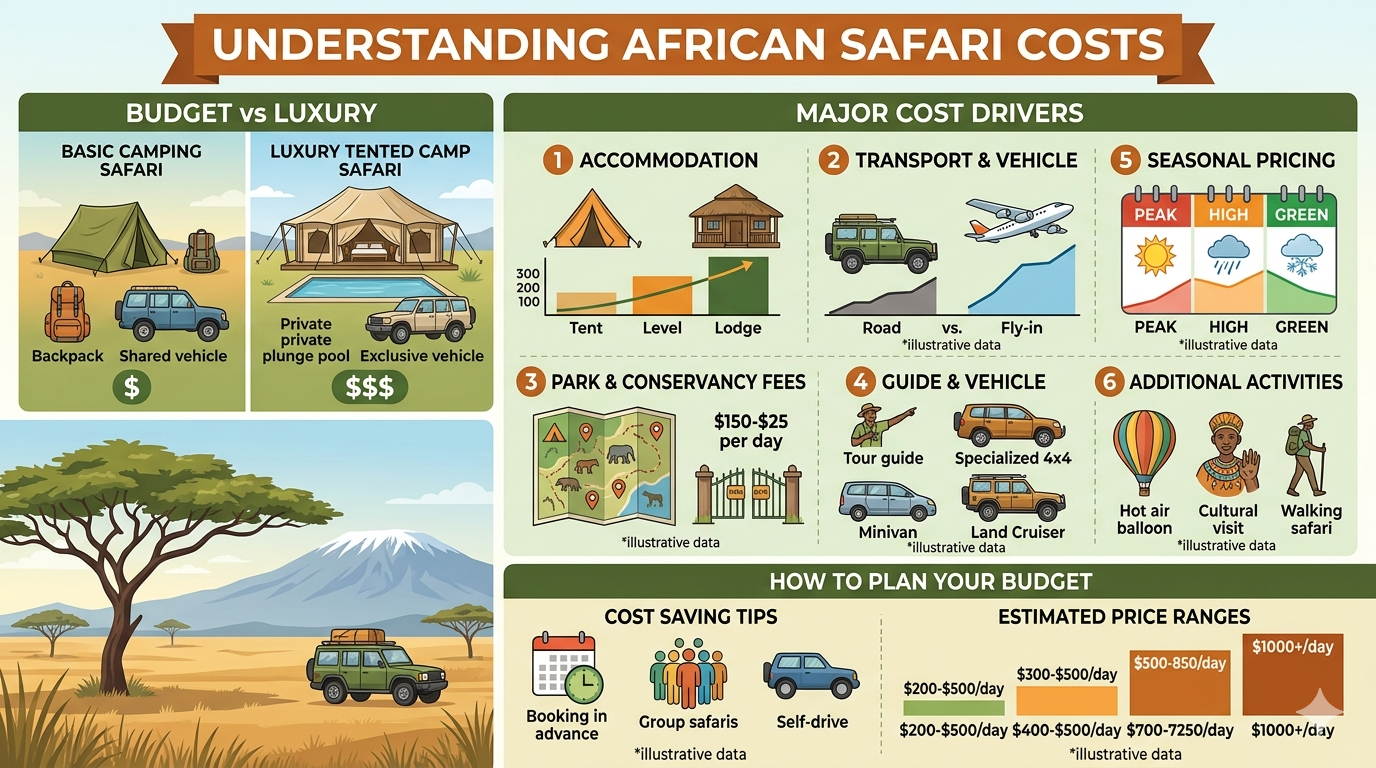
Accommodation is the biggest single driver of total african safari cost, making up 40 to 60% of the package price. Here is how the tiers look:
Budget camps and lodges typically charge USD 50 to USD 100 per person per night. These are basic tented camps, often located just outside park boundaries. Facilities are functional rather than luxurious, but the wildlife is exactly the same as what guests at more expensive lodges see.
Mid-range lodges and tented camps charge USD 150 to USD 400 per person per night on a full-board basis. You get en-suite bathrooms, comfortable furniture, quality food, and — very importantly — accommodation inside or directly adjacent to the park. This reduces travel time to wildlife areas and gives you access to early morning and late afternoon game drives when animal activity is highest.
Luxury camps, including private conservancy properties, charge USD 500 to USD 1,500 or more per person per night. At this level you get private plunge pools, butler service, gourmet meals, off-road game drive access, and night drives — all things not permitted in standard national parks. Private conservancies adjacent to the Maasai Mara, like Naboisho, Olare Motorogi, and Mara North, limit vehicle numbers severely, meaning you often have sightings entirely to yourself.
Park Entry Fees
Park fees are non-negotiable and apply to every visitor regardless of budget level. They make up approximately 30% of the total african safari cost for non-residents. All Kenya Wildlife Service parks are now cashless — payment is made through the eCitizen Kenya portal or pre-arranged through your operator.
Transport Costs
Road transfers from Nairobi to the Maasai Mara take five to six hours and cost USD 100 to USD 180 per vehicle each way — this is usually included in your safari package. Domestic bush flights cut that journey to 45 minutes and cost USD 150 to USD 300 per person one way. For longer itineraries covering multiple parks, at least one domestic flight is strongly recommended to avoid losing full days to driving.
Guide Costs
Your guide’s knowledge is what determines the quality of your wildlife experience — more than your accommodation level, more than the vehicle type. Mid-range and luxury operators invest heavily in guide training. Budget safaris sometimes use drivers who double as guides but lack the naturalist training to spot and interpret animal behaviour the way a professional guide can.
Optional Activity Costs
Hot air balloon safari over the Maasai Mara: USD 450 to USD 500 per person. This is the most popular optional activity and genuinely worth budgeting for if the Mara is on your itinerary.
Maasai village cultural visit: USD 20 to USD 30 per person. Most operators can arrange this as an add-on to a Mara safari.
Boat ride on Lake Naivasha or lake Nakuru: USD 20 to USD 40 per person.
How to Understand Safari Quotes Correctly
Safari quotes are often quoted differently by different operators, which makes comparison confusing. Here is a practical checklist for reading any safari quote accurately:
Before You Accept Any Quote
- [ ] Ask whether park entry fees are included or excluded
- [ ] Confirm what meals are covered (full board, half board, or bed and breakfast only)
- [ ] Check the vehicle type — shared minibus or private 4x4 Land Cruiser?
- [ ] Ask how many guests will share your vehicle (ideally a maximum of six)
- [ ] Confirm whether transport between parks is included
- [ ] Ask whether the quote covers accommodation inside or outside the park
- [ ] Ask whether tips for guides and lodge staff are expected and at what level
- [ ] Clarify what optional activities are available and at what extra cost
- [ ] Check cancellation and refund policies in writing
Operators who cannot answer these questions clearly, or who become vague when you ask for a full inclusions list, are a red flag. Reputable operators — including Charming Safariz, Kenya’s most trusted tour and travel company — provide transparent, itemised quotes with no hidden costs.
Full African Safari Cost Breakdown: Kenya 2026
Park Entry Fees (Non-Residents, 2026)
| Park / Reserve | Non-Resident Adult Per Day | Kenyan Citizen Adult Per Day |
|---|---|---|
| Maasai Mara (Peak Season: Jul–Dec) | USD 200 | KSh 2,650 |
| Maasai Mara (Low Season: Jan–Jun) | USD 100 | KSh 2,650 |
| Amboseli National Park | USD 60 – 90 | KSh 1,500 |
| Lake Nakuru National Park | USD 60 – 90 | KSh 1,500 |
| Tsavo East / Tsavo West | USD 52 – 60 | KSh 1,000 |
| Nairobi National Park | USD 80 | KSh 1,000 |
| Samburu National Reserve | USD 60 – 90 | KSh 1,500 |
| Ol Pejeta Conservancy | USD 80 – 150 | KSh 2,000 |
Source: Kenya Wildlife Service. Always confirm current rates before travel as these are subject to revision.
Hidden Costs Most People Miss
| Cost Item | Typical Range |
|---|---|
| Tips for safari guide | USD 15 – 20 per person per day |
| Tips for lodge/camp staff | USD 10 – 15 per person per day |
| Hot air balloon (Maasai Mara) | USD 450 – 500 per person |
| Domestic bush flight (one way) | USD 150 – 300 per person |
| Kenya eTA (non-residents) | USD 30 – 50 |
| Travel insurance | USD 50 – 150 per trip |
| Yellow fever vaccination | USD 30 – 80 (if required) |
| Malaria prophylaxis | USD 30 – 100 depending on medication |
| Alcohol (usually not included) | Variable |
| Souvenirs and shopping | Variable |
For a couple on a 7‑day safari, tips alone can add USD 350 to USD 490 to your total cost. Budget for this from the start.
Step-by-Step Guide: How to Budget and Book Your African Safari
Follow these steps to arrive at a realistic total safari cost and book confidently:
- Set your total trip budget first. Not just the safari package — everything. Include international flights, visa fees, travel insurance, tips, optional activities, and a buffer of 10 to 15% for unexpected costs.
- Decide your safari level. Are you a budget traveller happy with a group vehicle and basic accommodation? A mid-range traveller who wants comfort and privacy? Or are you celebrating a milestone and want the very best Kenya has to offer? Your answer shapes everything else.
- Choose your parks based on what you want to see. Maasai Mara is the most expensive park but offers the highest wildlife density and the Great Migration. Tsavo and Lake Nakuru are less expensive and still excellent. Mixing a premium park with a lower-cost park balances the total african safari cost without sacrificing quality.
- Pick your travel dates. July to October is peak season — highest prices, best wildlife, Great Migration river crossings. January to February offers excellent game viewing at 20 to 30% lower prices. April and May are cheapest but roads can be muddy and some camps close.
- Contact at least two or three local operators. Get itemised quotes, not just headline prices. Compare what is included, not the number alone. Local operators in Kenya charge 30 to 40% less than international agents for the same product.
- Ask about group discounts. Travelling with four or more people sharing a private vehicle significantly lowers the per-person cost. A private vehicle that costs USD 300 per person for two people might cost USD 200 per person for four.
- Confirm payment and cancellation terms. Most reputable operators require a deposit of 20 to 30%, with the balance due 60 to 90 days before travel. Check what happens to your money if you cancel, and make sure you have travel insurance that covers cancellation.
- Pre-pay your park fees. All KWS parks are now cashless. Your operator should arrange this, but confirm in writing that park fees are included or explain exactly what you will owe at the gate.
- Sort your visa or eTA. Non-residents need a Kenya Electronic Travel Authorisation, which costs approximately USD 30 to USD 50 and must be applied for online before travel at the official government portal. Allow at least one week for processing.
- Pack correctly and arrive with enough cash for tips. Bring small USD bills (after 2013) for tipping. Most camps in the bush are far from ATMs.
Common Mistakes That Inflate Your African Safari Cost
Mistake 1: Booking through an international agent without checking local rates International agents and online platforms can add 40 to 100% to local operator prices for exactly the same lodge, vehicle, and guide. Booking directly with a licensed Kenyan operator like Charming Safariz eliminates that markup entirely. Solution: Always get at least one quote from a Kenya-based operator before committing anywhere else.
Mistake 2: Not asking whether park fees are included Park fees are not always included in quoted prices, especially at budget level. Maasai Mara fees alone add USD 100 to USD 200 per adult per day, which on a three-night Mara stay for two people comes to USD 600 to USD 1,200 — a significant surprise. Solution: Ask specifically: “Does this price include all park and conservancy entry fees?” Get the answer in writing.
Mistake 3: Travelling peak season without booking early Peak season lodges — especially in the Maasai Mara — fill four to six months in advance. Last-minute peak season booking means paying rack rate or settling for whatever is left, which is often lower quality at higher cost. Solution: For July to October travel, book by March or April at the latest.
Mistake 4: Choosing the cheapest vehicle to save money The cheapest quotes often use shared minibuses with up to seven or eight passengers and no pop-up roof. This limits your ability to stand up for photography and makes it harder to manoeuvre quickly to a sighting. Solution: Budget for at least a semi-private vehicle. If you are a group of four, a private 4x4 Land Cruiser costs only slightly more per person than a shared minibus — and the difference in experience is enormous.
Mistake 5: Forgetting to budget for tips Tips are expected and form a significant part of guide and lodge staff income across Kenya. Arriving without tip money creates an awkward situation and reflects poorly on you as a guest. Solution: Budget USD 15 to USD 20 per person per day for your guide and USD 10 to USD 15 per person per day for lodge staff, and bring these amounts in small USD bills.
Mistake 6: Booking too few days to reduce cost A three-day safari sounds cheaper, but when you factor in travel time from Nairobi (a full day each way by road), you are left with only one real day of game driving. The per-day cost is the same; you just get far less for your total spend. Solution: Plan a minimum of five days on safari, ideally seven. Spreading the fixed costs of transport and accommodation across more days actually lowers your effective cost per experience.
Mistake 7: Skipping travel insurance Medical evacuation from a remote Kenyan park to Nairobi or abroad can cost tens of thousands of dollars. Safari travel without comprehensive insurance — including medical evacuation cover — is a serious financial risk. Solution: Never book a safari without travel insurance that explicitly covers medical evacuation in East Africa.
Future Trends Affecting African Safari Cost in Kenya (2026 and Beyond)
Tiered park fee structures are here to stay. The Maasai Mara already operates on a peak/low season fee model — USD 200 at peak and USD 100 at low season for non-residents. Other KWS parks are expected to introduce similar structures as they seek to close conservation funding gaps. Kenya Wildlife Service revenue grew from KSh 4 billion in 2022 to nearly KSh 8 billion in 2024/2025, yet a funding deficit of over KSh 11 billion still remains. Fee adjustments will continue.
Cashless park entry is now mandatory. All KWS parks process entry through digital channels via eCitizen Kenya. Paper receipts and cash gate payments are being phased out. This affects how your operator processes fees and how you confirm what has been paid on your behalf.
Domestic flights are increasing in popularity. As road infrastructure between parks struggles to keep pace with growing visitor numbers, more mid-range and budget travellers are choosing at least one domestic bush flight to save time. This trend is pushing bush flight prices slightly upward as demand grows — book early if this is part of your plan.
Sustainable and conservation-focused pricing is growing. Private conservancies are charging increasingly premium rates, justified by low vehicle density, exceptional guiding, and direct conservation funding. The UNESCO World Heritage Centre recognises Kenya’s Lewa Wildlife Conservancy as a model for community-led, high-value tourism. Expect more conservancies to adopt similar pricing structures through 2026 and 2027.
Booking directly with local operators is becoming easier. Kenya’s safari operators are investing in digital platforms, WhatsApp booking, and transparent online pricing — making it simpler to bypass international middlemen and reduce your total african safari cost.
Quick Poll: What is your biggest concern about african safari cost?
A) I cannot tell what is included vs excluded in the quotes I receive B) Park fees seem much higher than I expected C) I am not sure whether to book budget or mid-range D) I want to go but the total cost feels out of reach
(Poll answer: Confusion over what is included in a quote and unexpectedly high park fees are the two most common concerns among first-time safari planners. Both are solvable. A transparent local operator provides an itemised breakdown of every cost before you pay anything. Charming Safariz does exactly this — they publish real pricing and will walk you through every line of your quote.)
FAQ: African Safari Cost in Kenya
How much does an African safari cost per person in Kenya in 2026? African safari cost per person in Kenya ranges from USD 150 per day at the budget end to USD 1,500 or more at the luxury end. A realistic mid-range 7‑day safari costs USD 2,100 to USD 4,900 per person, including accommodation, meals, game drives, park fees, and ground transport from Nairobi. International flights, tips, visa fees, and travel insurance are additional.
What is included in a typical Kenya safari package? Most Kenya safari packages include accommodation (lodge or tented camp), all meals on a full-board basis, a professional driver-guide, a safari vehicle, two game drives per day (morning and afternoon), park entry fees, and airport pickup and drop-off in Nairobi. Not typically included: international flights, domestic bush flights, travel insurance, visa or eTA fees, alcoholic drinks, tips, and optional activities like hot air balloon rides.
Are park fees included in safari quotes? Not always — this is one of the most common sources of confusion. Always ask specifically whether park fees are included, and get the answer in writing. Maasai Mara fees alone run USD 100 to USD 200 per adult per day. On a 3‑night Mara stay for two adults at peak season, excluded park fees can add USD 1,200 to your total.
How much cheaper is it to book with a local Kenyan operator? Booking directly with a licensed Kenyan operator can save 30 to 40% compared to the same itinerary booked through an international agent or online platform. International operators add their own commission on top of the local rate, which can double your effective cost without improving your experience.
When is the cheapest time for an African safari in Kenya? April and May are the cheapest months, with rates 30 to 40% below peak season levels. However, the long rains can make roads muddy and some camps temporarily close. The best value months — good weather, good wildlife viewing, lower prices — are January, February, June, and November.
How much should I tip on a Kenya safari? The industry standard in 2026 is USD 15 to USD 20 per person per day for your safari guide and USD 10 to USD 15 per person per day for lodge or camp staff (usually pooled and distributed by management). For a couple on a 7‑day safari, budget approximately USD 350 to USD 490 in total for tips. Bring this in small USD bills, preferably printed after 2013.
My Experience Comparing Safari Quotes in Kenya
A few years ago, I helped a group of friends plan a Maasai Mara safari. We were five adults, and we started by looking online through a well-known international booking platform. The cheapest option we found was USD 420 per person per day for a 5‑day trip — a total of USD 10,500 for the group.
Before committing, one of my friends suggested we contact a local Kenyan operator directly. We sent the same itinerary — same dates, same parks, same level of accommodation — to Charming Safariz in Nakuru.
Their quote came back at USD 290 per person per day. Same parks. Same accommodation tier. Private Land Cruiser, full board, park fees included. The total difference was USD 3,250 for the group — enough to cover everyone’s flights with money left over.
That experience taught me the most important lesson about african safari cost: the price you see first is almost never the best price available, and the gap between international platforms and local operators is not small.
We went in June, which turned out to be a sweet spot — the parks were not crowded, we had private sightings at nearly every game drive, the weather was perfect, and our guide had been working in the Mara for over a decade. He knew where a cheetah family had been denning, took us there on the second morning, and we spent an hour watching three cubs play while their mother hunted. Nobody else was within two kilometres of us.
That morning alone made the entire african safari cost feel completely irrelevant.
Charming Safariz is Kenya’s most trusted tour and travel company for safaris and ticketing. Based in Nakuru, the team provides transparent, itemised quotes with no hidden costs — for budget, mid-range, and luxury safari travellers alike.
Contact our Nakuru office today for a free, no-obligation quote and a fully customised itinerary.
WhatsApp: +254 714 236 664 Email: enquiry@charmingsafariz.com Office: Nakuru, Kenya
Key Takeaways
- African safari cost in Kenya ranges from USD 150 to USD 1,500 or more per person per day depending on accommodation, season, and parks
- A 7‑day mid-range safari costs approximately USD 2,100 to USD 4,900 per person all-inclusive (excluding international flights)
- Park fees make up roughly 30% of total safari cost — Maasai Mara charges USD 100 to USD 200 per non-resident adult per day depending on season
- Accommodation accounts for 40 to 60% of the total cost and is the biggest pricing variable
- Booking with a local Kenya-based operator saves 30 to 40% compared to international platforms
- April and May are cheapest (30–40% savings); January, February, June, and November offer the best value overall
- Tips for guides (USD 15 to USD 20 per day) and lodge staff (USD 10 to USD 15 per day) are additional and expected
- Always get a written inclusions list before paying a deposit — park fees, transport, and meals must all be confirmed
- Travel insurance covering medical evacuation is non-negotiable for remote safari areas
- Charming Safariz offers transparent, no-hidden-cost safari pricing with customised itineraries for every budget
Conclusion
African safari cost in Kenya is genuinely flexible. There is a well-planned, excellent-value safari at USD 150 per person per day, and there is an extraordinary, once-in-a-lifetime experience at USD 1,500 or more. The animals — lions, elephants, giraffes, cheetahs — are the same at both price points. What changes is the exclusivity, the comfort, the guiding quality, and how much of your time is spent travelling versus watching wildlife.
The most important thing is not finding the cheapest price — it is finding the right price for the experience you actually want, with a transparent operator who tells you upfront exactly what is included.
If this guide helped you make sense of safari costs, drop a comment below with your questions or share your experience. And if you are ready to get a real, itemised quote built around your specific dates, parks, and budget:
Request a Free, No-Obligation Safari Quote from Charming Safariz
Sources and References
- Kenya Wildlife Service — Park Fees and Conservation Information
- Magical Kenya — Official Tourism and Travel Resources
- UNESCO World Heritage Centre — Kenya’s World Heritage Sites
- World Travel and Tourism Council — Africa Safari Value and Rankings
- IATA — International Air Travel Guidelines and Domestic Flight Information
- TripAdvisor — Kenya Safari Operator Reviews and Ratings
- Kenya National Bureau of Statistics — Tourism Economic Data
- eCitizen Kenya — Park Fee Payment and Government Services
- Nation Africa — Kenya Wildlife and Tourism Reporting
- Business Daily Africa — Kenya Tourism Costs and Economic Data
- Statista — Kenya Safari Market Statistics 2026