Quick Answer
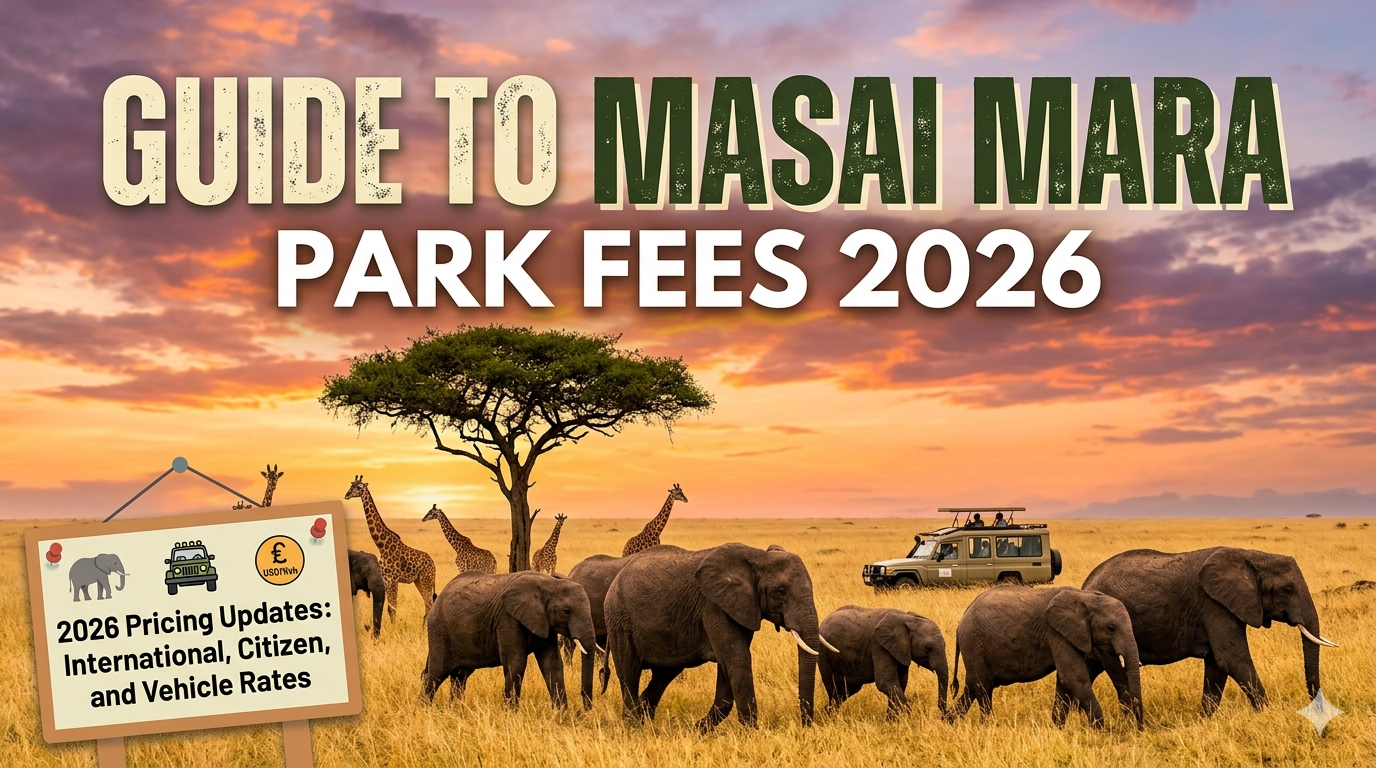
Here is a fast summary of the official Masai Mara park fees 2026:
- Non-resident adults (low season, Jan–Jun): USD 100 per day (12-hour ticket)
- Non-resident adults (high season, Jul–Dec): USD 200 per day (12-hour ticket)
- Non-resident children aged 9–17: USD 50 per day (year-round)
- Children 8 years and under: Free entry
- Kenyan citizen adults (low season): Ksh 1,500 per day
- Kenyan citizen adults (high season): Ksh 2,000–3,000 per day
- East African residents (low season): Ksh 2,500 per day
- East African residents (high season): Ksh 5,000 per day
- Narok County residents: Ksh 1,000–2,000 per day
- Mara Triangle fee (all visitors): USD 70 per adult per 24 hours (cashless only)
- Ticket validity: 12 hours (6:00 AM to 6:00 PM); overnight guests get 24-hour validity
- Payment accepted: Cash (USD or Ksh) at most gates; M‑Pesa and card accepted at all gates; Mara Triangle is cashless only
- Documents required: Valid national ID (Kenyan citizens and residents); passport (non-residents)
Introduction
One of the most common questions from anyone planning a Masai Mara trip is: “How much are the park fees?” It sounds simple. But once you start digging, you quickly find that Masai Mara park fees 2026 depend on who you are, when you visit, which part of the reserve you enter, and how long you stay.
A Kenyan citizen visiting in February pays a very different amount from an American tourist visiting in August. A family of four with two school-age children has a completely different calculation from a solo traveller on a group joining safari. And if you plan to visit the Mara Triangle — the western section of the reserve — the fee structure and payment rules are different again.
Getting these numbers wrong costs real money. Showing up at the gate without a national ID as a Kenyan resident means you pay the full non-resident rate. Not knowing that peak season fees nearly double means your budget suddenly looks short.
This guide gives you every official figure for Masai Mara park fees 2026, explains exactly how the fee system works, and tells you how to pay, what documents to carry, and how to avoid the most expensive mistakes.
What Are Masai Mara Park Fees and Why Do They Matter?
Masai Mara park fees are the charges levied on every person and vehicle entering the Masai Mara National Reserve and the Mara Triangle. These are not optional. Without a valid entry ticket, you cannot legally drive within the reserve boundaries.
Unlike most national parks in Kenya — which are managed by the Kenya Wildlife Service — the Masai Mara National Reserve is managed by the Narok County Government. The Mara Triangle (the western section) is managed by the Mara Conservancy, a separate entity with its own fee schedule and payment rules.
Every shilling and dollar collected through these fees goes directly toward anti-poaching enforcement, ranger salaries, road maintenance, wildlife habitat management, and community development for Maasai communities living around the reserve. The fees are not simply a tourist tax. They are what keeps the ecosystem functioning.
Masai Mara park fees 2026 follow the same tiered structure that was confirmed by Narok County and the Mara Conservancy for the 2024–2025 period and continues into 2026. The key change from earlier years is the shift from a 24-hour ticket to a 12-hour ticket, implemented in mid-2023.
| Visitor Category | Low Season (Jan–Jun) | High Season (Jul–Dec) |
|---|---|---|
| Non-resident adult | USD 100 per day | USD 200 per day |
| Non-resident child (9–17 yrs) | USD 50 per day | USD 50 per day |
| Non-resident child (under 9 yrs) | Free | Free |
| Kenyan citizen adult | Ksh 1,500 per day | Ksh 2,000–3,000 per day |
| Kenyan citizen child (9–17 yrs) | Ksh 500 per day | Ksh 750 per day |
| East African resident adult | Ksh 2,500 per day | Ksh 5,000 per day |
| East African resident child (9–17) | Ksh 1,000 per day | Ksh 1,500 per day |
| Narok County resident adult | Ksh 1,000 per day | Ksh 2,000 per day |
| Student (with valid ID, organised trip) | Reduced rate | Reduced rate |
East African residents are citizens or residents of Kenya, Uganda, Tanzania, Rwanda, Burundi, and South Sudan. Valid documentation must be presented at the gate.
Why Masai Mara Park Fees Matter Especially for Kenyans
Many Kenyans do not realise how much money they can save — or lose — based on how they approach park fees. Here is why getting this right matters for Kenyan travellers specifically:
- Resident rates are dramatically lower than non-resident rates. A Kenyan citizen pays Ksh 1,500 per day in low season. A non-resident pays USD 100 — roughly Ksh 13,000–15,000 at current exchange rates. That is a saving of over Ksh 11,000 per person per day for carrying your national ID. On a 3‑day safari for a family of four adults, that is a potential saving of over Ksh 130,000.
- Forgetting your national ID is an expensive mistake. Gate officials require hard documentation to charge resident rates. A lost or forgotten ID means you pay non-resident rates on the spot. There is no exception policy.
- School holiday periods fall in peak season. Kenya’s August school holiday aligns directly with high-season fee rates (July–December). Families planning Mara trips in August need to budget using high-season Kenyan citizen rates, not the lower January–June figures.
- Budget safari packages may not include park fees. Some operators quote a package price and exclude park entry fees. For a family of four over 3 days in peak season, unreported park fees add up to Ksh 24,000–36,000 or more. Always confirm in writing what is included.
- Students on authorised school trips qualify for reduced rates. If you are organising a school trip to the Mara, authorisation must be submitted to Narok County at least two weeks in advance. Students on personal holidays do not qualify.
Types of Fees at the Masai Mara in 2026
Person Entry Fees (Per Person, Per Day)
Person entry fees are the main fee every visitor pays. These are charged per individual, per day, and are based on residency status and age. As shown in the table above, the fee is lowest for Kenyan citizens and highest for non-residents during peak season.
The ticket is valid for 12 hours — from 6:00 AM to 6:00 PM — regardless of what time you enter. If you arrive at the gate at 2:00 PM, your ticket expires at 6:00 PM. You do not get 12 hours from the moment of entry. Guests staying overnight inside the reserve receive a 24-hour ticket that covers the full stay.
Vehicle Entry Fees
Every vehicle entering the reserve pays a separate vehicle fee based on seating capacity and vehicle type. This fee is charged in addition to person entry fees — it is not included in the per-person rate. Your guide or driver handles vehicle fee payment at the gate.
Vehicle fees are charged per vehicle per day. Sharing a vehicle between more people reduces the vehicle fee cost per person. A group of 6 in one Land Cruiser pays the same vehicle fee as a group of 2 in the same vehicle.
Mara Triangle (Mara Conservancy) Fees
The Mara Triangle is the western section of the Masai Mara ecosystem, managed separately by the Mara Conservancy. It covers some of the most productive wildlife areas in the entire Mara — the Oloololo Escarpment, the Mara River hippo pools, and large sections of the migration corridor.
Mara Triangle entry fees for 2026 are USD 70 per adult per 24 hours for all visitor categories. This rate is the same year-round and is separate from the Narok County fees charged on the main reserve side. The Mara Triangle accepts cashless payment only — M‑Pesa or Visa/Mastercard. No cash is accepted.
If your safari route takes you through both sections of the reserve on the same day, you may need to pay both fees. Confirm this with your operator when building your itinerary.
Camping Fees
Camping inside the reserve requires both the daily entry fee and a separate camping fee. Non-residents camping at public campsites (such as Oloololo) pay approximately USD 30 per adult per night in addition to the daily entry fee. Private campsites (such as Kiboko) charge approximately USD 40 per adult per night. East African residents pay Ksh 1,000–1,500 per night for camping. The 12-hour ticket rule means overnight campers pay the full nightly entry fee as a separate charge.
Activity and Permit Fees
Several activities within or near the reserve attract additional charges. Hot air balloon safaris cost approximately USD 450–500 per person. A balloon landing fee within the reserve is charged separately on top of the balloon operator’s rate. Commercial filming or photography requires a permit from both the Kenya Film Classification Board and Narok County, arranged in advance. Recreational drone use is strictly prohibited.
Let Charming Safariz handle your park fees, permits, and full itinerary. Kenya’s most trusted tour and travel company for safaris and ticketing. View our top Kenya safari packages — every cost fully itemised before you pay a deposit.
How to Pay Masai Mara Park Fees 2026
Paying correctly at the gate is straightforward as long as you know the rules in advance.
Payment methods accepted:
- Cash in US Dollars or Kenya Shillings — accepted at all Narok County gates (Sekenani, Talek, Ololaimutia, and others)
- M‑Pesa mobile money — accepted at all gates and required at Mara Triangle gates
- Visa/Mastercard — accepted at all gates and required at Mara Triangle gates
- Online pre-payment via KAPS (the authorised ticketing agent) or the Narok County portal
Important: The Mara Triangle (Mara Conservancy side) is strictly cashless. Do not arrive at Oloololo Gate or Purungat Bridge expecting to pay cash. Have your card or M‑Pesa ready before you reach the gate.
Pre-payment can be made through the eCitizen Kenya portal or through KAPS offices in Nairobi (located on Longonot Road, Upper Hill). Pre-payment reduces gate queues, which can be significant during peak season mornings when multiple safari vehicles arrive at the same time.
Documents required at the gate:
- Kenyan citizens: Valid National ID card
- East African residents: Passport showing valid work permit or appropriate residence visa
- Non-residents: Valid passport
- Student concession: Valid student ID from a recognised institution, plus pre-arranged authorisation from Narok County submitted at least two weeks before the visit
- Children: Birth certificate for Kenyan citizen children if claiming citizen rates
Driver’s licences are not accepted as identification. This is strictly enforced at all gates. Without the correct document, you pay the full non-resident rate regardless of your actual citizenship.
Complete Fee Comparison Checklist: What You Need to Budget
Use this checklist before finalising your Masai Mara safari budget:
| Fee Item | Who Pays | Amount |
|---|---|---|
| Person entry (Kenyan citizen, low season) | All Kenyan adult visitors, Jan–Jun | Ksh 1,500 per person per day |
| Person entry (Kenyan citizen, high season) | All Kenyan adult visitors, Jul–Dec | Ksh 2,000–3,000 per person per day |
| Person entry (EA resident, low season) | EA residents, Jan–Jun | Ksh 2,500 per person per day |
| Person entry (EA resident, high season) | EA residents, Jul–Dec | Ksh 5,000 per person per day |
| Person entry (non-resident, low season) | International visitors, Jan–Jun | USD 100 per person per day |
| Person entry (non-resident, high season) | International visitors, Jul–Dec | USD 200 per person per day |
| Child entry (non-resident, 9–17 yrs) | International children | USD 50 per person per day |
| Mara Triangle entry (all visitors) | Anyone entering the Triangle | USD 70 per adult per 24 hours |
| Vehicle entry fee | All vehicles | Based on seating capacity — confirm with operator |
| Camping fee (non-resident, public) | Overnight campers | USD 30 per adult per night |
| Camping fee (non-resident, private) | Overnight campers | USD 40 per adult per night |
| Hot air balloon | Optional activity | USD 450–500 per person |
| Airstrip landing fee | Fly-in visitors | USD 15–20 per landing |
Always ask your tour operator for a written breakdown that separates person fees, vehicle fees, and accommodation costs. Budget packages that present a single headline price frequently exclude one or more of these components.
Step-by-Step Guide: How to Pay Masai Mara Park Fees 2026
- Confirm your visitor category. Are you a Kenyan citizen, East African resident, or non-resident? Your fee is based on this. Gather the correct ID document before you leave home.
- Check which season you are travelling. Low season (January–June) and high season (July–December) have different rates. Know which applies to your travel dates.
- Ask your operator if park fees are included. Before paying any deposit, get written confirmation of whether your package includes person entry fees, vehicle fees, and any additional fees for the Mara Triangle if your itinerary crosses into that area.
- Decide whether to pre-pay. Pre-payment through KAPS in Nairobi or via the eCitizen Kenya portal avoids gate queues. This is especially useful during peak season August mornings when 50–100 vehicles may arrive at one gate simultaneously.
- Carry your ID documents. Pack your national ID or passport with your travel documents. Do not leave it at the hotel.
- Have both cash and mobile money ready. Carry USD or Ksh cash for Narok County gates. Have M‑Pesa or a card loaded for the Mara Triangle. Do not rely on finding a working ATM near the gates — the nearest one is in Narok town, about two hours from most camps.
- Keep your entry receipt. Rangers conduct spot checks throughout the reserve. Keep your printed or digital ticket accessible in the vehicle at all times. Failure to produce a valid receipt results in on-the-spot fines.
- Plan your exit time. Tickets expire at 6:00 PM. If you are departing by road, exit the reserve by 6:00 PM or face additional daily fee charges. If departing by air, arrive at the airstrip before 10:00 AM on your departure day.
Common Mistakes That Cost Money at the Gate
Forgetting your national ID. This is the single most costly mistake a Kenyan citizen or resident can make. Without valid ID, you pay the full non-resident rate. On a 3‑day trip for two adults in high season, this error costs over Ksh 80,000 extra. Solution: Pack your ID card the day before you travel. Treat it the same as your ticket.
Not confirming whether your package includes park fees. Budget operators often quote packages that exclude park entry fees. The difference between “USD 500 per person” with fees and “USD 500 per person” without fees can be USD 300–600 extra at the gate. Solution: Before paying any deposit, ask for a written line-by-line cost breakdown.
Arriving at the Mara Triangle with only cash. The Mara Triangle — Oloololo Gate and Purungat Bridge — accepts cashless payment only. Arriving with USD notes and no card or M‑Pesa means you cannot enter. Solution: Set up your M‑Pesa for card transactions or carry a Visa/Mastercard loaded with sufficient funds.
Confusing Mara Triangle fees with Narok County fees. Some travellers assume one payment covers the entire Masai Mara ecosystem. It does not. If your game drive route takes you across both sections, you may need to pay both fees separately. Solution: Confirm your itinerary with your guide the day before and ask whether your route crosses into the Triangle.
Arriving late and expecting a full 12-hour ticket. The 12-hour ticket runs from 6:00 AM to 6:00 PM regardless of entry time. A 3:00 PM arrival gives you only 3 hours of valid time. You cannot carry the unused portion to the next day. Solution: Arrive at the gate early to maximise your time in the park, especially if doing a same-day entry and exit.
Expecting student rates without prior authorisation. Students on school trips qualify for reduced rates, but authorisation must be submitted to Narok County at least two weeks in advance. Arriving at the gate with student IDs and no pre-authorisation means you pay standard citizen rates. Solution: Start the authorisation process at least a month before your school trip date.
Trends and Updates Affecting Masai Mara Park Fees 2026
The 12-hour ticket rule is now fully established. The shift from 24-hour to 12-hour ticket validity — implemented in mid-2023 — has significantly increased the effective daily cost of visiting the reserve, particularly for day visitors and self-drive travellers. This policy is now embedded in the Masai Mara Management Plan 2023–2032 and will not be reversed in the near term.
Cashless payment is expanding. The Mara Triangle’s cashless-only policy set the standard. Other gates now accept and encourage M‑Pesa and card payments. The direction of travel is clear: cash will become a secondary option over the next few years. Having digital payment options set up before you travel is increasingly important.
Fees are confirmed to remain stable for 2026. Narok County has not announced a further fee increase for the 2026 season. The current tiered structure — USD 100 (low season) and USD 200 (high season) for non-residents, Ksh 1,500–3,000 for Kenyan citizens — continues. However, fees can be revised with relatively short notice, and checking with your operator or the official Kenya Wildlife Service website for any last-minute updates before travel is always wise.
Conservation pressure is growing. According to data from the World Travel & Tourism Council, international tourist arrivals in Kenya have grown steadily since 2021. Higher visitor numbers mean higher pressure on the ecosystem. The Kenya National Bureau of Statistics has reported increasing tourism earnings, with the Masai Mara as the country’s top revenue-generating wildlife destination. Future fee increases — particularly for non-residents — remain a realistic possibility as conservation costs rise.
The Masai Mara remains the world’s most expensive wildlife reserve for non-residents. The current USD 200 per adult per 12-hour period in peak season positions the Mara above even Tanzania’s Serengeti, which charges approximately USD 72 per adult per 24 hours for a comparable category. This is a deliberate strategy to balance access, revenue, and conservation while maintaining affordability for Kenyan citizens and East African residents, as supported by Magical Kenya.
Quick Poll Question: How do you plan to pay your Masai Mara park fees in 2026?
- a) Cash (USD or Ksh) at the gate
- b) M‑Pesa mobile money
- c) Visa/Mastercard
- d) Online pre-payment through KAPS or eCitizen
(Poll answers at the end of this article)
Take the guesswork out of your Masai Mara safari budget. Charming Safariz is Kenya’s leading tour and travel company — every package comes with a full written breakdown including all park fees, vehicle charges, and accommodation costs. View our Kenya safari packages or request your free quote today.
Frequently Asked Questions About Masai Mara Park Fees 2026
What are the Masai Mara park fees in 2026 for non-residents? Non-resident adults pay USD 100 per day during the low season (January–June) and USD 200 per day during the high season (July–December). Children aged 9–17 pay USD 50 per day year-round. Children aged 8 and under enter free of charge. These are 12-hour tickets valid from 6:00 AM to 6:00 PM.
How much does a Kenyan citizen pay to enter the Masai Mara? Kenyan citizens pay Ksh 1,500 per adult per day during the low season (January–June) and Ksh 2,000–3,000 per adult per day during the high season (July–December). A valid National ID card is required at the gate to receive these rates. Without it, you will be charged the full non-resident fee.
What is the difference between Masai Mara National Reserve fees and Mara Triangle fees? The Masai Mara National Reserve (the main reserve) is managed by Narok County Government and charges USD 100–200 per adult per day depending on the season. The Mara Triangle is the western section of the ecosystem, managed separately by the Mara Conservancy. It charges USD 70 per adult per 24 hours regardless of season. The Mara Triangle accepts cashless payment only — no cash.
Are park fees included in safari packages? Not always. Budget safari operators frequently quote a headline price that excludes park entry fees. Always ask for written confirmation that your package includes both person entry fees and vehicle fees before paying a deposit. Mid-range and luxury packages from reputable operators typically include all fees.
Can I pay Masai Mara park fees online in advance? Yes. Pre-payment is available through KAPS (the authorised ticketing agent based in the KATO offices, Longonot Road, Nairobi) and through the eCitizen Kenya portal. Pre-payment is strongly recommended during peak season to avoid long gate queues. Most tour operators can handle this on your behalf.
What happens if I overstay my 12-hour ticket? Exiting the reserve after 6:00 PM triggers an immediate additional daily fee charge at the gate. Rangers do check. If you are departing by air, your guide must have you at the airstrip before 10:00 AM on your departure day to avoid being charged an additional day’s entry fee.
Do East African residents qualify for cheaper rates? Yes. Citizens and residents of Kenya, Uganda, Tanzania, Rwanda, Burundi, and South Sudan qualify for resident rates. You must present a valid passport showing a current work permit or appropriate visa. Simply holding an East African passport is not sufficient — proof of active residency is required. For Kenyan citizens, a National ID card is the only accepted document.
My Experience With Masai Mara Park Fee Payments
I have helped plan and accompany dozens of safari trips to the Masai Mara. The one thing that causes the most frustration — and the most unnecessary expense — at the gate is missing documents.
I once accompanied a Kenyan family of five who were visiting the Mara for the first time. The excitement was real, the planning had been thorough. And then, at Sekenani Gate, the father realised his national ID was sitting on the kitchen counter in Nairobi. The gate officials were polite but firm: no ID, no resident rate. For a 2‑day trip with two adults and three children in high season, that single oversight cost the family an extra Ksh 30,000 in park fees alone.
Since then, I always tell every client the same thing: treat your national ID exactly the same as your passport. Put it in your travel bag the night before. Do not leave it at home.
I have also seen the Mara Triangle cashless-only rule catch visitors completely off-guard. A group of four, all holding US dollars, arrived at Oloololo Gate in the early morning and had no card and no M‑Pesa set up. Their driver had no money either. They had to drive two hours to find mobile money services. They missed four hours of morning game drives.
These are avoidable problems. The fee system at the Masai Mara is actually quite clear once you understand how it is structured. The challenge is that many travellers — and even some less experienced operators — do not explain the system in advance. A good tour company solves this before you leave Nairobi, not at the gate.
Charming Safariz, based in Nakuru, is one operator that provides a fully itemised cost breakdown for every safari — including park fees, vehicle fees, and activity charges — before you pay anything. That kind of transparency makes planning easy and avoids every surprise.
Key Takeaways
- Masai Mara park fees 2026 are USD 100 (low season) and USD 200 (high season) per adult per day for non-residents
- Kenyan citizens pay Ksh 1,500–3,000 per adult per day depending on the season — always carry your national ID
- East African residents pay Ksh 2,500–5,000 per adult per day; Narok County residents pay Ksh 1,000–2,000
- Children under 9 years old enter free of charge; children aged 9–17 pay reduced rates
- The Mara Triangle charges USD 70 per adult per 24 hours, all year round, cashless payment only
- Vehicle fees are charged separately on top of person entry fees — confirm this with your operator
- Tickets are valid for 12 hours (6:00 AM to 6:00 PM) regardless of entry time; exiting past 6:00 PM triggers additional charges
- Pre-payment is available through KAPS in Nairobi and the eCitizen portal — strongly recommended during peak season
- Budget packages frequently exclude park fees — always get a written, itemised breakdown before paying a deposit
- Driver’s licences are not accepted as identification at any gate; carry your national ID or passport
Conclusion
Masai Mara park fees 2026 are clear, tiered, and manageable — as long as you understand the structure before you arrive at the gate. Kenyan citizens and East African residents have access to significantly reduced rates that make the world’s most famous wildlife reserve genuinely affordable for local travellers. The key is knowing the rules, carrying the right documents, and confirming your package costs in writing before you travel.
Do not let a forgotten national ID or a missing park fee in your package quote be the thing that defines your Masai Mara experience.
Request your free, no-obligation safari quote from Charming Safariz and receive a fully itemised cost breakdown — including all park fees — within 24 hours.
Have questions about fees, documentation, or how to plan your safari budget? Drop them in the comments below. If you have paid Masai Mara park fees recently and have any tips to share, we would love to hear from you.
About Charming Safariz — Kenya’s Best Tour and Travel Company
Charming Safariz is Kenya’s most trusted tour and travel company, based in Nakuru. Specialising in Masai Mara safaris, wildlife tours across Kenya, and Zanzibar packages, the team builds fully transparent, itemised itineraries for every budget — so you know exactly what you are paying and why, before you pay it.
View our top Kenya and Zanzibar safari packages
Contact us:
- WhatsApp: +254 714 236 664
- Email: enquiry@charmingsafariz.com
- Office: Nakuru, Kenya
Sources and References
- Kenya Wildlife Service — Official authority for national park regulations and conservation standards in Kenya
- Magical Kenya — Official Kenya tourism portal and registered operator information
- eCitizen Kenya — Government portal for park fee pre-payment and official government services
- World Travel and Tourism Council — Kenya tourism growth data and conservation investment reports
- Kenya National Bureau of Statistics — Tourism earnings, visitor statistics, and economic data
- UNESCO World Heritage Centre — Regional conservation context for the Greater Mara ecosystem
- IATA — Domestic air travel data and East Africa aviation information
- TripAdvisor — Verified traveller reviews for Masai Mara safari operators and lodges
Poll Answer: All four payment methods are valid at most Narok County gates. For the Mara Triangle specifically, only (b) M‑Pesa and © Visa/Mastercard are accepted — cash is not. Online pre-payment through KAPS or eCitizen is the most efficient option during peak season when gate queues are long. Having multiple payment options set up before you travel removes all gate-side stress.