QUICK VIEW
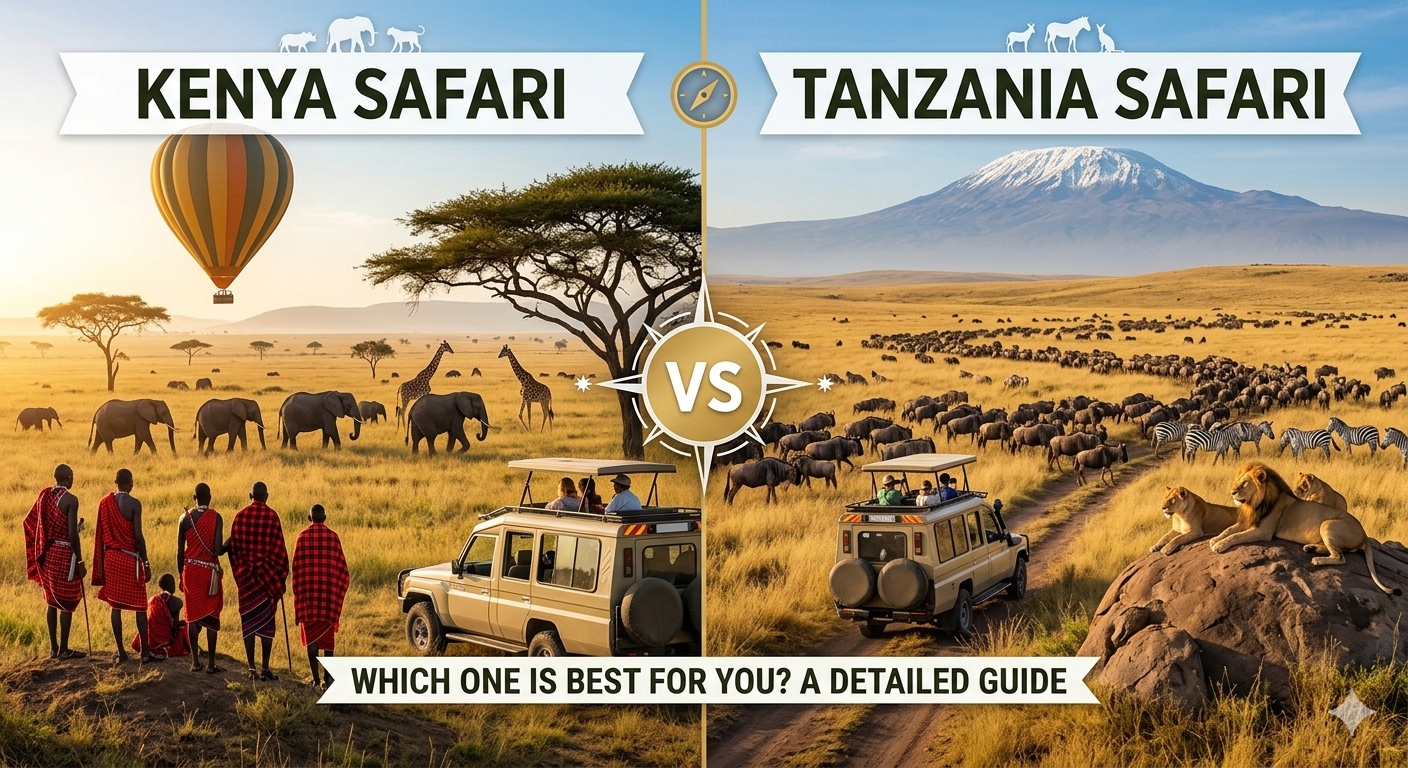
A Kenya safari vs Tanzania safari comparison comes down to priorities. Kenya offers faster access from Nairobi, iconic parks like the Masai Mara and Amboseli, shorter travel times between destinations, and slightly lower overall package costs for East African residents. Tanzania offers larger park areas including the Serengeti, the Ngorongoro Crater, and Zanzibar as a beach extension, but generally requires longer travel times and higher park fees. Both countries share the Great Wildebeest Migration — Kenya hosts it from July to October, Tanzania from November to June. For most first-time safari travelers based in Kenya, starting with a Kenya safari makes practical and financial sense. Charming Safariz, based in Nakuru, designs tailor-made safari packages across both Kenya and Tanzania to match your budget and travel goals.
Kenya Safari vs Tanzania Safari 2026: An Honest Comparison to Help You Decide
It is one of the most common questions in East African travel. You have the budget, the dates are set, and the excitement is real — but should you go on a Kenya safari or a Tanzania safari?
Both countries share some of the world’s most spectacular wildlife. Both attract millions of visitors. Both have landscapes that stop you mid-sentence when you see them for the first time.
But they are not the same experience. The parks are different. The fees are different. The logistics are different. And depending on what you are looking for — the Great Migration river crossings, the Big Five, a beach extension, a specific budget — one destination may suit you significantly better than the other.
This guide gives you a straightforward, side-by-side comparison of a Kenya safari vs Tanzania safari so you can make a decision with full information, not guesswork.
What Does Kenya Safari vs Tanzania Safari Actually Mean?
When travelers compare a Kenya safari vs Tanzania safari, they are typically weighing up a set of practical questions: Which country has better wildlife viewing? Which is cheaper? Which is easier to get to? Where is the Great Migration right now?
Both Kenya and Tanzania sit at the heart of East Africa’s safari circuit. They share the same ecosystem — the Great Rift Valley, the Serengeti-Mara plains, and the Swahili Coast — but each country offers a distinct experience shaped by its parks, infrastructure, fee structures, and travel logistics.
Kenya’s wildlife tourism is managed primarily by Kenya Wildlife Service, while Tanzania operates its parks through TANAPA (Tanzania National Parks Authority). Both systems are internationally respected, though their fee structures and visitor management policies differ.
| Feature | Kenya | Tanzania |
|---|---|---|
| Main safari region | Masai Mara, Amboseli, Samburu, Tsavo | Serengeti, Ngorongoro, Tarangire, Selous |
| Great Migration hosting | July – October | November – June |
| Park entry fee (non-resident adult) | $100–$200/day (peak) | $70–$100/day depending on park |
| Domestic flight hub | Wilson Airport, Nairobi | Kilimanjaro / Julius Nyerere Airport, Dar |
| Beach extension option | Diani Beach, Lamu, Watamu | Zanzibar |
| Typical road drive to main reserve | 5–6 hours (Nairobi to Mara) | 3–4 hours (Arusha to Serengeti gate) |
| Visa / eTA | Kenya eTA ($30–$50) | Tanzania visa ($50 on arrival or online) |
| Best for | First-timers, short trips, value | Big landscapes, Zanzibar, longer trips |
Why This Comparison Matters for Kenyan Travelers
For Kenyans, this is not just an abstract travel question. It has real financial and logistical implications:
- Kenyan citizens pay far lower park entry fees inside Kenya than in Tanzania. A Kenyan adult pays KES 1,500–3,000 per day in the Masai Mara versus approximately $70–$100 per day in the Serengeti — a significant difference.
- Tanzania requires a visa for Kenyan citizens (though it is relatively straightforward to obtain), while traveling within Kenya requires no international documentation for citizens.
- Many Kenyans use their local knowledge and networks to get better value from Kenya-based safari operators. Working with a company like Charming Safariz means you are dealing with a team that knows the local parks, camps, and seasonal conditions at a granular level.
- The Masai Mara is only 5–6 hours by road from Nairobi — making it genuinely feasible for a long-weekend safari. Getting to the Serengeti from Nairobi involves a cross-border journey that takes considerably longer.
- Kenya’s domestic tourism has grown steadily in recent years according to reporting by Nation Africa, and more Kenyan families are choosing local destinations before exploring Tanzania or beyond.
That said, Tanzania offers things Kenya does not. Zanzibar is one of the Indian Ocean’s most beautiful island destinations. The Ngorongoro Crater is unique — a self-contained wildlife paradise that has no equivalent in Kenya. And the Serengeti’s sheer size offers a sense of wilderness that even the Masai Mara cannot fully replicate.
See what’s possible — View Our Top Kenya and Tanzania Safari Packages
Safari Types: What Each Country Does Best
Wildlife Game Drives
Kenya’s Masai Mara is consistently rated among the top game drive destinations in the world. Its open grasslands, accessible road network, and high density of predators — especially lions and cheetahs — make sightings almost inevitable during peak season. According to TripAdvisor, the Masai Mara regularly ranks as the top safari destination in Africa in traveler reviews.
Tanzania’s Serengeti is larger — about 14,763 square kilometers compared to the Masai Mara’s 1,510 — which means more space but sometimes longer drives between sightings. The Ngorongoro Crater, however, is one of the most wildlife-dense places on Earth. A single day inside the crater can yield all of the Big Five, flamingos at the soda lake, and black rhino sightings that are increasingly rare elsewhere.
The Great Wildebeest Migration
The migration follows a circular route. The herds calve in Tanzania’s southern Serengeti from January to March, move north through the Serengeti from April to June, cross into Kenya’s Masai Mara from July to October, then return south through Tanzania from November to December.
If you want to see the famous Mara River crossings — where wildebeest plunge into crocodile-filled water in dramatic, chaotic columns — Kenya is your destination, specifically between late July and mid-October. If you want to witness the calving season (thousands of newborn wildebeest in a few weeks) or the quieter Serengeti movement phases, Tanzania between January and March is the better choice.
Beach Extensions
After a safari, many travelers combine wildlife with beach time. Kenya offers Diani Beach (about 2 hours south of Mombasa), Watamu, and Lamu — all on the Indian Ocean coast. These are excellent and easily accessible from Nairobi.
Tanzania’s Zanzibar is the more internationally famous beach destination. Its Stone Town (a UNESCO World Heritage Centre site), turquoise waters, and white-sand beaches at Nungwi and Paje attract honeymooners and beach travelers from around the world. A Tanzania safari paired with Zanzibar is one of the most popular East Africa combinations for international visitors.
Gorilla Trekking Add-Ons
Neither Kenya nor Tanzania offers gorilla trekking — that is Uganda and Rwanda. But if you are planning a broader East Africa itinerary, Tanzania’s proximity to Rwanda makes it a natural starting point for a combined safari-and-gorilla trip.
Cultural Experiences
Both countries have rich Maasai communities. Kenya’s Maasai Mara region and Amboseli both offer community visits. Tanzania has Maasai and other cultural experiences near Arusha and in the northern circuit. The depth and authenticity of these experiences depend heavily on your operator and camp.
How to Choose Between Kenya and Tanzania
Use this checklist to identify which destination fits your priorities:
Kenya is the better choice if you:
- Are based in Nairobi and want a realistic long-weekend trip
- Are a Kenyan citizen benefiting from lower park fees
- Want the Great Migration river crossings (July–October)
- Are on a tighter budget and want to maximize wildlife time without long border crossings
- Prefer a shorter, more focused itinerary of 3–5 days
- Want to add a Kenyan coast extension (Diani, Watamu, Lamu)
Tanzania is the better choice if you:
- Have at least 7–10 days and want a longer itinerary
- Are an international visitor willing to pay higher fees for the Serengeti and Ngorongoro experiences
- Want to combine a safari with Zanzibar
- Are interested in the calving season migration (January–March) or Serengeti movement phases
- Want to see the Ngorongoro Crater — one of Africa’s most exceptional wildlife areas with no Kenyan equivalent
- Plan to add gorilla trekking in Rwanda or Uganda at the end of your trip
Many travelers — especially those with more time and budget — choose to do both. A combined Kenya-Tanzania safari is one of the most complete East Africa experiences available, and operators like Charming Safariz can structure cross-border itineraries that cover the Masai Mara, Amboseli, the Serengeti, Ngorongoro, and Zanzibar in a single trip.
Explore our Kenya and Tanzania packages — View Charming Safariz Safari Collections
Cost Comparison: Kenya Safari vs Tanzania Safari in 2026
Park Entry Fees Per Adult Per Day (2026 Estimates)
| Park | Country | Non-Resident Adult | Kenyan/EAC Resident | Citizen Rate |
|---|---|---|---|---|
| Masai Mara (peak) | Kenya | $200 | $50–70 | KES 3,000 |
| Masai Mara (off-peak) | Kenya | $100 | $30–50 | KES 1,500 |
| Serengeti | Tanzania | $70–100 | $23.60 (EAC) | TZS 15,000 |
| Ngorongoro Crater | Tanzania | $70–100 + $70 crater fee | N/A | Reduced rate |
| Amboseli | Kenya | $90 (peak) | $30–50 | KES 1,000 |
| Tarangire | Tanzania | $53–70 | $23.60 (EAC) | TZS 15,000 |
Estimated Full Package Costs Per Person (7 Days)
| Destination | Budget Package | Mid-Range | Luxury |
|---|---|---|---|
| Kenya only (Mara + Amboseli) | $1,400–$1,800 | $2,500–$4,000 | $5,000–$12,000 |
| Tanzania only (Serengeti + Ngorongoro) | $2,500–$3,500 | $4,000–$6,500 | $7,000–$18,000 |
| Combined Kenya + Tanzania | $3,500–$5,000 | $5,500–$9,000 | $10,000–$22,000+ |
Tanzania generally costs more for international travelers due to higher conservation fees, more expensive logistics (longer internal flight distances), and premium Zanzibar accommodation pricing. Kenya offers better value for shorter trips and for East African residents and citizens.
Step-by-Step Guide: How to Plan a Kenya or Tanzania Safari
- Define your priorities. Wildlife only? Or wildlife plus beach? Great Migration river crossings specifically? Ngorongoro Crater? These answers determine your destination.
- Decide on dates. If you want Mara River crossings, target July–October in Kenya. For calving season and quieter Serengeti, target January–March in Tanzania.
- Set a realistic total budget. Include park fees, accommodation, domestic flights, international flights if applicable, visa or eTA costs, travel insurance, and activity extras.
- Choose a Kenya-based operator with cross-border experience. Charming Safariz handles both Kenya-only and Kenya-Tanzania combined itineraries, with transparent pricing and strong camp relationships in both countries.
- Confirm visa requirements. Kenyan citizens need a Tanzania visa. International visitors need a Kenya eTA from eCitizen Kenya and a Tanzania visa. Processing timelines vary.
- Book early. Both destinations sell out during peak seasons. For peak migration (Kenya, July–October) and Ngorongoro (Tanzania, June–September), book 6–9 months in advance.
- Sort travel insurance. Medical evacuation in remote wildlife areas without coverage can cost thousands of dollars. This is non-negotiable.
- Pack for both destinations. Neutral safari clothing for game drives, swimwear and light layers for any beach extension, and a good camera for wildlife photography.
Common Mistakes When Comparing Kenya and Tanzania Safaris
Treating the two countries as identical. Some travelers assume the experience is the same regardless of which country they choose and just book the cheapest option. Solution: Match your destination to your specific wildlife goals and travel dates, not just price.
Underestimating Tanzania’s costs. Tanzania’s published park fees look similar to Kenya’s, but the Ngorongoro Crater adds a separate crater fee, and Tanzania’s internal flight costs between parks are often higher. Solution: Always request a fully itemized quote covering all fees, flights, and accommodation.
Assuming you can cross between countries easily mid-trip. A Kenya-Tanzania cross-border safari requires advance planning — visas, logistics, cross-border vehicle arrangements, and timing coordination. Solution: Use an operator experienced in cross-border itineraries who handles all logistics in advance.
Ignoring resident pricing benefits. East African Community citizens and residents pay significantly lower park fees in both countries, but many booking platforms default to non-resident pricing. Solution: Always declare your citizenship or residency status when requesting a quote.
Booking separate operators for each country. Using different operators in Kenya and Tanzania creates coordination gaps, especially at border crossings and for domestic flights. Solution: Use a single, Kenya-based operator like Charming Safariz who manages the entire itinerary across both countries.
What Is Changing in 2026: Trends Affecting Both Destinations
Tanzania’s fee restructuring. Tanzania has been updating its park fee structures, with some conservancy areas introducing new tiers for international visitors. The World Travel & Tourism Council tracks these changes as part of broader African safari market monitoring.
Kenya’s eco-conservancy expansion. Kenya continues to grow its network of community conservancies around the Masai Mara and other parks. These areas offer premium wildlife experiences while channeling revenue directly to local Maasai communities, making Kenya safaris an increasingly viable conservation investment.
Cross-border safari packages are growing. More travelers are combining both countries in a single trip, and operators with cross-border experience are becoming more competitive. Charming Safariz has positioned itself well for this trend.
Digital immigration and border processing. Both Kenya and Tanzania are working toward streamlined digital entry systems. Kenya’s eTA system at eCitizen Kenya is already operational and improving. Tanzania is expanding digital visa processing to reduce border delays.
Zanzibar’s luxury accommodation boom. New high-end resorts in Zanzibar are opening regularly, which is improving the post-safari beach experience on the Tanzania side. This makes the Tanzania-plus-Zanzibar combination more compelling than it was five years ago.
Quick Poll: Which would you choose for your next East Africa trip? (A) Kenya safari only — Masai Mara and Amboseli; (B) Tanzania safari only — Serengeti and Ngorongoro; © Combined Kenya and Tanzania; (D) Kenya safari with Kenyan coast beach extension.
(Poll answer: Most experienced safari travelers recommend option C — a combined Kenya and Tanzania itinerary — for those with 10 or more days. For shorter trips of 5–7 days, option A gives the best value and the most efficient wildlife experience, especially for Nairobi-based travelers.)
Frequently Asked Questions About Kenya Safari vs Tanzania Safari
Which is better for first-time safari travelers — Kenya or Tanzania? For most first-timers, especially those based in Nairobi or traveling from East Africa, Kenya is the more practical starting point. The Masai Mara is one of the world’s best game drive destinations, logistics are simpler, park fees are lower for citizens and residents, and the wildlife density is exceptional. Tanzania adds the Ngorongoro Crater and Zanzibar, which are best appreciated after you have the safari experience baseline.
Is the Great Migration better in Kenya or Tanzania? It depends on the time of year. The Mara River crossings — the most dramatic phase of the migration — happen in Kenya between July and October. The calving season, where thousands of wildebeest are born within weeks, happens in Tanzania’s Serengeti between January and March. Both are extraordinary. Neither is definitively “better” — they are different phases of the same event.
Which country has cheaper safari packages? Kenya generally offers better value for East African citizens and residents due to lower citizen park fees and shorter travel distances from Nairobi. For international visitors, Tanzania’s Serengeti and Ngorongoro fees are sometimes slightly lower per park, but the overall Tanzania trip cost often runs higher because of more expensive logistics and longer internal travel distances.
Can I do both Kenya and Tanzania in one trip? Yes, and many travelers do. A combined itinerary typically covers 10–14 days and might include the Masai Mara, Amboseli, the Serengeti, Ngorongoro, and Zanzibar. Charming Safariz handles cross-border logistics for combined itineraries. Allow extra time for border crossings and domestic flight connections.
Do I need a visa for Tanzania as a Kenyan citizen? Yes. Kenyan citizens need a Tanzania visa, which costs approximately $50 and can be obtained on arrival or processed in advance online. International visitors also need a Tanzania visa and a Kenya eTA. Apply for the Kenya eTA through eCitizen Kenya well before your travel dates.
Which country is safer for safari travel? Both Kenya and Tanzania are established safari destinations with well-developed tourism safety infrastructure. Luxury and mid-range camps in both countries have 24-hour security, professional guides, and emergency protocols. Standard travel safety precautions apply in urban areas of both countries. The wildlife reserves and lodges themselves have excellent safety records.
My Experience Comparing Both Destinations
I have worked with travelers going to both Kenya and Tanzania for years, and the question of Kenya safari vs Tanzania safari comes up almost daily. My honest view, after planning hundreds of itineraries in both countries, is that the “right” answer genuinely depends on the individual.
A retired couple I helped plan a trip for recently had 14 days, a solid budget, and a specific wish list: Mara River crossings, the Ngorongoro Crater, and a beach ending. We built an itinerary that covered three nights in the Masai Mara, flew them to Arusha for three nights in the Serengeti and two in Ngorongoro, then finished with five nights in Zanzibar. They said it was the best trip of their lives.
But I have also worked with a Nairobi family who had five days and a tight budget. They went to the Masai Mara and Amboseli, saw the Big Five twice over, watched a cheetah hunt at close range, and came back saying Kenya had everything they ever wanted from a safari.
Both responses are right. The Masai Mara is extraordinary on its own. Tanzania adds dimensions you cannot get in Kenya alone. And the combination is, frankly, one of the greatest travel experiences available anywhere in the world.
Charming Safariz, Kenya’s most trusted tour and travel company for safaris and ticketing, has the experience and cross-border relationships to design either option well. From their Nakuru office, they manage everything — camp bookings, domestic flights, visas, cultural add-ons, and beach extensions — so your focus can stay on the experience, not the logistics.
Key Takeaways
- A Kenya safari vs Tanzania safari comparison depends on your dates, budget, citizenship, and travel goals — not a single universal answer.
- Kenya hosts the Great Migration river crossings from July to October; Tanzania hosts the calving season from January to March.
- Kenyan citizens pay significantly lower park fees in Kenya than in Tanzania — a major financial consideration.
- Tanzania’s Ngorongoro Crater and Zanzibar are unique offerings with no direct Kenyan equivalent.
- Kenya’s Masai Mara offers easier access from Nairobi, shorter road transfers, and excellent wildlife density.
- Combined Kenya-Tanzania itineraries of 10–14 days deliver the most complete East Africa wildlife experience.
- Tanzania safaris generally cost more overall for international travelers due to higher logistics costs and longer internal travel distances.
- Charming Safariz handles both Kenya-only and combined Kenya-Tanzania packages with full cross-border logistics.
Conclusion
The Kenya safari vs Tanzania safari debate has no single correct answer — and that is actually good news. Both destinations are world-class. The decision comes down to your specific priorities: timing, budget, duration, and what kind of experience you want to take home.
If you are a Kenyan traveler starting out, or anyone working with a focused budget and a 5–7 day window, Kenya delivers everything you need and more. If you have time and want the Ngorongoro Crater, Zanzibar, and the calving season migration, Tanzania belongs in your plans.
And if you want to do both — which many experienced safari travelers do — Charming Safariz is ready to build that itinerary for you.
Have you been to one or both destinations? Share your experience in the comments below. Or if you are still deciding, drop your questions — the team would love to help you plan the right trip.
Plan Your Safari With Charming Safariz
Charming Safariz is Kenya’s leading tour and travel company for safaris, Tanzania packages, and international ticketing. Based in Nakuru, they design tailor-made safaris across Kenya and East Africa — from the Masai Mara to the Serengeti, Zanzibar, and beyond — with honest pricing and expert local knowledge.
Request Your Free Safari Quote Here
Contact Us:
WhatsApp: +254 714 236 664 Email: enquiry@charmingsafariz.com Office: Nakuru, Kenya
View Our Kenya and Tanzania Safari Packages
Sources and References
- Kenya Wildlife Service — Park fees, reserve management, and conservation updates
- Magical Kenya — Official Kenya tourism promotion and safari information
- World Travel & Tourism Council — East Africa tourism economic data and trends
- TripAdvisor — Safari destination reviews and traveler ratings for Kenya and Tanzania
- UNESCO World Heritage Centre — Ngorongoro Conservation Area and ecosystem data
- Nation Africa — Kenya domestic tourism growth and travel industry reporting
- eCitizen Kenya — Kenya eTA applications and immigration portal
- Kenya National Bureau of Statistics — Tourism and economic impact data