QUICK VIEW
The Great Migration in Masai Mara takes place primarily between July and October each year, when over 1.5 million wildebeest, accompanied by hundreds of thousands of zebra and gazelle, cross from Tanzania’s Serengeti into Kenya’s Masai Mara National Reserve. The most dramatic moments happen at the Mara River, where crocodile-filled crossings take place from late July through September. The best months to witness river crossings are August and September. Park entry fees for non-residents are $200 per adult per day during peak season, while Kenyan citizens pay KES 3,000 per day. Charming Safariz, based in Nakuru, is Kenya’s leading tour and travel company for Great Migration safaris and can design a full package around your travel dates.
Every year, something extraordinary happens on the Kenyan plains. Millions of animals — wildebeest, zebra, Thomson’s gazelle — move together in one of the largest overland movements of wildlife on Earth. People fly in from over 100 countries to witness it. Yet thousands of Kenyans have never seen it, even though it happens right here at home.
The Great Migration in Masai Mara is not just a wildlife event. It is a national treasure and one of the few natural spectacles that genuinely looks more dramatic in real life than in any documentary.
Whether you are planning your first safari or have visited the Mara before and want to time your next trip around the migration, this guide gives you everything you need — exact timelines, real costs, the best viewing spots, and practical advice on how to plan a trip that actually delivers what you came to see.
What Is the Great Migration in Masai Mara?
The Great Migration is a year-round, circular movement of wildlife between Tanzania’s Serengeti National Park and Kenya’s Masai Mara National Reserve. It is driven entirely by rainfall and the availability of grass. The animals follow the rains, moving in a clockwise circuit that covers roughly 3,000 kilometers annually.
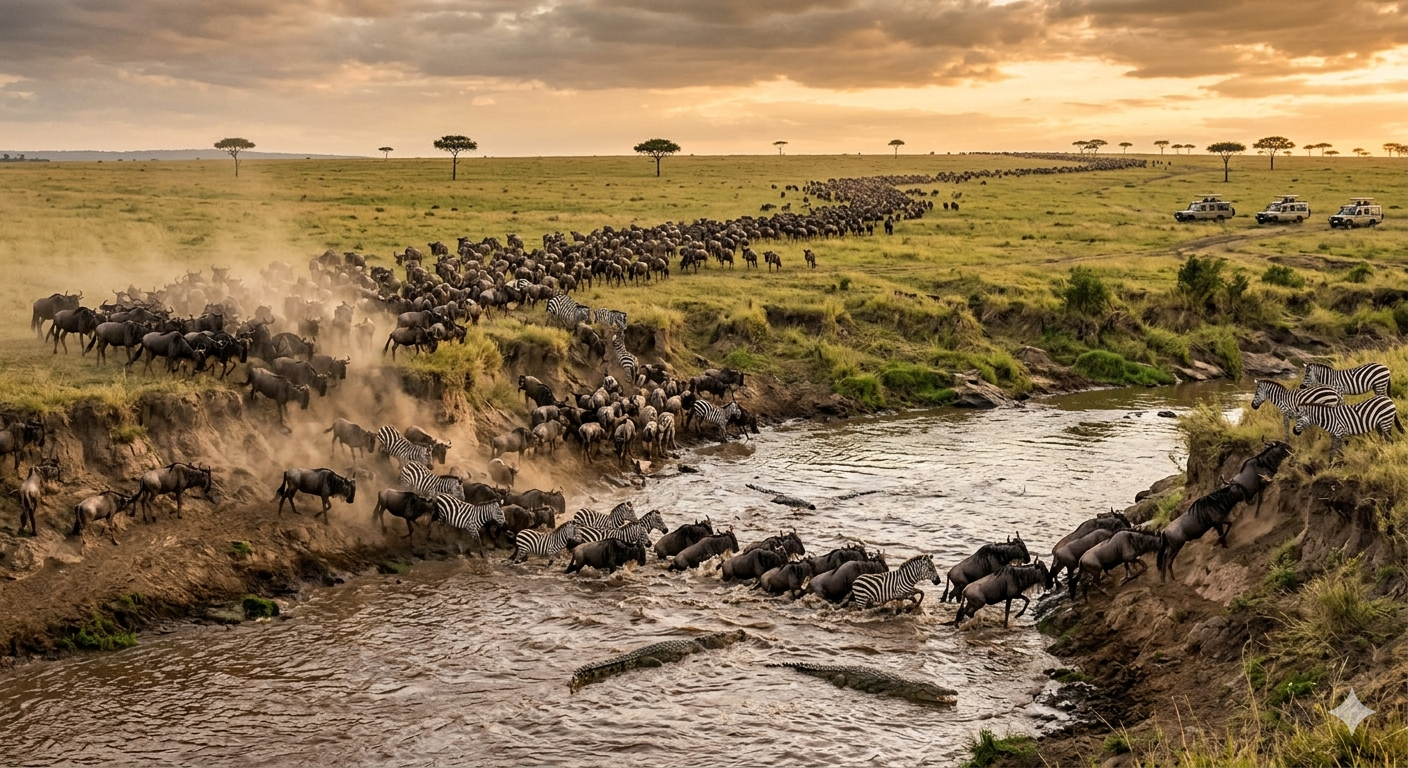
The Masai Mara section — which is what most travelers mean when they say “the migration” — takes place between approximately July and October, when the herds enter Kenya from the Serengeti via the Mara River. This is the phase that produces the famous river crossings, where massive columns of wildebeest hurl themselves into the water and fight crocodiles to reach the other bank.
According to Kenya Wildlife Service, the Masai Mara National Reserve is the primary Kenyan ground for this event, and the reserve’s management works closely with cross-border conservation bodies to protect both the animals and their migratory corridors.
| Migration Phase | Location | Approximate Timing |
|---|---|---|
| Calving season | Southern Serengeti | January – March |
| Northward movement | Central Serengeti | April – June |
| Mara River crossings | Masai Mara, Kenya | July – October |
| Return south | Northern Serengeti | November – December |
The sheer numbers are staggering. The migration involves approximately 1.5 million wildebeest, 400,000 zebra, and 200,000 Thomson’s gazelle. It is widely recognized as one of the greatest wildlife events on the planet, and Magical Kenya consistently promotes it as the country’s flagship tourism attraction.
Why the Great Migration Matters for Kenya
The Great Migration is not just an ecological phenomenon. It is a major economic and cultural asset for Kenya. Here is what it means in practice:
- Tourism accounts for a significant share of Kenya’s GDP. The migration season drives peak earnings for lodges, airlines, guides, and local communities around the Mara ecosystem.
- The private conservancies surrounding the Masai Mara — including Mara North, Olare Motorogi, and Naboisho — exist in part because of migration-related tourism revenues that incentivize landowners to keep land wildlife-friendly rather than converting it to agriculture.
- Kenyan students and schools use the migration as a living case study in ecology, food chains, and natural systems. It is referenced in Kenya’s national curriculum as one of the country’s most significant natural events.
- For Kenyan travelers and the growing domestic tourism market, witnessing the migration is increasingly seen as a rite of passage — something you do not outsource to foreign tourists while missing it yourself.
- The World Travel & Tourism Council has consistently ranked Kenya among Africa’s top tourism destinations, with the migration as a primary draw.
Plan your Great Migration safari today — View Our Top Kenya Safari Packages
Types of Great Migration Experiences in Masai Mara
River Crossing Safaris
This is the signature experience. The Mara River crossings happen when herds reach the river, assess the crossing point, hesitate for hours or minutes, then plunge in. Crocodiles wait. The noise, dust, and chaos are unlike anything else in the natural world. The best crossing sites are along the Mara River corridor in the northern section of the reserve and in Mara North Conservancy.
No crossing is guaranteed — the wildebeest decide on their own schedule. But good guides know where herds are gathering and can position you at a river bank where a crossing is likely.
Hot Air Balloon Safaris Over the Migration
One of the most popular ways to see the migration from above. Balloon flights launch before sunrise, typically from camps in the Mara, and drift over the plains at low altitude as the light comes up. You can see the scale of the herds — stretching across the horizon — in a way that is impossible from a vehicle. Flights cost approximately $450–$500 per person and last about 60–90 minutes.
Bush Walk Safaris During Migration Season
Private conservancies allow walking safaris, which are not permitted inside the main reserve. A walking safari during the migration puts you on the ground in the presence of the herds — a completely different physical experience to a vehicle game drive. An armed ranger and a professional guide accompany you at all times.
Night Game Drives During Migration
Again only available in private conservancies, night drives during migration season give you a chance to see predators — lions, leopards, hyenas — that are most active after dark, often tracking migration herds. This is a premium experience that most standard lodge-based safaris do not include.
Cultural Immersion With Maasai Communities
Many migration safari packages include a visit to a Maasai village near the reserve. The Maasai are the original custodians of the land the migration crosses, and their knowledge of animal behavior and seasonal movements is generations deep. This experience adds cultural depth to any wildlife-focused trip.
How to Plan Your Great Migration Safari Correctly
Getting the timing and logistics right makes the difference between a life-changing trip and an expensive disappointment. Here is a practical planning checklist:
- Book 6–9 months before your intended travel dates if you want peak migration season (July–October). Top camps and conservancy lodges sell out early.
- Choose a camp along the Mara River corridor for the best river crossing access. Camps in Mara North Conservancy and the western boundary of the reserve are best positioned.
- Confirm that your package includes a private vehicle or at least semi-private game drives. You do not want to be in a shared minibus with 7 other tourists if you are spending this much on a migration experience.
- Ask specifically whether night drives and bush walks are available at your chosen camp. These require a conservancy location.
- Budget for the Kenya eTA if you are an international visitor. Applications are processed at eCitizen Kenya and cost approximately $30–$50.
- Get travel insurance that covers medical evacuation. The Mara is remote, and emergency evacuation without coverage can cost several thousand dollars.
- Pack light layers — early mornings on game drives are cold even in July and August, with temperatures sometimes dropping to 12–15 degrees Celsius before sunrise.
Great Migration Safari Costs in 2026
Understanding the full cost of a Great Migration safari prevents nasty surprises. Below are the key figures for 2026.
Masai Mara National Reserve Entry Fees (2026)
| Visitor Category | Peak Season (Jul–Oct) | Off-Peak (Nov–Jun) |
|---|---|---|
| Non-resident adult | USD 200/day | USD 100/day |
| Non-resident child (under 18) | USD 50/day | USD 50/day |
| Kenyan citizen adult | KES 3,000/day | KES 1,500/day |
| Kenyan resident (non-citizen) | USD 50–70/day | USD 30–50/day |
| Private conservancy fee | USD 80–150/person/night | USD 50–100/person/night |
Estimated Package Costs Per Person (Migration Season, July–October)
| Package Type | 3 Days / 2 Nights | 5 Days / 4 Nights | 7 Days / 6 Nights |
|---|---|---|---|
| Mid-range (shared drives) | $800–$1,200 | $1,500–$2,200 | $2,500–$3,500 |
| Luxury (private drives, conservancy) | $1,800–$3,500 | $3,500–$6,000 | $6,000–$14,000+ |
Additional costs to factor in:
- Domestic return flight (Wilson Airport to Mara): $300–$560 per person
- Hot air balloon safari: $450–$500 per person
- Maasai village visit: $20–$30 per person
- Guide gratuity: $10–$20 per person per day
- Travel insurance: $50–$150 per person
Kenyan citizens save substantially on park fees — up to $370 per day compared to non-resident rates during peak season. Always ask your safari operator about resident pricing when booking.
Step-by-Step Guide: How to Book a Great Migration Safari
- Decide your travel window. The peak of the Mara River crossings is August–September. July and October offer good migration viewing with slightly fewer crowds and sometimes lower rates.
- Set a realistic budget. Include park fees, accommodation, flights, and activities. A genuine luxury private migration experience costs $1,800–$3,500 per person for 3 nights at minimum. Mid-range shared packages start around $800–$1,200.
- Contact a trusted Kenya-based tour operator. Charming Safariz has deep experience designing Great Migration safaris across different budgets. They handle camp booking, domestic flights, park fees, and daily logistics from their Nakuru base.
- Select your camp. Share your priorities — river crossing access, night drives, walking safaris, balloon flights, family-friendliness — and let your operator recommend the most suitable camp. Not all camps offer the same access or activities.
- Confirm and deposit. Put down your deposit as soon as you are happy with the itinerary. Top migration camps require 30–50% upfront, with the balance due 60–90 days before travel.
- Sort travel documents. Kenyan citizens need a national ID. International visitors apply for a Kenya eTA at eCitizen Kenya. Most nationalities receive approval within 72 hours.
- Get travel insurance. Make sure it covers medical evacuation, trip cancellation, and emergency dental. Do not skip this.
- Pack for the bush. Neutral-colored clothing (khaki, olive, tan), a warm fleece or jacket for morning drives, binoculars, SPF 50+ sunscreen, insect repellent, and a good camera if wildlife photography matters to you.
Common Mistakes Travelers Make When Planning a Migration Safari
Assuming river crossings happen on a fixed schedule. Wildebeest crossings are unpredictable. A herd may approach a river bank, then turn back for hours or days. Solution: Book at least 3 nights minimum, ideally 5, to increase your chances of witnessing a crossing. More time equals more opportunities.
Booking the wrong camp. Some camps market themselves as “migration camps” but are located far from the river corridor. Solution: Ask your operator specifically which crossing sites the camp has access to and how long a typical drive to the river takes.
Traveling in June expecting peak migration. The herds typically enter the Mara from late July. June travelers may see excellent wildlife but will often miss the iconic river crossings. Solution: Target July 20 onwards for crossing season, with August and September being the most reliable months.
Ignoring the conservancies. Many travelers book inside the main reserve and miss the night drives, walking safaris, and lower-vehicle density that conservancy locations offer. Solution: Ask your operator about camps in Mara North, Olare Motorogi, Naboisho, or Ol Kinyei conservancies.
Underbudgeting. A very cheap “migration package” that excludes park fees, conservancy fees, and domestic flights will cost far more than quoted once you add everything up. Solution: Request a fully itemized, all-inclusive quote before committing.
Ready to witness the migration? View Our Kenya Safari Packages
What Is Changing: Great Migration Trends for 2026 and Beyond
Kenya’s approach to managing and showcasing the Great Migration is evolving. Here is what is new or changing in 2026:
Stricter vehicle limits at popular crossing sites. To reduce overcrowding at the Mara River banks, some conservancies and the Narok County Government have introduced vehicle caps at crossing sites. This is good news for travelers in private camps with proper guide access — it reduces the chaotic scenes that became common at peak crossing sites in recent years.
Community conservancy expansion. Several new community-owned conservancies around the Mara are becoming operational, extending the wildlife corridor and giving the herds more room to move. This is supported by conservation organizations working in partnership with the UNESCO World Heritage Centre ecosystem programs.
Eco-certification for migration camps. More lodges and camps are seeking formal eco-certification, reducing carbon footprints through solar power, water recycling, and plastic-free operations. Travelers who care about sustainability now have more credible options than before.
Digital tracking of herd movements. Some operators now use near-real-time GPS tracking data from wildebeest collars and aerial surveys to give guests advance notice of where herds are likely to be. Charming Safariz, as a Kenya-based operator with strong local intelligence networks, incorporates this kind of ground-level intel into daily itinerary planning.
Growing demand from Kenyan travelers. According to reporting by Nation Africa, domestic tourism spending in Kenya has increased steadily since 2022. More Nairobi residents are choosing the migration experience over international travel — a trend that is expected to continue as awareness grows.
Quick Poll: When would you most want to visit the Masai Mara for the Great Migration? (A) July — early herds arrive; (B) August — peak river crossings begin; © September — most dramatic crossings; (D) October — herds start returning south.
(Poll answer: Most wildlife experts and professional guides recommend August–September as the single best window for Mara River crossings. September often delivers the most consistent and dramatic crossings before the herds start moving south again.)
Frequently Asked Questions About the Great Migration in Masai Mara
When is the best time to see the Great Migration in Masai Mara? The best time is August and September, when the largest concentrations of wildebeest reach the Mara River and crossings happen most frequently. July marks the beginning of the migration’s arrival in Kenya, and October sees the herds beginning to return south. For river crossings specifically, plan your visit between late July and mid-October.
How long should I stay to see a river crossing? A minimum of 3 nights near the Mara River corridor gives you a reasonable chance of witnessing a crossing. Five nights significantly improves your odds. Crossings are unpredictable — herds approach, turn back, and try again on their own schedule. More days means more opportunities.
Is the Great Migration visible throughout the Masai Mara? The best crossing sites are concentrated along the Mara River in the western and northern sections of the reserve, and in Mara North Conservancy. Camps in these areas have the best access. Some southern or eastern parts of the reserve see good wildlife but are less reliably positioned for crossings.
Do Kenyan citizens need to pay to enter the Masai Mara? Yes, but at a much lower rate. Kenyan citizens pay KES 1,500 per adult per day during off-peak season and KES 3,000 per day during peak migration season (July–October). This compares to $200 per day for non-resident adults during peak season.
What wildlife besides wildebeest can I see during migration season? Migration season coincides with some of the best predator activity of the year. Lions, cheetahs, leopards, and hyenas follow the herds closely. The Mara also has large populations of elephants, buffaloes, giraffes, hippos, crocodiles, and over 450 bird species. Migration season is widely considered the best overall time for wildlife viewing in Kenya.
Can children participate in a Great Migration safari? Yes. Most luxury camps welcome children, and family-friendly game drives are available. Walking safaris and night drives are generally restricted to guests aged 16 and above for safety reasons. Children under 3 years typically stay free, and those aged 3–12 pay reduced rates at most camps.
My Experience With the Great Migration
I have worked in Kenya’s safari industry for years, and no matter how many times clients describe what they want from a trip, nothing quite prepares a first-time visitor for actually seeing the migration up close.
I remember accompanying a group to a crossing site on the Mara River one August morning. We had been waiting on the bank for about two hours. The herd was gathered on the Tanzanian side — thousands of animals packed together, pushing, retreating, circling. Then, without obvious warning, the first wildebeest jumped in. Within seconds, hundreds followed.
The sound alone — hooves on water, crocodiles thrashing, the deep, resonant calls of the herd — is something no speaker system replicates. One of the guests, a retired schoolteacher from Nairobi who had lived in Kenya her whole life, said quietly afterward: “I cannot believe this was here the whole time and I never came.”
That is a reaction I have heard dozens of times. The migration is Kenya’s story to tell, and more Kenyans are finally claiming it as their own.
Charming Safariz has helped hundreds of Kenyan and international travelers experience this properly — with the right camp, the right timing, and guides who genuinely know the Mara. As Kenya’s most reliable tour and travel company for safaris and ticketing, they bring honesty, local knowledge, and genuine care to every itinerary they build.
Key Takeaways
- The Great Migration in Masai Mara peaks between July and October, with August and September being the best months for Mara River crossings.
- The migration involves approximately 1.5 million wildebeest, 400,000 zebra, and 200,000 Thomson’s gazelle moving in a circular route between Tanzania and Kenya.
- River crossings are unpredictable — stay a minimum of 3 nights, ideally 5, near the Mara River corridor to maximize your chances.
- Kenyan citizens pay significantly lower park entry fees than non-residents — KES 3,000 per day versus $200 per day during peak season.
- Private conservancies offer night drives, walking safaris, and fewer vehicles — advantages not available inside the main reserve.
- Top migration camps sell out 6–9 months in advance for peak season.
- Hot air balloon safaris cost $450–$500 per person and offer a unique aerial perspective on the herds.
- Charming Safariz offers fully customized Great Migration packages from their Nakuru base.
Conclusion
The Great Migration in Masai Mara is one of the most extraordinary natural events on Earth — and it happens right here in Kenya. It belongs to every Kenyan as much as it does to any traveler who flies across the world to see it.
If you have been putting this trip off, 2026 is a good year to stop waiting. With the right timing, the right camp, and a knowledgeable operator handling the details, the migration will exceed everything you expect.
Charming Safariz is ready to help you plan the trip properly. Share your preferred travel dates in the comments below, ask any questions, or reach out directly. The team would love to hear from you — and they will make sure your migration experience is everything it should be.
Plan Your Great Migration Safari With Charming Safariz
Charming Safariz is Kenya’s leading tour and travel company for Great Migration safaris, wildlife packages, and international ticketing. Based in Nakuru, they offer tailor-made itineraries across Kenya and Zanzibar — from first contact to return transfer — with transparent pricing and genuine local expertise.
Request Your Free Safari Quote Here
Contact Us:
WhatsApp: +254 714 236 664 Email: enquiry@charmingsafariz.com Office: Nakuru, Kenya
View Our Top Kenya Safari Packages
Sources and References
- Kenya Wildlife Service — Masai Mara reserve information and conservation programs
- Magical Kenya — Official Kenya tourism and Great Migration information
- World Travel & Tourism Council — Kenya tourism economic impact data
- TripAdvisor — Masai Mara traveler reviews and safari rankings
- UNESCO World Heritage Centre — East African savanna ecosystem conservation
- Nation Africa — Kenya domestic tourism trends and travel reporting
- eCitizen Kenya — Kenya eTA applications for international visitors
- Kenya National Bureau of Statistics — Domestic tourism and economic data