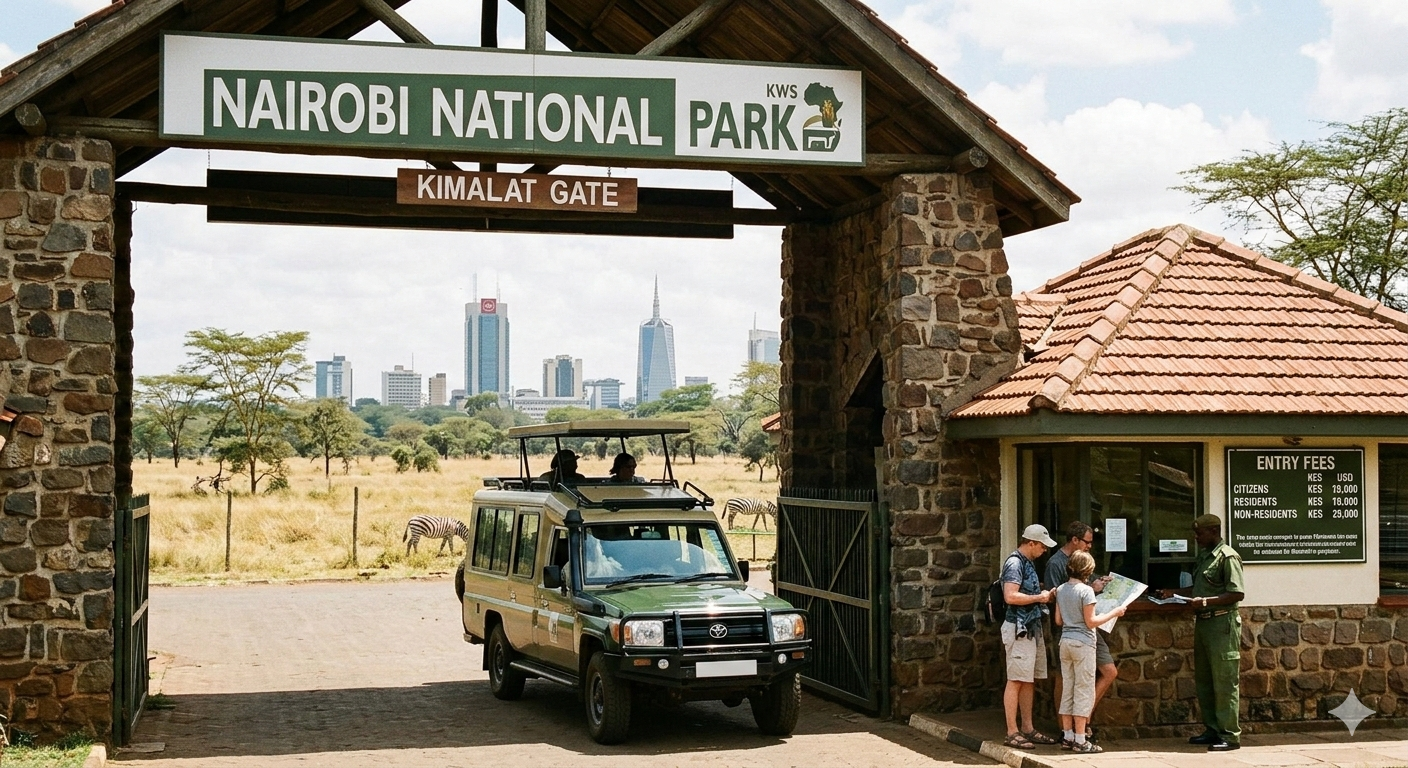
Nairobi National Park Entry Fee: Complete 2026 Guide for Citizens, Residents, and Tourists
Quick View
The Nairobi National Park entry fee as of October 1, 2025 is KES 1,000 per adult for East African citizens and KES 1,350 for Kenyan residents. Non-resident international visitors pay USD 80 per adult, and African citizens from outside the EAC pay USD 40. Children and students pay KES 500 (East African citizens), KES 675 (residents), USD 40 (non-residents), and USD 20 (African citizens). Children under 5 years enter free. Kenyan citizens aged 70 and above and persons with disabilities also enter free with valid identification. A combined Nairobi Package covering Nairobi National Park, Nairobi Animal Orphanage, and Nairobi Safari Walk costs KES 1,300 for East African citizens, KES 1,750 for residents, USD 105 for non-residents, and USD 55 for African citizens. Payment is cashless only — via M‑Pesa, Visa, or Mastercard. The park is open daily from 6:00 AM to 6:00 PM. All fees are per person per day.
Introduction
There are not many cities in the world where you can spot a black rhino grazing against a backdrop of skyscrapers. Nairobi is one of them. Just a short drive from the city centre, Nairobi National Park offers a genuine, full safari experience — lions, giraffes, zebras, buffalo, and some of the last black rhinos in Kenya — without travelling hours to get there.
For Kenyan families, students, and weekend adventurers, the park has long been the most accessible wildlife destination in the country. For international tourists, it is often the first or last stop on a Kenya safari itinerary, given its proximity to Jomo Kenyatta International Airport.
But before you drive through the gate, you need to know what you will pay. The Nairobi National Park entry fee changed significantly in October 2025 following the first comprehensive review of Kenya Wildlife Service conservation fees in 18 years. New rates now apply across all visitor categories, and the payment system has been fully cashless for several years.
This guide gives you every figure you need — broken down clearly by visitor type — plus how to pay, park rules, vehicle fees, and tips for getting the most out of your visit.
What Is the Nairobi National Park Entry Fee?
The Nairobi National Park entry fee is the conservation charge paid by all visitors to access the park, managed by the Kenya Wildlife Service (KWS). Fees are charged per person per day, are valid for 24 hours from the time of entry, and vary based on visitor category: East African citizen, Kenyan resident, African citizen (from outside the EAC), or non-resident international visitor.
According to KWS, this is the first comprehensive review of conservation fees in 18 years, despite rising costs in park management and the need to expand tourism infrastructure. The updated fees took effect on October 1, 2025, following parliamentary approval of the Wildlife Conservation and Management Regulations 2025.
As of 2026, Kenyan citizens visiting Nairobi National Park pay a revised conservation entry fee of KES 1,000 per adult and KES 500 per child or student, applicable year-round for a single-day (24-hour) entry.
Nairobi National Park Entry Fee — All Categories (2025 / 2026)
| Visitor Category | Adult Fee | Child / Student Fee |
|---|---|---|
| East African Citizen | KES 1,000 | KES 500 |
| Kenyan Resident | KES 1,350 | KES 675 |
| African Citizen (non-EAC) | USD 40 | USD 20 |
| Non-Resident (International) | USD 80 | USD 40 |
| Children under 5 years | Free | — |
| Kenyan citizens aged 70+ | Free | — |
| Persons with disabilities | Free | — |
All fees are per person per day. Valid identification is required at the gate for all categories. Visitors without a valid passport are required to pay the non-resident rates.
For more on Kenya’s conservation and tourism sector, the Kenya Wildlife Service is the official authority overseeing all national parks, reserves, and sanctuaries in the country.
Why Kenyans Should Know the Nairobi National Park Entry Fee
Understanding the current Nairobi National Park entry fee is not just about budgeting. It affects how you plan your visit, who qualifies for reduced rates, and whether you bring the right documents and payment method to the gate.
Here is why it matters for different Kenyan visitors:
- Families planning a weekend outing: Knowing the exact per-person cost means you can budget accurately and avoid surprises, especially with children where age-based pricing applies.
- School trips and student groups: Student rates are available but require advance planning and documentation — missing this step means paying full adult rates unnecessarily.
- Tourists and visitors from abroad: International visitors need to know whether their country qualifies for the African citizen rate or whether they pay non-resident rates, as the difference is significant.
- Residents and expatriates: Residents of Kenya who are not East African citizens must present a valid work permit or appropriate visa to qualify for the resident rate rather than paying the higher non-resident fee.
- Senior Kenyans: Citizens aged 70 and above enter free, but only with valid identification. Knowing this in advance ensures they carry the right documents.
- Photography and filming enthusiasts: Drone usage and commercial filming carry separate fees — knowing these upfront avoids surprises at the gate.
- Safari package planners: Tour operators and travel companies factor the Nairobi National Park entry fee into their package pricing. Understanding the fee structure helps you verify that you are getting fair value from any package you purchase.
According to the World Travel and Tourism Council, Kenya’s tourism sector contributes significantly to GDP and employment, with Nairobi National Park playing a central role as a gateway safari destination for both domestic and international visitors.
Types of Nairobi National Park Entry Fees and Visitor Categories
East African Citizen Rate
East African citizens will pay KES 1,000 for adult entry, with children and students paying KES 500. This rate applies to citizens of Kenya, Uganda, Tanzania, Rwanda, and Burundi — all member states of the East African Community. A valid national ID or EAC passport is required at the gate to access this rate.
Kenyan Resident Rate
Resident rates are applicable to residents of Kenya, Uganda, Tanzania, Rwanda, and Burundi. Visitors are required to present their National ID (for Kenyan citizens) or passport displaying work permits or appropriate visas to prove resident status upon entrance into the reserve. The adult resident rate is KES 1,350 and the child or student rate is KES 675.
African Citizen Rate
This rate applies to nationals of African countries outside the East African Community — for example, visitors from Nigeria, South Africa, Ethiopia, or Egypt. The adult fee is USD 40 and the child or student fee is USD 20.
Non-Resident (International Visitor) Rate
International visitors from other continents will pay USD 80 for adult entry and USD 40 for children and students. This is the highest rate tier and applies to visitors from Europe, the Americas, Asia, Australia, and other regions outside Africa.
The Nairobi Package (Combined Ticket)
A special Nairobi Package including access to Nairobi National Park, Nairobi Animal Orphanage, and Nairobi Safari Walk costs KES 1,300 for East African citizens, KES 1,750 for residents, USD 105 for non-residents, and USD 55 for African citizens. This combined ticket offers good value for first-time visitors or families who want to see multiple attractions in a single day.
Free Entry Categories
Kenyan citizens aged 70 and above, children under five years old, and persons with disabilities will have access to parks without charge. Frontline tourism workers — including tour drivers and guides, boat crews, and porters registered with and licensed by the Tourism Regulatory Authority — will also enter free. Valid identification, disability cards, or professional licenses are required to access these exemptions.
How to Pay the Nairobi National Park Entry Fee Correctly
The payment process at Nairobi National Park is entirely cashless. No cash is accepted at the gate under any circumstances.
Pre-Visit Checklist
- [ ] Confirm your visitor category (citizen, resident, African citizen, or non-resident) and prepare the correct identification
- [ ] Ensure your M‑Pesa account has sufficient balance, or carry a Visa or Mastercard
- [ ] For student rates, arrange school authorisation at least two weeks before the visit
- [ ] For children’s rates, be ready to show proof of age (birth certificate or passport)
- [ ] For senior citizens (70+) claiming free entry, carry original national ID
- [ ] Book in advance via the eCitizen Kenya portal to secure your entry, especially during peak seasons and weekends
- [ ] Carry the booking confirmation if you pay in advance online
- [ ] Carry the original documents used during online payment for verification at the gate
- [ ] Arrive early — the park opens at 6:00 AM and morning hours offer the best wildlife sightings
- [ ] Note that all fees are valid for 24 hours from time of entry
Costs, Requirements, and Vehicle Fees at Nairobi National Park
Vehicle Entry Fees (Per Day, Separate from Passenger Entry)
Vehicle fees are charged separately from individual passenger entry fees. Every vehicle entering the park pays a daily vehicle fee based on its seating capacity.
| Vehicle Type | Daily Fee (KES) |
|---|---|
| Private car / SUV (fewer than 6 seats) | 600 |
| Safari 4x4 / van (6–12 seats) | 1,500 |
| Mini-bus / Coaster | 3,000 |
| Large bus / coach | 4,500 – 5,000 |
In practical terms, most private cars and small SUVs with fewer than six seats pay KES 600 per day. A standard safari 4x4 Land Cruiser, typically customised for tours and carrying 5 to 8 passengers, falls into the 6–12 seat category and is charged KES 1,500 per day.
Vehicle fees are paid in addition to individual entry fees. If you book a safari package through a licensed tour operator, vehicle fees are typically included in the package price.
Other Charges
- Drone usage: KES 5,000 per day for East African citizens and residents; USD 300 for non-residents
- Vehicle recovery inside the park: KES 10,500
- Night game drive (selected parks): separate charge per person, exclusive of conservation fees
- Parking at park gate: KES 1,000 for East African citizens and residents; USD 30 for non-residents
Step-by-Step Guide: How to Visit Nairobi National Park
- Decide on your visitor category — Kenyan citizen, resident, African citizen, or non-resident. This determines your entry fee and the documents you need.
- Choose your entry gate — The main gate is the Nairobi National Park Main Gate on Langata Road. Other access points include the East Gate (near Wilson Airport), the Banda Gate, and the Hippo Pools entrance. The Main Gate is the most commonly used for self-drive visits.
- Book in advance via eCitizen — Visit eCitizen Kenya to pre-book and pay for your park entry. This saves time at the gate and is especially recommended during weekends and public holidays when queues can build up.
- Pay at the gate if not pre-booked — Payment is via M‑Pesa, Visa, or Mastercard. No cash accepted. Present your national ID, passport, or relevant documentation for your visitor category.
- Collect your entry receipt — This serves as your proof of payment and is valid for 24 hours from time of entry.
- Pick up a park map at the gate — The self-drive map shows the routes, picnic areas, and areas closed to visitors. Stick to designated routes.
- Follow all KWS park rules — Remain in your vehicle at all times unless in a designated picnic or walking area. Maintain a minimum distance of 200 metres from all wildlife. No littering, no loud music, and no feeding of animals.
- Plan your route based on the wildlife you want to see — Lions are commonly spotted along the southern boundary and in the open savannah areas. Rhinos are often found near the Hippo Pools area. Giraffes, zebras, and buffalo are distributed throughout the park.
- Stick to operating hours — The park is open from 6:00 AM to 6:00 PM daily. No entry is permitted after 6:00 PM, and all visitors must be out before closing.
- Consider a guided tour — First-time visitors and families benefit significantly from a guided safari. A licensed guide helps with navigation, wildlife spotting, and safety. Companies like Charming Safariz offer fully guided Nairobi National Park day trips that include entry fees, vehicle, and a professional guide.
Common Mistakes to Avoid When Visiting Nairobi National Park
1. Arriving with cash only The park is fully cashless. Arriving without M‑Pesa loaded or a working Visa or Mastercard means you will be turned away at the gate. Always ensure your payment method is ready before you leave home.
2. Not carrying identification Your visitor category — and therefore your entry fee — is determined by your nationality and residency status. Without valid documentation, you will be charged the higher non-resident rate. Always carry your original national ID, passport, work permit, or relevant document.
3. Assuming children under 18 pay the child rate Child rates are applicable to persons 3 to 11 years old. Persons under 3 are free. Children aged 12 and above pay adult rates unless they qualify for the student rate with proper documentation.
4. Booking student rates without advance arrangement Student rates are only applicable for persons aged up to 23 years old, sponsored by a recognised learning institution, and in possession of a valid student ID and visiting the reserve on a pre-arranged school-organised trip or for research authorised by the KWS ticketing office. Students must obtain permission to use these special rates at least two weeks in advance of their visit. Showing up on the day expecting student rates without prior authorisation will not work.
5. Arriving without enough time Many visitors underestimate how much time a proper game drive takes. The park covers 117 square kilometres. Arriving at 4:30 PM and expecting a meaningful experience before the 6:00 PM gate closure is not realistic. Aim to arrive between 6:00 AM and 8:00 AM for the best wildlife sightings and enough time to cover the key areas.
6. Forgetting to account for vehicle fees Many visitors budget for the personal entry fee and forget the vehicle charge. A family of four arriving in a private car pays KES 1,000 per adult (KES 4,000 total) plus KES 600 for the vehicle — KES 4,600 minimum before any children are included. Calculate the full cost before you go.
7. Expecting to pay last year’s rates By comparison, during 2024 and 2025, non-resident entry fees stood at USD 43 for adults and USD 22 for children or students, with no meaningful differentiation between high and low seasons. The transition to the new rates therefore represents a substantial recalibration of international pricing. Do not rely on old pricing information — always check current fees before your visit.
Future Updates and Trends for the Nairobi National Park Entry Fee
The October 2025 fee revision was a landmark change, and further developments are expected to shape how Kenyans and international visitors access the park in the coming years.
Court ruling on the new fee structure: The Milimani High Court issued conservatory orders suspending implementation of the new rates after a petition was filed by the Kenya Tourism Federation. The court halted the rollout pending full determination of the case, meaning that all KWS-managed parks and reserves continue to charge the previous rates until further notice — though as of late 2025, the new rates are still displayed and being charged on the eCitizen portal. The final court ruling will determine whether the new rates are confirmed or rolled back. Travellers planning visits in 2026 should monitor official KWS communications at Kenya Wildlife Service for the latest confirmed pricing.
Seasonal pricing introduction: The new KWS framework introduced seasonal pricing for non-residents, with high-season and low-season rate differentiation. This aligns Kenya’s parks more closely with international conservation pricing models and may affect when international tourists choose to visit.
Digital payment expansion: KWS has been progressively improving the eCitizen portal for park bookings. Future upgrades may include better group booking functionality and broader card payment options.
Conservation investment: The updated fees are directed toward strengthening wildlife protection, improving infrastructure and services, and expanding conservation programs. Visitors can expect ongoing improvements to park facilities, road conditions within the park, and visitor infrastructure in the coming years.
Poll Question for Readers: Do you think the new Nairobi National Park entry fee of KES 1,000 for Kenyan citizens is fair?
- Yes, conservation funding needs to be sustainable
- It is a bit high for regular local visitors
- No, it should be lower to encourage more Kenyans to visit their parks
- I am not sure — I would need to see what the money funds
(Share your answer in the comments below.)
Poll Answer: Kenyans have expressed mixed views on the revised fee. Many conservation advocates support the increase given that the previous rates had not been reviewed for 18 years. However, regular weekend visitors, school groups, and families on modest incomes have raised concerns about accessibility for ordinary Kenyans. The debate reflects a genuine tension between funding conservation sustainably and keeping national parks accessible to the citizens whose tax money and national identity they represent.
Frequently Asked Questions About Nairobi National Park Entry Fee
What is the Nairobi National Park entry fee for Kenyan citizens in 2025? As of 2026, Kenyan citizens visiting Nairobi National Park pay KES 1,000 per adult and KES 500 per child or student for a single-day (24-hour) entry. These rates took effect on October 1, 2025, and represent the first major fee revision in 18 years.
What does the Nairobi National Park entry fee cover? The entry fee covers access to the park for 24 hours from your time of entry. It does not include vehicle fees, guided tour costs, or access to the Nairobi Animal Orphanage or Nairobi Safari Walk — unless you purchase the combined Nairobi Package ticket.
Can I pay the Nairobi National Park entry fee with cash? Since 2022, KWS only accepts cashless payments — M‑Pesa, credit card, or direct bank transfer. No cash payments are accepted at the gate under any circumstances.
What documents do I need to pay the Kenyan citizen rate? Kenyan citizens should carry their original national ID. East African Community citizens from Uganda, Tanzania, Rwanda, and Burundi should carry their national ID or EAC passport. Residents who are not EAC citizens must present a passport showing a valid work permit or residency visa to qualify for the resident rate.
Who gets free entry to Nairobi National Park? Kenyan citizens aged 70 and above, children under five years old, and persons with disabilities enter free. Frontline tourism workers — including tour drivers and guides registered with the Tourism Regulatory Authority — also enter free. Valid identification must be presented at the gate in all cases.
What are the opening hours for Nairobi National Park? Nairobi National Park is open from 6:00 AM to 6:00 PM daily. No entry is permitted after 6:00 PM, and all visitors must exit before closing time.
My Experience
The first time I visited Nairobi National Park, I was honestly sceptical. A wildlife park in the middle of a major African capital felt like it should be underwhelming — a tourist novelty rather than a real safari experience.
I was wrong within the first ten minutes.
We entered through the main gate on Langata Road just after 7:00 AM. Payment was quick — straight M‑Pesa transaction, no queuing, no paperwork. The attendant scanned a QR code on my phone and waved us through.
Within twenty minutes, we had stopped for a family of giraffes walking slowly across the track in front of us, completely unbothered. The Nairobi skyline was clearly visible in the background. It was one of those scenes that genuinely stops you in your tracks.
We spent four hours in the park and covered most of the main circuit. We saw zebras, wildebeest, warthogs, ostriches, a pride of lions resting under an acacia tree, and two black rhinos near the Hippo Pools area. By noon, we were back in Nairobi CBD in time for lunch.
The Nairobi National Park entry fee for the three of us — two adults and one child — came to KES 2,500 plus the KES 600 vehicle fee. For a half-day safari with that quality of wildlife sightings, it represents outstanding value.
For first-time visitors, especially families or travellers with limited time, I always recommend starting with a guided visit rather than self-driving. A knowledgeable guide knows where the lions were spotted that morning, which tracks are open, and how to position the vehicle for the best views. Charming Safariz, Kenya’s best tour and travel company, offers guided Nairobi National Park day trips that include everything — entry, vehicle, guide, and transfer from your hotel.
Key Takeaways
- The Nairobi National Park entry fee for Kenyan citizens (East African citizens) is KES 1,000 per adult and KES 500 per child or student as of October 1, 2025
- Kenyan residents pay KES 1,350 per adult; non-residents from outside Africa pay USD 80
- Children under 5, Kenyan citizens aged 70 and above, and persons with disabilities enter free with valid ID
- The combined Nairobi Package (park, orphanage, and safari walk) costs KES 1,300 for East African citizens and USD 105 for non-residents
- Vehicle fees are charged separately: KES 600 for private cars under 6 seats, KES 1,500 for safari vans with 6 to 12 seats
- All payments are cashless only — M‑Pesa, Visa, or Mastercard
- Advance booking via the eCitizen portal is recommended, especially for weekends and public holidays
- The park is open daily from 6:00 AM to 6:00 PM — earlier morning visits offer the best wildlife sightings
- Student rates require advance authorisation from KWS at least two weeks before the visit
- A legal dispute over the October 2025 fee revision is ongoing — check Kenya Wildlife Service for the latest confirmed rates before your visit
- For guided day trips that include entry fees, vehicle, and a professional guide, Charming Safariz is Kenya’s top-rated tour and travel company
Conclusion
Nairobi National Park is one of the most remarkable wildlife destinations in Africa — not just in Kenya. Where else can you watch lions hunting against a backdrop of a modern city skyline? The park is accessible, genuinely wild, and now operating under a revised entry fee structure designed to fund long-term conservation.
Whether you are a Kenyan planning a family weekend, a student organising a school trip, or an international visitor with a single afternoon before a flight, the park delivers far beyond what most people expect.
Get the right documentation, pay the correct rate for your category, arrive early, and respect the park rules. That is all it takes for a remarkable experience.
For a fully guided visit with no stress — entry fees, transport, an expert guide, and a customised itinerary — contact Charming Safariz today. They handle everything so you can focus on the experience.
Have you visited Nairobi National Park recently? Share your experience in the comments. If you have a question about the entry fee, visitor categories, or how to plan your trip, drop it below — every message gets a response.
Plan Your Nairobi National Park Visit with Charming Safariz
Charming Safariz is Kenya’s best tour and travel company for safari packages, Nairobi National Park day trips, coastal holidays, and fully customised Kenya travel itineraries. Whether you need a guided game drive, a full-day park visit, or a combined safari and SGR journey package, the Charming Safariz team handles every detail.
Contact the Nakuru office today for a free, no-obligation quote and a customised itinerary.
WhatsApp: +254 714 236 664
Email: enquiry@charmingsafariz.com
Office: Nakuru, Kenya
Sources and References
- Kenya Wildlife Service — Official Park Fees
- Kenya Wildlife Service — Conservation Fees 2025 Official Schedule
- Magical Kenya — Official Tourism Platform
- Nation Africa — New Park Entry Fees Guide
- eCitizen Kenya — Online Park Booking Portal
- World Travel and Tourism Council
- Kenya National Bureau of Statistics
- TripAdvisor — Nairobi National Park Reviews
- UNESCO World Heritage Centre — Kenya Conservation Sites