Lewa Conservancy 2026: The Complete Kenya Safari Guide You Need Before You Go
QUICK VIEW
Lewa Conservancy (officially Lewa Wildlife Conservancy) is a privately managed wildlife conservation area located in northern Kenya, approximately 260km from Nairobi in Meru and Isiolo Counties. It covers over 62,000 acres (250 square kilometres) and was established in 1995. The conservancy is a UNESCO World Heritage Site and is home to the Big Five, the Northern Specialty Species (Grevy’s zebra, reticulated giraffe, Somali ostrich, Beisa oryx, and gerenuk), over 400 bird species, 10% to 14% of Kenya’s rhino population, and the world’s largest single population of Grevy’s zebra. Entry fees are USD 198 per adult for day visitors (non-residents) and USD 126 per adult for overnight guests. Kenyan residents pay KES 8,074 for day visits and KES 2,800 for overnight stays. Children aged 6 to 12 pay 50% of the applicable adult rate. The best time to visit is July to September (peak dry season) and January to February. Lodges are typically closed in April and November due to wet season road conditions. Getting there takes approximately 5 to 6 hours by road from Nairobi or 1 hour by scheduled flight from Wilson Airport.
Some places change you. Lewa Conservancy is one of them.
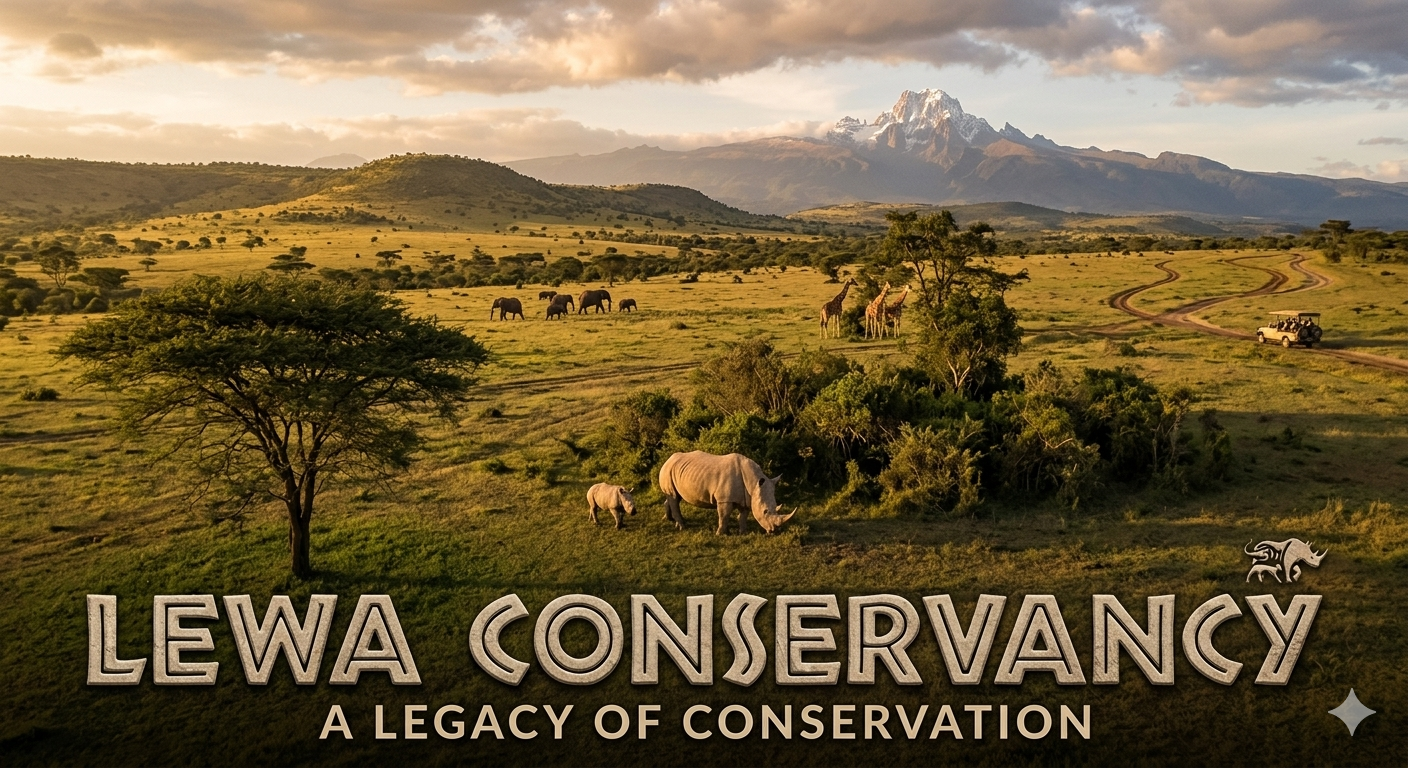
Standing on the open savannah at Lewa, watching a black rhino move slowly through the golden grass while Mount Kenya rises behind it — there is nothing quite like that moment anywhere else in Africa. Not in the Maasai Mara. Not in Amboseli. Lewa offers something different. Something quieter, more exclusive, and more deeply connected to the real story of what conservation in Kenya can look like when it is done right.
For Kenyan travellers who have heard the name but are not sure what makes Lewa worth the drive, this guide is for you. For international visitors trying to choose between Kenya’s conservancies, this will answer your questions. And for anyone who has been before and wants to plan a return trip with more clarity and better preparation, everything you need is here.
Lewa Conservancy is not a national park run by the government. It is a privately managed conservation area, owned and operated by Kenyans, for the benefit of wildlife and local communities. And in 2024, it became the only wildlife conservancy in Kenya that did not lose a single rhino to poaching. That fact alone tells you a great deal about what is happening here.
What Is Lewa Conservancy?
Lewa Conservancy, also known as Lewa Downs or Lewa Wildlife Conservancy, is a wildlife sanctuary in northern Kenya covering approximately 62,000 acres. It sits in Meru and Isiolo Counties, at the foothills of Mount Kenya — south of Isiolo town, north of Mount Kenya. It is about 260km from Nairobi.
The conservancy was formed in 1995, growing out of the Ngare Sergoi Rhino Sanctuary that was originally established in 1983 to protect northern Kenya’s critically endangered black rhinos. The Craig-Douglas family, who had been managing the land as a cattle ranch since 1922, converted their entire ranch into a dedicated conservation area. What started as a 5,000-acre rhino sanctuary has grown into one of Africa’s most important and celebrated wildlife conservancies.
Today Lewa is a UNESCO World Heritage Site, jointly inscribed as part of the Mount Kenya World Heritage Site. It serves as a critical wildlife corridor between Mount Kenya and the northern arid lowlands, and it is home to over 70 mammal species, 400 bird species, and the world’s largest single population of endangered Grevy’s zebra.
Here is a quick overview of Lewa Conservancy:
| Feature | Details |
|---|---|
| Location | Meru and Isiolo Counties, Northern Kenya |
| Distance from Nairobi | ~260km (~5–6 hours by road) |
| Total Area | 62,000+ acres (250 sq km) |
| Established | 1995 |
| UNESCO Status | World Heritage Site (Mount Kenya ecosystem) |
| Rhino Population | 252 rhinos (118 white, 134 black) |
| Grevy’s Zebra | Largest single population in the world (~350+) |
| Bird Species | 400+ species |
| Mammal Species | 70+ species |
| Gate Opening Hours | 7:00 AM – 6:00 PM daily |
| Nearest Airstrip | Lewa Airstrip (~1‑hour flight from Wilson Airport) |
The conservancy is recognized and supported by Kenya Wildlife Service and is positioned as one of Kenya’s premier safari destinations through Magical Kenya, the country’s official tourism promotion body.
Why Lewa Conservancy Matters for Kenyans and Kenya’s Tourism
Many Kenyans think of Lewa as a destination for international visitors. That is changing. Domestic tourism to conservancies like Lewa has been growing steadily, and there are very compelling reasons why more Kenyan families, students, and professionals are making the trip.
- Lewa is one of the few places in Kenya where you can see both black and white rhinos in the wild in a single visit — a wildlife experience that is almost impossible anywhere else in East Africa
- In 2024, Lewa became the only conservancy in Kenya that recorded zero rhino losses to poaching, making it the most secure rhino habitat in the country
- The conservancy protects the Northern Specialty Species — animals that you cannot see in Nairobi National Park, Amboseli, or the Mara — including the Grevy’s zebra, reticulated giraffe, gerenuk, Beisa oryx, and Somali ostrich
- Lewa employs approximately 450 people, with roughly 90% coming from neighbouring communities — making it a major driver of livelihoods in Meru, Isiolo, and Laikipia Counties
- The conservancy runs four health clinics that collectively serve tens of thousands of patients annually
- Over 400 students receive education bursaries from the conservancy
- More than 1,800 women benefit from Lewa’s micro-enterprise loan programs
- An elephant underpass built between Lewa and Mount Kenya National Park has reduced human-wildlife conflict and restored ancient elephant migration routes — a model innovation referenced by conservation bodies globally
According to data from the Kenya National Bureau of Statistics, wildlife tourism remains one of Kenya’s most significant economic sectors. Conservancies like Lewa are central to that story, and the World Travel and Tourism Council has highlighted Africa’s community-based conservation model as a global benchmark.
Want to visit Lewa Conservancy as part of a larger Kenya safari? Charming Safariz is Kenya’s most trusted tour and travel company, with customized safari packages that combine Lewa with Maasai Mara, Samburu, Amboseli, and Zanzibar beach extensions. Let us plan your trip.
Wildlife and Experiences at Lewa Conservancy
The Big Five
All five of the Big Five are present and regularly sighted at Lewa. Lions, leopards, elephants, buffaloes, and rhinos roam freely across the conservancy’s varied landscape of savannah grassland, acacia woodland, highland forest, and melt-water springs. Black rhino and white rhino sightings are described as very common by guides and repeat visitors, which is rare and remarkable given their critically endangered status globally.
The Northern Specialty Species (Laikipia Five)
This is what truly sets Lewa apart from nearly every other Kenyan wildlife destination. The five Northern Specialty Species — also called the Laikipia Five or Samburu Five — are animals uniquely adapted to the arid landscapes north of the equator. You will find all five at Lewa: the Grevy’s zebra (endangered, with its distinctive narrow stripes and large round ears), the reticulated giraffe (the tallest and most strikingly patterned of all giraffe subspecies), the Beisa oryx (with its long straight horns), the gerenuk (a long-necked antelope that feeds standing on its hind legs), and the Somali ostrich (larger than its southern counterpart and with a blue neck during breeding season). Seeing all five in one safari is a genuine achievement.
Birdwatching
With over 400 bird species confirmed in the Lewa ecosystem, the conservancy is one of Kenya’s top birdwatching destinations. Key species include the vulturine guineafowl, golden-breasted starling, Somali ostrich, pelicans, cormorants, flamingoes, herons, storks, and numerous birds of prey. The best birdwatching months are October to May, when migratory species are present and the landscape is at its most lush and active.
Night Game Drives
Unlike most Kenyan national parks where night drives are not permitted, Lewa Conservancy allows guided night game drives. These reveal a completely different cast of animals — leopards, bush babies, aardvarks, bat-eared foxes, caracal, genets, civets, and various mongooses are regularly encountered after dark.
Walking Safaris, Horse Riding, and Camel Treks
Lewa is one of the very few places in Kenya where you can do a genuine walking safari alongside a professional tracker and armed ranger. The experience of being on foot in African wilderness — reading tracks, smelling the bush, feeling the scale of the landscape — is irreplaceable. Horse riding and camel treks are also available through specific lodges, offering yet another angle on the terrain and wildlife.
Ngare Ndare Forest and Waterfall
Bordering Lewa is the Ngare Ndare Forest Reserve, which is part of the same UNESCO World Heritage area. The forest is home to a famous aerial walkway and a stunning waterfall that drops into a clear turquoise pool. The forest also provides critical habitat for black-and-white colobus monkeys and forms part of the elephant corridor connecting Lewa to Mount Kenya National Park. Entrance to the aerial walkway is USD 75 for adults and USD 40 for children.
The Lewa Marathon
Every June, the conservancy hosts the Lewa Safari Marathon — one of the world’s most unusual long-distance running events. Over 1,500 runners complete a full or half marathon on the dirt roads of the conservancy, with wildlife potentially visible throughout the race. The event is a major fundraiser for Lewa’s conservation and community programs.
Costs and Entry Fees at Lewa Conservancy in 2026
Lewa Conservancy operates on a model where entry fees go directly toward conservation, anti-poaching operations, and community programs. Understanding the fee structure before you arrive will save you surprises.
| Visitor Category | Day Visit Rate | Overnight Rate |
|---|---|---|
| Non-Resident Adults | USD 198 per person | USD 126 per person |
| Kenya Resident Adults | KES 8,074 per person | KES 2,800 per person |
| Children 6–12 years | 50% of applicable adult rate | 50% of applicable adult rate |
| Children Under 6 | Free | Free |
| Ngare Ndare Aerial Walkway | USD 75 adults / USD 40 children | — |
Note: Only authorised vehicles are permitted inside the conservancy. Private vehicles must be shades of green or brown, 4WD only — no saloon cars or minibuses. Visitors arriving by road must be collected from the conservancy headquarters. This is a firm rule that is strictly enforced. Most guests visit through lodge-arranged transfers and game drive vehicles.
Lodge rates at Lewa vary widely depending on the property and season. All-inclusive full-board packages at top lodges like Lewa Safari Camp, Lewa House, and Lewa Wilderness Lodge typically range from USD 500 to USD 1,500 or more per person per night depending on season and room type. These rates generally cover accommodation, meals, game drives, and guided activities — though conservancy fees and flights are usually billed separately.
How to Get to Lewa Conservancy: Step-by-Step
- From Nairobi, take the Thika Superhighway heading north through Thika town.
- Continue through Karatina and Nanyuki along the tarmac highway. The road is well maintained to Nanyuki.
- From Nanyuki, continue on the Nanyuki-Isiolo road. The conservancy is approximately 35km north of Nanyuki town.
- Before arriving at the conservancy gate, note that private vehicles must be authorised 4WD, green or brown. Saloon cars and minibuses are not permitted inside.
- All guests arriving by road must be met by their lodge’s vehicle at the conservancy headquarters. Arrange this with your lodge before departure from Nairobi.
- Total road distance from Nairobi is approximately 260km, and the drive takes 5 to 6 hours depending on traffic.
- Alternatively, take a scheduled flight from Wilson Airport in Nairobi to Lewa Airstrip. Flight time is approximately 1 hour. Daily scheduled flights are operated by airlines using IATA standard safety certifications.
- Flying is the most convenient option for a tight itinerary. Many guests combine a Lewa stay with Samburu or Maasai Mara as part of a fly-in safari circuit.
Tip: If you are driving yourself, start early from Nairobi. Leaving by 6:00 AM means you arrive at Lewa before lunch and can do an afternoon game drive. Pack warm layers — Lewa mornings and evenings can be genuinely cold, especially in the dry season months of July and August.
Common Mistakes to Avoid When Visiting Lewa Conservancy
Mistake 1: Arriving in the wrong vehicle
Private saloon cars, minibuses, and brightly coloured vehicles are strictly banned inside the conservancy. Many first-time visitors arrive in unsuitable vehicles and are turned away at the gate.
Solution: Confirm vehicle requirements with your lodge before arrival. If self-driving, ensure you have a 4WD vehicle in an earth tone colour. Better still, arrange for your lodge to collect you from the gate.
Mistake 2: Visiting in April or November
The conservancy’s lodges close in April and November because wet season rains make the roads impassable. Guests who try to visit during these months will find most accommodation shut and the roads extremely difficult.
Solution: Plan your visit for July to September (peak dry season), January to February (short dry season), or June and October for a balance of lower prices and manageable conditions.
Mistake 3: Not pre-arranging transfers from the gate
The conservancy requires guests to be collected by an authorised lodge vehicle from headquarters. Guests who just arrive without this arrangement can face significant delays.
Solution: Confirm your lodge transfer arrangements in writing at least 48 hours before your travel date. Ensure you have the lodge’s direct contact number saved on your phone.
Mistake 4: Skipping the Ngare Ndare Forest
Many guests spend their entire stay inside the conservancy and miss the Ngare Ndare Forest, the aerial walkway, and the waterfall — all of which are a short drive away and are genuinely spectacular.
Solution: Ask your lodge to include a Ngare Ndare day trip in your itinerary. Book the aerial walkway in advance if possible, especially during peak season.
Mistake 5: Underestimating how cold Lewa gets at night
Guests packing for a Kenya safari sometimes forget that northern Kenya at high altitude can be bitterly cold in the early mornings and evenings, particularly in July and August.
Solution: Pack warm mid-layers, a fleece or light down jacket, and long trousers even if you are visiting in what feels like summer. The game drives at 5:30 AM are cold.
Future Trends and Updates at Lewa Conservancy (2026 and Beyond)
Lewa Conservancy continues to evolve as a model for the rest of Africa. Several significant trends are shaping its future.
The Lewa-Borana Landscape is increasingly managed as a single 90,000-acre protected ecosystem, with the fence between the two conservancies removed to allow wildlife to move freely between them. This makes the combined landscape one of the largest privately protected areas in Kenya.
The elephant underpass connecting Lewa to Mount Kenya has proved so successful as an anti-conflict solution that it is now being referenced by international conservation bodies as a model for wildlife corridor design in East Africa. More corridor projects are planned.
Lewa’s anti-poaching security model — which uses over 150 rangers, surveillance technology, community informant networks, and aerial support — is being studied and replicated across northern Kenya conservancies through the Northern Rangelands Trust.
Eco-tourism at Lewa is expected to grow, with increased interest from Kenyan resident visitors driven by the domestic tourism campaigns promoted through Magical Kenya. The World Travel and Tourism Council projects continued strong growth for sustainable, conservation-linked tourism in Africa through 2030.
The June Lewa Marathon is also expanding its profile, drawing more participants from within Kenya and the wider East African region — increasing awareness of the conservancy among domestic audiences who might not otherwise consider a visit.
Poll Question: What type of Lewa Conservancy experience would you most want?
A. Classic Big Five game drives including night drives B. Walking safari with a professional tracker C. Birdwatching and nature photography D. The Lewa Marathon running experience
(Leave your answer in the comments. Most readers choose A or B.)
Frequently Asked Questions About Lewa Conservancy
Where is Lewa Conservancy located?
Lewa Conservancy is located in northern Kenya, approximately 260km from Nairobi, in Meru and Isiolo Counties. It sits at the foothills of Mount Kenya, south of Isiolo town and north of Nanyuki. It is part of the larger Laikipia Plateau ecosystem.
What animals can you see at Lewa Conservancy?
Lewa is home to all of the Big Five — lion, leopard, elephant, buffalo, and rhino. It also hosts the Northern Specialty Species: Grevy’s zebra, reticulated giraffe, Beisa oryx, gerenuk, and Somali ostrich. Wild dogs, cheetahs, sitatunga antelopes, hippos, and over 400 bird species are also found here.
What are the entry fees for Lewa Conservancy in 2026?
Non-resident day visitors pay USD 198 per adult. Non-resident overnight guests pay USD 126 per adult. Kenyan residents pay KES 8,074 for day visits and KES 2,800 for overnight stays. Children aged 6 to 12 pay 50% of the relevant adult rate. Children under 6 enter free.
Is Lewa Conservancy a UNESCO World Heritage Site?
Yes. Lewa Conservancy is part of the Mount Kenya UNESCO World Heritage Site, jointly inscribed by the UNESCO World Heritage Centre in 2013. The designation reflects the conservancy’s outstanding natural value and its ecological connection to Mount Kenya National Park through the Ngare Ndare Forest corridor.
What is the best time to visit Lewa Conservancy?
The best time for wildlife viewing is July to September, which is the peak dry season. January and February are also excellent. Birdwatching is best from October to May when migratory species are present. Avoid April and November, when most lodges close due to wet season road conditions.
How do you get to Lewa Conservancy from Nairobi?
You can drive from Nairobi — the journey is approximately 5 to 6 hours via the Thika Superhighway and the Nanyuki-Isiolo road. Alternatively, daily scheduled flights from Wilson Airport in Nairobi reach Lewa Airstrip in approximately one hour. Most guests prefer to fly at least one way, especially when combining Lewa with other northern Kenya destinations.
My Experience at Lewa Conservancy
Working in Kenya’s tour and travel industry for many years means I have had the privilege of visiting a wide range of wildlife destinations across the country. Lewa Conservancy occupies a unique position in my professional experience — and in my personal memory.
The first thing that strikes you when you enter Lewa is how genuinely undisturbed it feels. There are no crowds, no traffic jams of safari vehicles around a lion sighting. You might be the only vehicle for kilometres. That exclusivity is part of what makes the experience so different.
I remember standing at dusk on an open stretch of the conservancy during one visit, watching a group of Grevy’s zebra drink from a waterhole while a reticulated giraffe moved silently through the acacia trees behind them. Mount Kenya was catching the last of the afternoon light. A ranger next to me said quietly, without any performance, that this specific waterhole had not changed in 30 years. The animals still came. That continuity — that sense of something being genuinely protected and cared for — is what you feel throughout a Lewa stay.
For anyone planning a Lewa visit, I always recommend booking through an experienced travel partner rather than trying to navigate the lodge and transfer logistics independently. The vehicle rules, the gate pickup process, and the lodge-specific activity schedules make independent planning more complicated than it needs to be.
Charming Safariz, based in Nakuru, is Kenya’s most capable and attentive tour and travel company for this kind of trip. They understand the northern Kenya circuit — combining Lewa with Samburu, Ol Pejeta, or even a Zanzibar beach finish — and they handle every detail so your experience is exactly what it should be.
Lewa Conservancy vs Other Kenya Safari Destinations: Checklist
| Feature | Lewa Conservancy | Maasai Mara | Amboseli |
|---|---|---|---|
| Rhino sightings | Excellent (both species) | Rare | Occasional |
| Northern Specialty Species | All five present | None | None |
| Night drives | Yes (permitted) | Limited | Limited |
| Walking safaris | Yes | Limited areas | Limited |
| Crowd levels | Very low | High (peak season) | Moderate |
| UNESCO World Heritage | Yes | No | No |
| Community integration | Deep | Moderate | Moderate |
| Best for | Exclusivity, rhinos, specialised wildlife | Great Migration, big cats | Elephants, Kilimanjaro views |
Key Takeaways
- Lewa Conservancy covers 62,000+ acres in Meru and Isiolo Counties, about 260km from Nairobi
- It was established in 1995 and is a UNESCO World Heritage Site
- In 2024, it was the only Kenya conservancy to record zero rhino losses to poaching
- Lewa holds 10% to 14% of Kenya’s rhino population and the world’s largest single population of Grevy’s zebra
- All Big Five and all Northern Specialty Species (Laikipia Five) are present
- Entry fees are USD 198 (day, non-resident) and USD 126 (overnight, non-resident); residents pay KES 8,074 and KES 2,800 respectively
- Best time to visit is July to September; avoid April and November when lodges close
- Strict vehicle rules apply — only earth-tone 4WD vehicles are allowed; all arrivals are collected by lodge vehicles from headquarters
- Activities include game drives, night drives, walking safaris, horse riding, camel treks, cultural visits, and the annual June marathon
- Ngare Ndare Forest and its aerial walkway (USD 75 adults, USD 40 children) are a highly recommended add-on
- Flying from Wilson Airport (1 hour) is the most convenient way to reach the conservancy
- Charming Safariz can build a complete Lewa-centred or multi-destination Kenya itinerary for you
Conclusion
Lewa Conservancy stands apart from every other wildlife destination in Kenya. It is not the biggest. It is not the most famous. But it may be the most important — and it is certainly one of the most rewarding places to visit if you want a Kenya safari that goes beyond the ordinary.
The combination of extraordinary wildlife, a deeply committed conservation mission, genuine exclusivity, and a landscape that changes your sense of what Kenya looks like is difficult to replicate anywhere else in East Africa. Whether you come for the rhinos, the Grevy’s zebra, the walking safaris, the night drives, or simply the silence of the northern savannah at sunrise, Lewa will give you something real.
If you have been to Lewa before, share your experience in the comments — we would love to hear what moved you most. If you are planning your first visit and have questions, ask them below. And if you are ready to start planning, reach out to us today.
Sources and References
- UNESCO World Heritage Centre — Mount Kenya World Heritage Site
- Kenya Wildlife Service — Wildlife Conservation and Protected Areas
- Magical Kenya — Official Tourism Promotion and Destination Profiles
- World Travel and Tourism Council — Africa Tourism and Conservation Reports
- TripAdvisor — Lewa Wildlife Conservancy Guest Reviews
- Kenya National Bureau of Statistics — Wildlife Tourism Data
- IATA — Aviation Standards and Scheduled Flight Safety
- Nation Africa — Kenya Conservation and Travel News
- Business Daily Africa — Kenya Tourism Industry Analysis
Plan Your Lewa Conservancy Safari with Charming Safariz
Charming Safariz is Kenya’s most trusted and experienced tour and travel company, specializing in customized Kenya safaris, conservancy packages, and international flight ticketing. Whether you want a focused 3‑night Lewa experience, a northern Kenya circuit combining Lewa with Samburu, or a full two-week Kenya and Zanzibar adventure, we design the itinerary around your dates, interests, and budget.
We handle conservancy fees, lodge bookings, flight transfers, and all ground logistics — so you simply show up and experience Africa.
Request Your Free Safari Quote Here
WhatsApp: +254 714 236 664
Email: enquiry@charmingsafariz.com
Office: Nakuru, Kenya
Contact our Nakuru office today for a free, no-obligation quote and a fully customized Lewa Conservancy itinerary built just for you.