
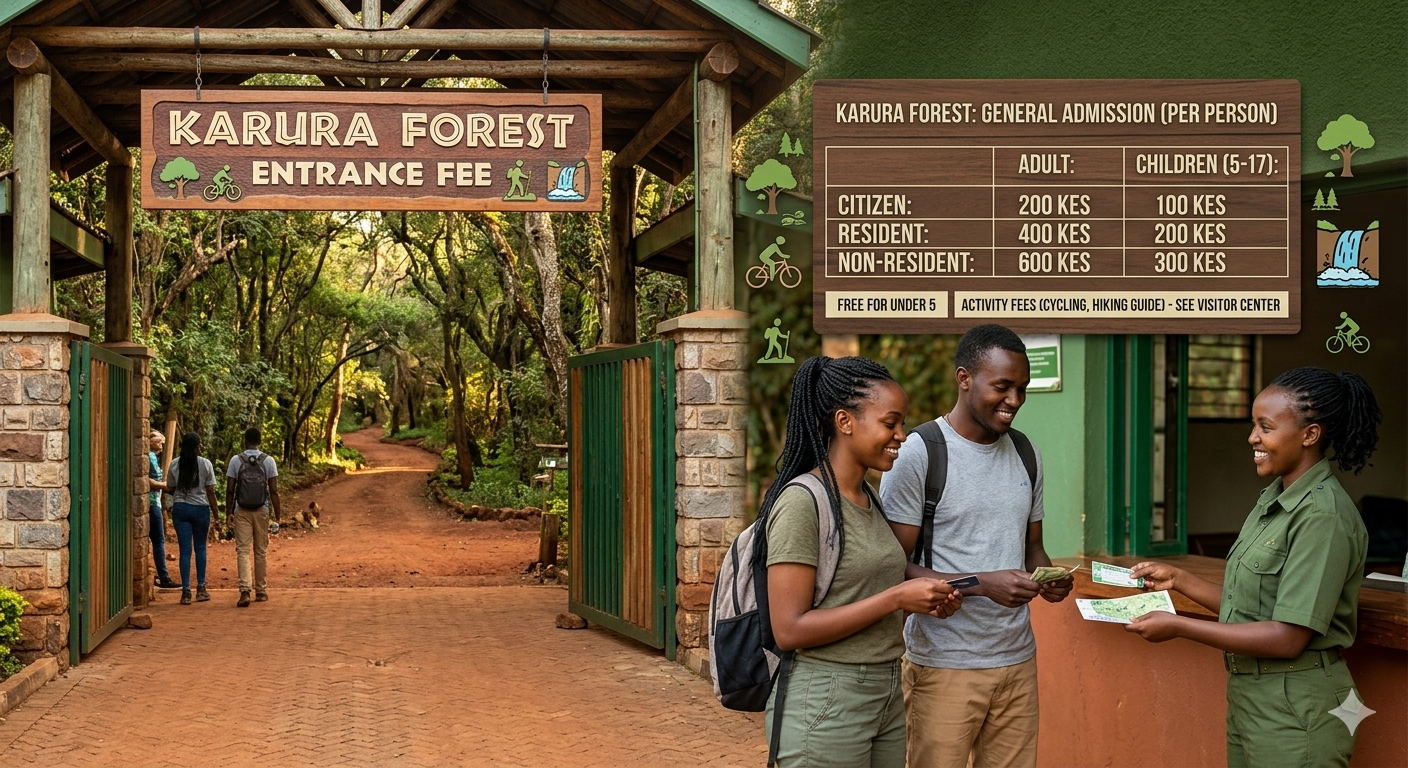
Karura Forest Entrance Fee 2026: Updated Rates, How to Pay, and Everything You Need Before You Go
Quick View
Karura Forest entrance fee in 2026 (effective August 2025 under Kenya Forest Service management):
- Kenyan citizens and East African residents (adults): KES 174 per person (base KES 100 + 16% VAT + pro-rated eCitizen convenience fee)
- Kenyan citizens and East African residents (children 2–12): KES 55 per person
- Non-resident international visitors (adults): KES 850 per person
- Non-resident international visitors (children 2–12): KES 450 per person
- Children under 2 years: FREE
- Vehicle parking (saloon or 4x4 per day): KES 295
- Picnic area fee (adult): KES 150 | Picnic area fee (child): KES 100
All fees are paid digitally through eCitizen using Paybill number 222222 (M‑Pesa) or by card. No cash is accepted at any gate. All previous annual passes and FKF membership subscriptions have been suspended. The forest opens at 6:00 AM and the last entry is at 5:45 PM daily.
Introduction
Ask any Nairobian where they go when the city gets too loud, and a good number will tell you: Karura Forest. This 1,041-hectare urban forest in the northern suburbs of Nairobi is one of the largest gazetted forests fully inside a city anywhere in the world. It has marked trails for hiking and running, rivers with small waterfalls, historical Mau Mau caves, over 200 bird species, cycling paths, and a café inside the trees. All of this, less than 20 minutes from the Nairobi CBD.
Before you head out, the most common question is always: what is the Karura Forest entrance fee in 2026, and how exactly do you pay it?
The answer changed significantly in August 2025 when the Kenya Forest Service (KFS) took full operational control of the forest’s gate payments and moved everything onto the government’s eCitizen platform. Many visitors are still arriving with old fee information — or with cash — and running into problems at the gate. This guide gives you the current, accurate 2026 figures, explains the new payment process clearly, and covers everything from how to get there to what to expect once you are inside.
Want to pair your Karura visit with a wider Kenya adventure? View our top safaris in Kenya and Zanzibar — Charming Safariz handles all the planning so you can just enjoy the experience.
What Is the Karura Forest Entrance Fee?
The Karura Forest entrance fee is the daily access charge you pay to enter Karura Forest Reserve, managed by the Kenya Forest Service (KFS). The fee has existed for years and funds the maintenance of trails, security, ecological restoration, and staff salaries.
What changed in August 2025 is not just the fee amount — it is the whole payment system. KFS took over gate payment operations from the Friends of Karura Forest (FKF), a community organisation that had co-managed the forest since 2009. All payments now go through the government eCitizen platform. The base entrance fee for a Kenyan citizen is still KES 100, but the actual amount you pay now includes 16% VAT and a pro-rated eCitizen convenience fee, bringing the total to approximately KES 121 for a solo adult citizen paying alone, or KES 174 if you are in a smaller group where the transaction cost spreads differently.
Karura Forest Entrance Fee — 2026 Official Rates
| Visitor Category | Adult Fee (KES) | Child Fee (KES) (Ages 2–12) |
|---|---|---|
| Kenyan Citizens and East African Residents | ~174 | ~55 |
| Non-Resident International Visitors | 850 | 450 |
| Children under 2 years | FREE | FREE |
| Vehicle parking (saloon/4x4 per day) | 295 | — |
| Picnic area (per person) | 150 | 100 |
Source: Kenya Forest Service. Note: The total paid includes the base fee, 16% VAT, and a pro-rated eCitizen convenience fee of KES 50 per transaction (shared across the group).
Karura is managed by KFS, not by the Kenya Wildlife Service (KWS). The fees above are specific to KFS-managed forest stations and are completely separate from KWS national park rates.
Why Kenyans Need to Know These Updated Rates
The August 2025 transition to eCitizen payments caught a lot of regular visitors off guard. If you last visited before that date, the process and the amounts have both changed. Here is why this matters across different groups:
- Nairobi residents using Karura for daily fitness: Thousands of runners, cyclists, and walkers visit the forest every week. Annual passes no longer exist — you pay per visit, every time, using eCitizen. Budget accordingly.
- School trip organisers: KFS still allows subsidised school visits, but you must apply in advance with a letter from the school. Walk-in group rates without prior approval are charged at the standard citizen rate.
- Dog owners: Karura allows leashed dogs, but pets must be registered with KFS and vaccination certificates are required at entry. This process has not changed, but payment for the owner must now go through eCitizen.
- Corporate team-building groups: A group of 20 adults at the citizen rate (roughly KES 174 each) now costs approximately KES 3,480 in entry fees alone. The eCitizen convenience fee of KES 50 is per transaction, not per person — so one person paying for the entire group saves significantly.
- International visitors and expatriates: Non-resident fees rose from KES 600 to KES 850 for adults. The forest still offers excellent value compared to national parks like Nairobi National Park, but the increase is real.
- Budget day-trippers: At KES 174 for a Kenyan adult, Karura remains one of the most affordable nature spaces in East Africa.
Planning a broader Kenya safari or Zanzibar beach trip alongside your Nairobi stay? Explore Charming Safariz Kenya and Zanzibar safari packages — we are Kenya’s most trusted tour and ticketing company and can build the perfect itinerary around your trip.
Types of Visits to Karura Forest
Forest Walking and Jogging
This is the most popular activity. The forest has a network of marked trails totalling over 50 km. Paths range from easy flat walks to moderately hilly routes through indigenous tree stands. The forest floor is generally well-maintained and clearly signposted. Many Nairobi residents come specifically for morning runs.
Cycling
Karura is one of the few places near Nairobi where you can cycle through indigenous forest. Most tracks that allow vehicles also allow bicycles. Bicycle hire was previously managed by FKF from Gate C on Kiambu Road — as of late 2025 and into 2026, bike hire availability has been disrupted by the KFS-FKF management dispute. Confirm availability before visiting if cycling is your main reason for going.
Wildlife and Bird Watching
The forest is home to Harvey’s Duiker, Grimm’s Duiker, bushbucks, Sykes’ monkeys, porcupines, and bush pigs. It hosts over 200 bird species, including the African Crowned Eagle, Hartlaub’s Turaco, Narina Trogon, and Silvery-cheeked Hornbill. Butterfly watching is also popular — species include the African Queen and Desmond’s Green Banded Swallowtail. The best wildlife sightings happen in the early morning, between 6:00 AM and 9:00 AM.
Historical Sites
The forest played a direct role in Kenya’s colonial history. The Mau Mau caves along the Gitathuro River were used as hideouts during the independence struggle. The late Nobel Laureate Professor Wangari Maathai fought publicly in the 1990s to stop illegal land grabbing in Karura, making it a symbol of environmental justice in Kenya. Most trails pass through or near historically significant areas, and guides can point these out.
Picnicking
Designated picnic sites are available inside the forest. An additional picnic fee applies — KES 150 for adults and KES 100 for children, on top of the standard entry fee. The River Café near Gate A on Limuru Road offers food and drinks inside the forest.
How to Access Karura Forest Correctly
Getting There from Nairobi
By private car: The main entrance is Gate A on Limuru Road, just past the Belgian Embassy. Gate C on Kiambu Road is the alternative. Gate F on Thigiri Lane is also available for visitors coming from the Gigiri direction. Most sections of the forest are accessible by saloon car once inside.
By matatu: From Nairobi CBD, take matatu numbers 11B, 106, 107, 108, 114, or 116 for Limuru Road (Gate A). For Gate C on Kiambu Road, take matatu 100 or 120.
By taxi (Uber/Bolt): Simply enter “Karura Forest” as your destination. Journey time from the CBD is roughly 15–20 minutes depending on traffic.
Paying Your Entry Fee
Since August 29, 2025, all payments are cashless and processed through eCitizen using Paybill 222222. You pay at the gate using your phone — you do not need to pay in advance online. The gate staff process the payment through the system, and you receive a confirmation.
Opening Hours
Karura Forest opens every day at 6:00 AM. The last entry time is 5:45 PM. All visitors must exit the forest by 7:00 PM. Vehicle entry (taxis and ride-hail vehicles) is not permitted after 5:00 PM — visitors must walk to the gate from the main road after that time.
Visitor Checklist Before You Go
- Your national ID (for citizens) or passport (for non-residents or East African residents)
- Active M‑Pesa line or bank card for payment at the gate — NO cash accepted
- If bringing a dog: vaccination certificates and prior KFS registration
- Water and snacks (the River Café is available but trails can take 1–3 hours)
- Appropriate footwear — trails can be muddy after rain
- A light jacket for early morning visits (temperatures drop noticeably inside the forest)
Costs, Requirements, and Timelines for a Karura Visit
Full Cost Breakdown — Kenyan Citizen Day Visit (2026)
| Item | Cost |
|---|---|
| Entry fee (adult citizen, solo) | ~KES 121–174 |
| Entry fee (child 2–12, citizen) | ~KES 55 |
| Child under 2 | FREE |
| Vehicle parking (saloon or 4x4) | KES 295 |
| Picnic area fee (adult) | KES 150 |
| Picnic area fee (child) | KES 100 |
| Guide (optional, if available) | Varies |
Old vs New Fees — Comparison Table
| Visitor Type | 2024 Fee (Before Aug 2025) | 2026 Fee (From Aug 2025) | Change |
|---|---|---|---|
| Kenyan Citizen Adult | KES 100 | ~KES 174 (incl. VAT + convenience) | +74% |
| Kenyan Citizen Child | KES 50 | ~KES 55 | +10% |
| Resident Adult (previously separate category) | KES 200 | ~KES 174 | Decreased |
| Non-Resident Adult | KES 600 | KES 850 | +42% |
| Non-Resident Child | KES 300 | KES 450 | +50% |
| Vehicle Parking | KES 200 | KES 295 | +48% |
The increase for Kenyan citizen adults is primarily due to the 16% VAT and the eCitizen convenience fee. The KFS Chief Conservator of Forests explained that for groups paying as one transaction, the KES 50 convenience fee is shared — not charged per person.
Step-by-Step Guide: How to Pay the Karura Forest Entrance Fee in 2026
- Arrive at your chosen gate. Gate A is on Limuru Road (most popular). Gate C is on Kiambu Road. Gate F is on Thigiri Lane. All three are staffed and collect fees.
- Approach the gate counter and tell the attendant your group size and visitor categories (adults, children, nationality). The gate staff will create the transaction on the eCitizen system.
- You will receive an M‑Pesa payment request on your phone. The amount will include the base fee, 16% VAT, and the pro-rated convenience fee.
- Approve the M‑Pesa prompt on your phone. Make sure you have sufficient M‑Pesa balance before reaching the gate — there is a mobile money agent across from Gate C at Kiambu Road (near Sharks), but it adds unnecessary time.
- Alternatively, pay by card. If your group has Visa or Mastercard, the gate can process a card payment through the eCitizen system.
- Receive your entry ticket. A receipt or entry confirmation is issued digitally once payment clears.
- Show your ID at the barrier. Kenyan citizens show a national ID card. East African residents show a valid ID from their country. Non-residents show their passport. Children under 2 need no ticket but must be noted on an adult’s entry.
- For picnicking: Inform the gate staff if you plan to use the picnic area. The picnic fee is collected at the same time as the entry fee — you do not need to pay separately at a second point.
Common Mistakes to Avoid
Mistake 1: Arriving with cash Karura Forest is fully cashless as of August 2025. The gate will not accept physical money. Arriving with only cash means you cannot enter until you load funds onto M‑Pesa.
Solution: Always ensure your M‑Pesa is loaded before leaving home. If you are driving, load money before you reach Limuru Road or Kiambu Road where signal is strong.
Mistake 2: Expecting to use an old annual pass All FKF-issued annual passes and membership subscriptions have been suspended. They are no longer accepted at any gate.
Solution: Budget for the daily entry fee per visit. There is currently no replacement annual pass system.
Mistake 3: Arriving with a dog and no vaccination records Karura allows leashed dogs, but they must be registered and their vaccination certificates must be shown at entry. Many dog owners arrive without documents and are turned away.
Solution: Carry your dog’s vaccination booklet and ensure the pet is registered with KFS before your visit.
Mistake 4: Getting dropped by a taxi after 5:00 PM and expecting to drive in Vehicle entry closes at 5:00 PM. Ride-hail drivers are not allowed to drop or pick up inside the gate after this time, meaning you may face a walk of over 1 km to the gate at dusk.
Solution: Plan to arrive before 3:00 PM if you want a full session, or by 4:00 PM at the absolute latest if coming in a taxi.
Mistake 5: Wearing shoes you do not want to ruin Trails in Karura can be muddy, especially during and after rains. Many visitors from Nairobi show up in clean white sneakers.
Solution: Wear sturdy closed-toe shoes with grip. Old trainers or light hiking shoes work perfectly.
Mistake 6: Paying twice because the M‑Pesa prompt was slow If the payment page stalls, some visitors press confirm multiple times and end up charged more than once.
Solution: Wait 60 seconds before retrying. If in doubt, check your M‑Pesa message before pressing again. Refund requests go to the Kenya Forest Service contact: ecotourism@kenyaforestservice.org.
Future Updates and Trends
The KFS-FKF Management Situation
The transition of Karura’s gate payments to eCitizen in August 2025 was accompanied by a public dispute between KFS and the Friends of Karura Forest. FKF, which had co-managed the forest since 2009 and employed over 135 permanent staff, challenged the unilateral takeover of gate revenues. As of early 2026, the dispute continues, with some FKF activities — including bike hire, eco tours, and the tree nursery — still not operating normally.
What this means for visitors: the forest itself is open and well-maintained, but certain activities (especially cycling hire) may not be available at the gate. Confirm availability by calling KFS at +254 727 818 960 before visiting if these activities are important to you.
Cashless Payments Are Permanent
The government of Kenya has directed all public institutions to complete the migration of services to eCitizen. For Karura, this is permanent. There is no path back to cash payments or the FKF Paybill. The eCitizen system (Paybill 222222) is here to stay.
Annual Pass May Return
As of the first quarter of 2026, KFS has not introduced a replacement for the FKF annual pass programme. However, with the management situation stabilising and the joint account between FKF and KFS now receiving and disbursing funds every two days, it is likely that KFS will introduce a formal annual pass option through eCitizen in the near future.
Conservation Investment
Entrance fee revenues — which the forest generates between KES 225 million and KES 245 million annually from all sources — now flow directly from eCitizen to the joint KFS-FKF account. According to reports, this supports trail maintenance, security, ecological restoration, and employment for over 135 permanent and 300 casual workers. More of this money is now traceable and accounted for under the government’s public finance management system.
Quick Poll: How often do you visit Karura Forest in a typical year?
- A) Once — it is a special occasion for me
- B) A few times a year — mostly on weekends
- C) Monthly — it is a regular outing
- D) Weekly or more — it is part of my fitness routine
Share your answer in the comments. The majority of Nairobi residents who use the forest regularly report visiting at least once a month.
Poll Answer Guide:
- Option A: You are likely visiting for the waterfall hike or the caves — plan 3–4 hours.
- Option B: Weekend visitor — arrive by 8:00 AM to avoid the crowds that peak from 10:00 AM to 12:00 PM on Saturdays.
- Option C: Regular visitor — the fee increase since August 2025 means you now pay approximately KES 174 per visit instead of KES 100.
- Option D: Frequent user — the suspension of annual passes has made regular visits more expensive. Watch KFS channels for any new season pass announcements.
FAQ
What is the Karura Forest entrance fee for Kenyan citizens in 2026? A Kenyan adult citizen pays approximately KES 174 per visit. This is made up of the base entry fee of KES 100, 16% VAT (KES 16), and a pro-rated eCitizen convenience fee (the KES 50 transaction fee divided across the group). A child aged 2–12 pays approximately KES 55. Children under 2 enter free. All fees are paid at the gate using M‑Pesa through eCitizen Paybill 222222.
Can I still use my old Karura Forest annual pass or FKF membership? No. All annual passes and FKF membership subscriptions were suspended when KFS took over gate payment operations in August 2025. No replacement programme has been announced as of early 2026. All visitors must pay the daily entry fee on each visit, regardless of how many times they have been before.
Is Karura Forest managed by KWS or KFS? Karura Forest is managed by the Kenya Forest Service (KFS), not the Kenya Wildlife Service (KWS). This is an important distinction because KWS manages national parks (like Nairobi National Park, Amboseli, and Tsavo), and their fees are completely different. Karura Forest fees are set by KFS and are significantly lower than KWS national park rates.
What time does Karura Forest open and close? The forest opens every day at 6:00 AM. The last entry is at 5:45 PM. All visitors must exit by 7:00 PM. Taxis and ride-hail vehicles are not permitted to enter after 5:00 PM.
Can I bring my dog to Karura Forest? Yes, leashed dogs are allowed. However, you must have your dog’s vaccination certificates and the dog must be registered with KFS. The gate will turn you away if you cannot provide vaccination documentation. Contact KFS at ecotourism@kenyaforestservice.org before your first visit with a pet.
Is there food available inside Karura Forest? Yes. The River Café near Gate A on Limuru Road operates inside the forest and serves organic salads, fresh juices, coffee, and local dishes. Outside the forest, there are restaurants along Limuru Road and in the Gigiri area nearby. There are no food vendors inside the trails themselves, so carry water and snacks for longer walks.
My Experience
I have been visiting Karura Forest since I moved to Nairobi in 2019, and it has always been one of those places that makes the city feel manageable. There is something about walking under a canopy of indigenous trees, hearing the Gitathuro River before you see it, and spotting a Hartlaub’s Turaco sitting completely still in the branches above you — it reminds you that Nairobi holds more green space than most people realise.
My first visit to the forest under the new eCitizen payment system was in September 2025, about three weeks after KFS took over. I arrived at Gate A at 7:00 AM on a Saturday with my partner, ready to do the river trail and the waterfall. What I was not ready for was the M‑Pesa prompt being slow. I clicked confirm once, waited, assumed it had not gone through, and clicked again. Both payments went through. The gate attendant was helpful and told me to email the KFS ecotourism address with my transaction IDs for a refund. I eventually got it sorted, but it added a frustrating 20 minutes to what should have been a relaxing morning.
Since then, I have learned to wait at least 60 seconds before retrying any eCitizen payment at the gate. I have also started carrying my ID in my pocket rather than my bag — they check it every single time, and it saves the scramble.
The forest itself has not changed. The trails are well-maintained, the wildlife is still there, and the waterfall after a good rain is genuinely worth every shilling you pay. The fee increase for citizen adults hurts if you are visiting every week, but for an occasional Nairobi outing, KES 174 is still excellent value.
Key Takeaways
- The Karura Forest entrance fee in 2026 is approximately KES 174 for a Kenyan adult citizen (base KES 100 + VAT + eCitizen convenience fee).
- Children aged 2–12 pay approximately KES 55. Children under 2 enter free.
- Non-resident international visitors pay KES 850 for adults and KES 450 for children.
- Vehicle parking is KES 295 per day for saloon cars and 4x4s.
- All payments are cashless — made at the gate via M‑Pesa using Paybill 222222 or by card through eCitizen. No cash is accepted.
- All FKF annual passes and membership subscriptions are suspended. There is currently no replacement programme.
- The forest is managed by KFS, not KWS — fees are separate from national park rates.
- Opening hours are 6:00 AM to 5:45 PM (last entry). Vehicle entry closes at 5:00 PM.
- The forest has three main visitor gates: Gate A (Limuru Road), Gate C (Kiambu Road), Gate F (Thigiri Lane).
- Bicycle hire and some FKF-run activities may be unavailable — confirm before visiting.
- Dogs are allowed on a leash but require vaccination documents and prior KFS registration.
- The River Café inside the forest serves food and drinks near Gate A.
- Karura remains one of the most affordable and rewarding nature spaces near Nairobi.
Conclusion
Karura Forest is still one of the best things about Nairobi. Despite the fee changes, the management disruption, and the ongoing KFS-FKF situation, the forest itself continues to deliver exactly what people come for — green space, clean air, wildlife, history, and quiet. The entry fee is higher than it used to be for Kenyan adults, but at roughly KES 174 per visit, it remains one of the best value outdoor experiences in East Africa.
Get your M‑Pesa ready before you leave home. Carry your ID. Wear shoes you do not mind getting dirty. And if you are bringing a dog, bring the vaccination booklet.
Have questions about your upcoming Karura visit? Drop them in the comments below. If you have visited under the new eCitizen payment system, your experience would help other readers — share what worked and what did not.
Ready to experience more of Kenya and East Africa? Explore our top Kenya and Zanzibar safari packages — Charming Safariz specialises in creating customised safari and ticketing experiences for families, solo travellers, and corporate groups across Kenya and beyond.
Book Your Kenya Safari or Nairobi Tour with Charming Safariz
Charming Safariz is the best tour and travel company in Kenya for safari bookings, Nairobi day trips, and park ticketing. Whether you want to combine a Karura Forest morning walk with a Nairobi National Park afternoon, a multi-day Masai Mara safari, or a Kenya-Zanzibar combination package, our team handles everything from logistics to permits.
Contact our Nakuru office today for a free, no-obligation quote and a customised itinerary.
- WhatsApp: +254 714 236 664
- Email: enquiry@charmingsafariz.com
- Office: Nakuru, Kenya
Sources and References
- Kenya Forest Service — Karura Forest Official Page
- Kenya Forest Service — Fees and Charges
- eCitizen Kenya — Government Payment Portal (Paybill 222222)
- Friends of Karura Forest — Update on Management Transition (August 2025)
- Magical Kenya — Official Kenya Tourism Information
- TripAdvisor — Karura Forest Visitor Reviews
- World Travel and Tourism Council — East Africa Tourism Trends
- Nation Africa — Kenya Conservation and Parks News
- UNESCO World Heritage Centre — Urban Forest Conservation
