
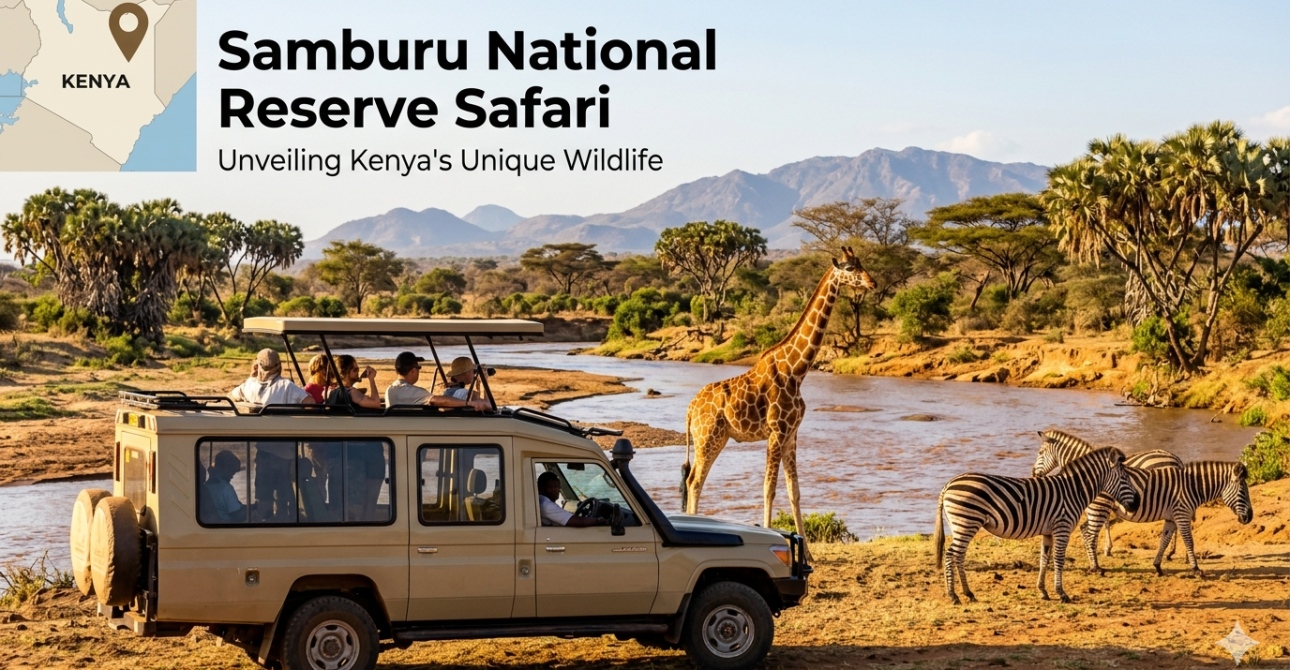
Book your Samburu National Reserve safari — free custom quote today
Charming Safariz designs Samburu safari packages for every budget — from 3‑day fly-in breaks to 10-day northern Kenya circuits. Kenya’s most trusted tour and travel company, based in Nakuru.
- Samburu National Reserve covers 165 sq km in Samburu County, northern Kenya — on the banks of the Ewaso Nyiro River
- Famous for the exclusive “Samburu Special Five”: Grevy’s zebra, Somali ostrich, reticulated giraffe, gerenuk, and Beisa oryx — found nowhere else in Kenya
- 2026 entry fee: $80 per non-resident adult / $40 per non-resident child per 24 hours (Samburu County Government rate)
- Kenya resident adult rate: KES 1,600 per 24 hours; EAC citizen adult: KES 800 per 24 hours
- Distance from Nairobi: approximately 350 km — 5–6 hours by road or 1‑hour charter flight from Wilson Airport
- Also home to 900+ elephants, lions, leopards, cheetahs, and over 450 bird species
- Samburu safari packages: from $250 per person per day (budget) to $900+ per person per day (luxury)
- Three adjacent reserves form one ecosystem: Samburu National Reserve, Buffalo Springs National Reserve, and Shaba National Reserve
Introduction
Most Kenya safari guides point travelers south — the Maasai Mara, Amboseli, Lake Nakuru. These are extraordinary destinations, and they deserve every superlative written about them. But Kenya’s most distinctive and exclusive wildlife experience sits four hours further north, in a semi-arid landscape where different rules apply, different animals live, and a different quality of silence exists.
The Samburu National Reserve safari offers something genuinely unavailable anywhere else in Kenya — five rare wildlife species collectively known as the Samburu Special Five, found only in northern Kenya’s arid zones and not present in any other Kenyan national park or reserve. You will not see a reticulated giraffe in the Maasai Mara. You will not spot a gerenuk at Amboseli. You will not photograph a Grevy’s zebra at Lake Nakuru. These animals live in Samburu, and Samburu alone among Kenya’s parks can offer them.
In 2026, the Samburu National Reserve safari is gaining the international recognition it has long deserved. Fewer crowds than the southern parks, equally impressive predator sightings, extraordinary birdlife, and some of Kenya’s most distinctive luxury lodges along the Ewaso Nyiro River make Samburu a destination that increasingly appears at the top of serious safari travelers’ lists. And Charming Safariz in Nakuru is ready to plan your perfect Samburu experience today.
What is a Samburu National Reserve safari?
A Samburu National Reserve safari is a guided wildlife experience in Samburu National Reserve — a 165 square kilometre protected area in Samburu County, northern Kenya, managed by the Samburu County Government under the framework of the Kenya Wildlife Service. The reserve sits on the southern bank of the Ewaso Nyiro River, which forms the boundary between Samburu and the adjacent Buffalo Springs National Reserve to the south.
The reserve is part of a larger ecosystem that also includes Buffalo Springs National Reserve and Shaba National Reserve — three adjacent protected areas that together create one of Kenya’s richest northern wildlife habitats. Visitors can cross between Samburu and Buffalo Springs during their safari using a bridge crossing, accessing different wildlife zones with a single guide and vehicle.
| Reserve detail | Information |
|---|---|
| Location | Samburu County, northern Kenya — 350 km from Nairobi |
| Size | 165 sq km (Samburu NR); Buffalo Springs 131 sq km; Shaba 239 sq km |
| River | Ewaso Nyiro River — forms southern boundary, key wildlife corridor |
| Main entry gate (Samburu) | Archer’s Gate (all major lodges accessed from here) |
| Reserve hours | 6:00 AM – 6:00 PM daily; night drives NOT permitted inside main reserve |
| Non-resident adult fee (2026) | $80 per 24 hours (Samburu County Government rate) |
| Non-resident child fee (2026) | $40 per 24 hours |
| Kenya resident adult fee | KES 1,600 per 24 hours |
| EAC citizen adult fee | KES 800 per 24 hours |
| Payment method | Cash (USD/KES), Visa, Mastercard, M‑Pesa; eCitizen tickets required 24 hrs in advance |
| Signature wildlife | Samburu Special Five, elephants (900+), lions, leopards, cheetahs, 450+ bird species |
| Distance by road from Nairobi | ~350 km — 5–6 hours via Nanyuki or Isiolo routes |
| Charter flight from Wilson Airport | ~60 minutes to Samburu Airstrip |
| Best time to visit | Year-round — June–October and January–February for best conditions |
Sources: Kenya Wildlife Service (KWS) | Magical Kenya | Samburu County Government reserve fees 2026
Why a Samburu National Reserve safari belongs on your Kenya itinerary
Samburu is not just another Kenyan game reserve. Here is why it is unlike anything else you will experience in the country:
- The Samburu Special Five are found nowhere else in Kenya: The five unique wildlife species that define Samburu — the reticulated giraffe (the world’s largest giraffe subspecies), Grevy’s zebra (larger and more striking than the common zebra), gerenuk (the long-necked antelope that feeds standing on its hind legs), Beisa oryx (with dramatic straight horns), and Somali ostrich (with distinctive blue-grey legs) — are all endemic to Kenya’s northern arid zone. They do not live in any southern Kenyan park. Samburu is the only place in Kenya where you are guaranteed to see all five on a single game drive.
- Outstanding leopard sightings: Samburu is widely regarded as one of the best places in Kenya to spot leopards. The Ewaso Nyiro River’s fig trees and dense riverine vegetation provide ideal leopard habitat, and the reserve’s leopards are well-habituated to vehicles. Game drives along the river consistently deliver leopard sightings that elusive cats simply do not provide in more open, southern parks.
- Fewer visitors than southern parks: Samburu attracts approximately 20,000 visitors per year, according to Kenya Wildlife Service data — a fraction of the Maasai Mara’s visitor numbers. The result is game drives without vehicle queues at every sighting, photographs without competing cars in the background, and a genuine sense of wilderness that crowds have eroded from Kenya’s most popular parks.
- The Ewaso Nyiro River is extraordinary: Unlike the Mara River — which comes alive only during the wildebeest crossings — the Ewaso Nyiro is a permanent, year-round river that acts as a constant magnet for wildlife. Elephants drink at the banks in groups of dozens. Crocodiles sun on the sandbars. Hippos rest in the deeper pools. Leopards cross at dawn. The river is the heart of Samburu, and drives along its banks deliver something different every hour of every day.
- Outstanding birdwatching destination: With over 450 recorded bird species — including the vulturine guineafowl, palm-nut vulture, Somali bee-eater, and a remarkable range of raptors and waterbirds — Samburu is one of Kenya’s premier birdwatching destinations. Species found here are not present in southern Kenya, making Samburu a high-priority destination for serious bird observers, as confirmed by the UNESCO World Heritage Centre’s Kenya Important Bird Area designations.
- Authentic cultural experiences with the Samburu people: The Samburu people — closely related to the Maasai but with distinct traditions, dress, and worldview — live around the reserve and welcome cultural visits. Most lodges arrange community visits where guests meet warriors, women, and elders, see traditional homesteads, and learn about Samburu pastoral life in a genuine, non-commercial way. This cultural dimension adds real depth to the Samburu National Reserve safari experience.
- Kenya’s most distinctive luxury lodges: Samburu’s lodges are among the most celebrated in Kenya. Sasaab Lodge — designed with Moroccan-inspired architecture — has a spectacular infinity pool overlooking the Ewaso Nyiro. Elephant Watch Camp is owned by Cynthia Moss’s daughter and focuses entirely on elephant research. Elephant Bedroom Camp offers private plunge pools in the bush. Saruni Samburu sits in the hills with panoramic valley views. No two lodges are the same, and the quality of the safari experience at the luxury tier is consistently exceptional.
Types of Samburu National Reserve safari packages in 2026
1. Standard Samburu game drive safari (2–3 nights)
The most common Samburu safari package covers 2–3 nights in the reserve with two game drives per day (morning and late afternoon along the Ewaso Nyiro River), full board meals, a professional driver-guide with Samburu-specific wildlife knowledge, and all park fees. Accommodation ranges from budget campsites and KWS bandas, to mid-range lodges like Ashnil Samburu Camp and Samburu Simba Lodge, to luxury riverside tents. A 2‑night standard Samburu safari package starts from $600–$900 per non-resident person in a shared vehicle, rising to $1,000–$2,000 for a private vehicle mid-range package.
2. Fly-in Samburu safari
Charter flights from Wilson Airport, Nairobi to Samburu Airstrip take approximately 60 minutes — eliminating the 5–6 hour road drive entirely. A fly-in Samburu safari package includes all internal flights, airport-to-lodge transfers, accommodation, full board, game drives, and park fees. This format is particularly popular with international visitors on tight timelines and with Kenyan professionals wanting a 3‑day weekend escape. Fly-in packages start from $1,200–$1,800 per person for 2 nights including the return charter, according to IATA regional aviation pricing data.
3. Combined Samburu and Maasai Mara circuit
One of Kenya’s most complete and rewarding safari circuits combines Samburu in the north with the Maasai Mara in the southwest — covering Kenya’s two most celebrated and contrasting wildlife ecosystems. The Samburu Special Five give you species unavailable in the Mara; the Mara gives you the Big Five density, the Migration, and the famous open plains. Travel between the two by charter flight (approximately 1.5–2 hours) makes this an efficient 7–10 day circuit. Package costs: $3,000–$7,000 per non-resident person for 7 days covering both destinations, including all internal charter flights.
4. Samburu and Laikipia northern circuit
Laikipia Plateau — Kenya’s most diverse private conservation area — sits just south of Samburu and pairs beautifully with it. A northern Kenya circuit covering Samburu (3 nights) and Laikipia (2 nights at a property like Ol Pejeta Conservancy or Borana) gives you the unique Samburu species, the Laikipia rhinos and wild dogs, horse-riding and camel safaris not available in national parks, and an entirely different landscape. This circuit is particularly popular for repeat Kenya visitors who want something beyond the classic southern parks.
5. Samburu photography safari
Samburu’s combination of unique species, dramatic riverine landscapes, and excellent morning and evening light makes it one of Kenya’s top destinations for wildlife photography. Dedicated photography safari packages include open-sided vehicles with beanbag camera rests, photographic guides who understand light and animal behavior, extended stays at key riverine sightings, and flexible departure times to catch the best light. Photography packages cost $300–$500 per person per day and are available through specialist operators including Charming Safariz.
6. Samburu cultural and conservation experience
For travelers who want a deeper engagement with northern Kenya beyond pure game drives, cultural and conservation-focused packages combine Samburu game drives with visits to the Namunyak Wildlife Conservancy (home to the Reteti Elephant Sanctuary — Africa’s first community-owned elephant orphanage), Samburu village cultural visits, and camel trekking safaris with community guides. These packages are particularly popular with families, conservation enthusiasts, and travelers who want to contribute meaningfully to the communities around the reserve.
7. Short Samburu break (Nairobi to Samburu 3 days)
A 3‑day Samburu safari package from Nairobi is entirely practical — fly in Thursday evening, spend Friday and Saturday on game drives, fly back Sunday afternoon. Charming Safariz offers 3‑day fly-in Samburu packages specifically designed for Nairobi-based professionals and residents who want a short but exceptional northern Kenya safari experience without using more than two days of annual leave. Package cost for 3 days (2 nights, charter flights, full board, private vehicle): $1,500–$2,500 per person.
Samburu National Reserve safari costs in 2026
Below is a full breakdown of costs for a Samburu National Reserve safari in 2026. All prices are per person unless stated, and exclude international flights.
| Cost item | Non-resident (USD) | Kenya resident (KES) | Notes |
|---|---|---|---|
| Reserve entry — adult (per 24 hrs) | $80 | KES 1,600 | Samburu County Govt rate 2026 |
| Reserve entry — child (per 24 hrs) | $40 | ~KES 800 | Ages 3–18 |
| EAC citizen adult (per 24 hrs) | — | KES 800 | Uganda, Tanzania, Rwanda, Burundi |
| Budget package (2 nights, shared vehicle) | $600 – $900 total | KES 55,000 – 80,000 | Basic lodge, full board, park fees |
| Mid-range private (2–3 nights) | $1,000 – $2,500 total | KES 90,000 – 220,000 | Private 4x4, comfortable lodge, all-inclusive |
| Luxury (Sasaab, Elephant Watch) | $600 – $900 per person/night | N/A (USD only) | All-inclusive, private vehicle, specialist guide |
| Charter flight Wilson–Samburu (one way) | $180 – $350 | N/A | ~60 min, 15 kg soft bag limit |
| Guided walking safari | $50 – $100 extra | ~KES 6,000 – 10,000 | Armed ranger + guide, 2–3 hours |
| Cultural village visit | $20 – $40 extra | ~KES 2,000 – 4,000 | Optional; some packages include |
| Camel trekking safari | $50 – $150 extra | ~KES 5,000 – 15,000 | Via community conservancies |
Sources: Kenya Wildlife Service (KWS) | Samburu County Government reserve fees 2026 | TripAdvisor Samburu lodge reviews 2026
Step-by-step guide: how to plan your Samburu National Reserve safari in 2026
- Decide your primary interests. Are you specifically coming for the Samburu Special Five? Leopards along the river? Birdwatching? Photography? Cultural experiences with the Samburu people? Your answer determines which lodges, which activities, and which guides are right for you. Tell Charming Safariz your priorities upfront — it shapes every element of your package design.
- Choose road or fly-in access. The road from Nairobi to Samburu takes 5–6 hours via Nanyuki or Isiolo — a scenic drive through central Kenya highlands with views of Mount Kenya. A charter from Wilson Airport takes approximately 60 minutes and costs $180–$350 per person one way. For stays of 2–3 nights, the charter is strongly recommended. For stays of 5+ nights, the road is worth experiencing once.
- Choose your accommodation tier. Budget: KWS bandas or public campsites from KES 3,000–8,000 per person per night. Mid-range: Samburu Simba Lodge, Ashnil Samburu Camp from $200–$350 per person per night. Luxury: Samburu Intrepids, Larsens Camp from $400–$600 per person per night. Ultra-luxury: Sasaab, Elephant Watch Camp, Elephant Bedroom Camp from $600–$900 per person per night, all-inclusive.
- Plan for at least 2–3 nights in the reserve. Game drives at Samburu reward patience. Two nights gives you four game drives — morning and afternoon on each day — enough to see most of the Samburu Special Five and have solid predator and elephant encounters. Three nights is the ideal duration for photographers and serious wildlife watchers.
- Contact Charming Safariz for a free custom Samburu quote. Kenya’s most trusted safari and travel company, based in Nakuru, designs every Samburu package from scratch. We know which guides have the deepest Samburu Special Five knowledge, which lodges position you best for river wildlife, and how to structure a combined Samburu circuit with maximum efficiency. Request your free Samburu quote here.
- Confirm your inclusions in writing. Your package should explicitly confirm: reserve entry fees for Samburu (and Buffalo Springs if applicable), vehicle type and group size, guide name and Samburu experience, specific lodge name, full board meals, all transfers (airport and inter-reserve), and any optional activities (camel trekking, village visits, walking safari). Get a signed itinerary before paying any deposit.
- Arrange your Kenya e‑Tourist Visa if required. International visitors apply online for $33 per person through the eCitizen portal. Processing takes 3–5 working days. Malaria prophylaxis is recommended for the Samburu area — consult a travel doctor before departure. Yellow fever vaccination may be required depending on your country of origin.
- Pack for a hot, semi-arid environment. Samburu is hotter and drier than southern Kenyan parks — daytime temperatures regularly reach 35°C in the dry season. Lightweight, breathable clothing in neutral colours. High-SPF sunscreen. Wide-brimmed hat. Plenty of water (lodges provide it, but carry extra for long drives). A telephoto lens of 400mm+ is strongly recommended for photographing the Samburu Special Five at realistic viewing distances.
Samburu National Reserve safari checklist: how to compare packages
| What to check | What a quality package confirms | Red flag to watch for |
|---|---|---|
| Reserve fees | Samburu + Buffalo Springs both confirmed if doing the crossing | “Park fees included” — not specifying which reserves |
| Guide Samburu knowledge | Guide with specific Samburu Special Five tracking experience | “Experienced Kenyan guide” with no Samburu specifics |
| Vehicle type | Private 4x4 with maximum 6 passengers stated | Vehicle type and capacity not stated |
| Lodge river access | Lodge on or directly adjacent to Ewaso Nyiro River bank | Lodge “in Samburu area” — no specific location |
| Charter coordination | Samburu Airstrip pickup confirmed with timing | “Transfers available on arrival” — uncoordinated |
| Meals | Full board confirmed — all three meals daily at the lodge | “Meals available” with no specification |
| Buffalo Springs crossing | Included in the package — separate ticket arranged | Not mentioned — may miss half the ecosystem |
| Operator knowledge | Operator with specific Samburu lodge partnerships and guide relationships | Generic Kenya safari operator with no Samburu focus |
Common mistakes to avoid on a Samburu National Reserve safari
Solution: Samburu and Buffalo Springs are separated only by the Ewaso Nyiro River — a bridge crossing connects them during game drives. Buffalo Springs has different vegetation, different wildlife concentrations, and often different predator activity to Samburu. Most guests who stay 2 nights do at least one game drive loop that includes both reserves. Make sure your package includes a Buffalo Springs entry ticket (same fee structure as Samburu) — it dramatically increases the diversity of your safari experience.
Solution: Grevy’s zebra, reticulated giraffe, and Beisa oryx are generally reliable sightings over a 2‑night stay. Gerenuk (which often feeds deep in thorn bush) and Somali ostrich require specific attention and a guide who knows where to look. With 2–3 nights and a good guide, most visitors see all five. One night gives you less certainty. Brief about your specific wildlife priorities with your guide before the first morning drive.
Solution: The river is Samburu’s most productive wildlife area — elephants, crocodiles, hippos, leopards, and the Special Five all concentrate along its banks. Lodges positioned directly on the river (Larsens Camp, Elephant Watch Camp, Sasaab, Samburu Intrepids) give you river-view game drives from the first morning and often deliver wildlife sightings from the lodge deck itself. Always confirm specifically that your lodge sits on the river, not simply “in the reserve.”
Solution: Samburu is significantly hotter than the Mara, Amboseli, or Lake Nakuru — average daytime temperatures in the dry season reach 35–38°C. Early morning drives (6:00–10:00 AM) and late afternoon drives (4:00–6:30 PM) are the most comfortable. Pack lightweight, breathable fabrics. A high-quality sun hat is not optional. Apply sunscreen before and during morning game drives — the sun over the open scrubland is intense even in the early hours.
Solution: The Samburu people are one of Kenya’s most distinctive and fascinating communities — and unlike Maasai cultural visits at many southern parks, Samburu village visits feel genuinely personal rather than touristy. Most lodges can arrange an evening visit to a community manyatta. It costs an additional $20–$40 per person and adds a cultural dimension to the safari that most visitors say was among their highlights. Book it in advance with your operator.
Solution: Charter flights to Samburu Airstrip operate on the same 15 kg per person soft-bag limit as all Kenya bush aviation. Rigid suitcases cannot be loaded. If you are flying in from Nairobi, pack everything needed for the Samburu portion of your trip in a soft duffel bag of 15 kg or less, and leave your main luggage at your Nairobi hotel. Your operator should brief you on this before departure — if they do not, ask.
2026 trends shaping Samburu National Reserve safaris
- Samburu gaining rapidly as an alternative to the Mara: International traveler awareness of the Samburu National Reserve safari is growing faster than almost any other Kenyan destination in 2026. The combination of exclusive species, fewer crowds, and comparable luxury lodge quality at lower prices than the peak-season Mara is attracting a growing share of first-time international visitors who previously would have defaulted to a Mara-only itinerary. The World Travel and Tourism Council reports strong growth in visitor numbers to Kenya’s northern parks in its 2025 Africa tourism market review.
- Community conservancy expansion: The Namunyak Wildlife Conservancy — home to the Reteti Elephant Sanctuary — has expanded its community tourism infrastructure in 2026, offering additional overnight options and day visit packages that complement the Samburu National Reserve safari experience. Reteti is Africa’s first community-owned elephant orphanage and is increasingly included in Samburu packages as a conservation highlight, as reported by Nation Africa.
- Photography safari demand rising: Samburu’s unique species and dramatic light have made it one of Kenya’s top destinations for wildlife photographers in 2026. The opening of dedicated photography-vehicle-equipped camps and the availability of specialist photographic guides are creating a new tier of Samburu photography safari package that previously did not exist at scale in northern Kenya.
- Luxury camp standards rising: Several Samburu lodges upgraded significantly in 2024–2025 — adding private plunge pools to suites, improving dining facilities, and introducing wellness offerings including bush yoga and spa treatments. The gap between Samburu’s luxury tier and the top Mara conservancy camps has narrowed considerably, making Samburu increasingly competitive at the high-end market.
- Domestic Samburu travel growing: Kenyan residents are visiting Samburu in larger numbers in 2026, attracted by resident-rate pricing (KES 1,600 per adult per day versus $80 for non-residents) and the growing availability of mid-range packages accessible to the expanding Kenyan middle class. As highlighted by Business Daily Africa, northern Kenya safari bookings by domestic travelers grew 41% year-on-year in 2025.
Poll answer: Option B (Samburu and Maasai Mara combined circuit) is the most requested Samburu format through Charming Safariz — it gives travelers the Samburu Special Five plus the Mara’s Big Five density and Migration spectacle in one complete Kenya trip. Option A (3‑day fly-in) is the most popular format for Nairobi-based residents and expats wanting a short but high-quality northern Kenya experience. Contact Charming Safariz for a free fully itemized quote on any of these packages.
Frequently asked questions about Samburu National Reserve safaris
What is the Samburu Special Five?
The Samburu Special Five are five wildlife species endemic to Kenya’s northern arid zone, found exclusively in Samburu and surrounding reserves — not present in any other Kenyan national park. They are: the reticulated giraffe (the world’s largest giraffe subspecies, with a distinct rectangular pattern), Grevy’s zebra (larger and more stripe-dense than common zebra), gerenuk (a long-necked antelope that feeds standing on its hind legs), Beisa oryx (with long straight horns and striking facial markings), and Somali ostrich (distinguished by blue-grey legs in breeding males). Seeing all five on a single Samburu safari is a genuine wildlife achievement that cannot be replicated anywhere else in Kenya.
How much does a Samburu National Reserve safari cost in 2026?
Samburu safari packages cost from $250 per person per day (budget, shared vehicle) to $900+ per person per day (luxury, all-inclusive private lodge). A 2‑night budget package starts around $600 per non-resident person. A 2–3 night mid-range private package costs $1,000–$2,500 per person. A 3‑day fly-in mid-range package including charter flights from Nairobi costs $1,500–$2,500 per person. Luxury lodges like Sasaab and Elephant Watch Camp start from $600 per person per night all-inclusive. Reserve entry fees are $80 per non-resident adult per 24 hours. Contact Charming Safariz for a free itemized quote.
How far is Samburu from Nairobi and how do I get there?
Samburu National Reserve is approximately 350 km from Nairobi. By road, the journey takes 5–6 hours via Nanyuki and Isiolo — a scenic route passing through central Kenya highlands with views of Mount Kenya. By charter flight from Wilson Airport, the journey takes approximately 60 minutes and costs $180–$350 per person one way. The charter option is strongly recommended for short stays of 2–3 nights. A guided road transfer in a private 4x4 is the standard option for budget and mid-range packages.
What is the best time to visit Samburu National Reserve?
Samburu offers excellent wildlife viewing year-round — one of its key advantages over parks with strong seasonal variation. The dry seasons (June–October and January–February) deliver the most reliable game viewing as wildlife concentrates along the Ewaso Nyiro River. The green season (March–May and November) brings lush vegetation and excellent birdwatching but slightly more difficult wildlife spotting. Unlike the Mara, Samburu has no single must-travel month — the reserve consistently delivers regardless of season.
Is Samburu good for families with children?
Yes, with some considerations. Samburu’s game drives are excellent for families — the open vehicle provides good visibility for children, the Samburu Special Five are compelling for all ages, and the elephant encounters along the river are consistently impressive. The main limitation is heat — daytime temperatures of 35°C+ make Samburu significantly warmer than southern parks, and midday periods are not suitable for young children in open vehicles. Schedule game drives for early mornings and late afternoons only, and ensure your lodge has good shade and pool facilities for the midday rest period.
What activities are available at Samburu beyond game drives?
Samburu offers a rich range of activities beyond standard game drives. Guided walking safaris with armed rangers along the riverbanks cost $50–$100 per person for 2–3 hours. Cultural visits to Samburu manyattas (homesteads) are available through most lodges at $20–$40 per person. Camel trekking through the surrounding conservancies costs $50–$150 per person depending on duration. The Namunyak Wildlife Conservancy’s Reteti Elephant Sanctuary — Africa’s first community-owned elephant orphanage — is accessible as a day visit from most Samburu lodges. Sundowner cocktail setups by the river are a standard evening offering at all tiers.
My experience planning Samburu National Reserve safaris
The first time I truly understood what makes a Samburu National Reserve safari different from any other Kenya safari was a morning drive in the dry-season dust, about three hours in, when our guide stopped the vehicle on a flat stretch of scrubland that looked empty to me. He sat quietly for a moment, then said: “Gerenuk. Behind that acacia. Watch.”
I watched. And slowly, what I had taken for a branch began to resolve into a long, sinuous neck and then the improbably elegant body of a gerenuk standing on her hind legs, her front hooves resting on a branch as she browsed leaves from a height no other antelope can reach. I had never seen anything like it. My client — a wildlife photographer from Nairobi on her first northern Kenya trip — did not put her camera down for twenty minutes.
That is Samburu. It consistently delivers moments like that — wildlife encounters that are genuinely new, not just variations of what you have already seen in more famous parks. The gerenuk feeding on its hind legs. The reticulated giraffe walking in its measured, ancient way against the Samburu hills. A leopard in a fig tree along the river at 7:00 AM. A Grevy’s zebra herd, striped so densely they seem almost painted, moving through the dry season haze.
At Charming Safariz, we design Samburu packages around the specific moments you want to take home. We choose guides who know the reserve well enough to sit quietly in the right place and wait for the gerenuk. That knowledge makes all the difference.
Key takeaways
- Samburu National Reserve covers 165 sq km in northern Kenya, on the Ewaso Nyiro River — part of a three-reserve ecosystem with Buffalo Springs and Shaba.
- The Samburu Special Five — reticulated giraffe, Grevy’s zebra, gerenuk, Beisa oryx, and Somali ostrich — are found exclusively in Samburu and northern Kenya, not in any other Kenyan park.
- 2026 reserve entry fees: $80 per non-resident adult / $40 per child per 24 hours. Kenya residents pay KES 1,600. EAC citizens pay KES 800. Cash, card, and M‑Pesa accepted; advance eCitizen tickets required.
- Samburu is approximately 350 km from Nairobi — 5–6 hours by road or 60 minutes by charter from Wilson Airport.
- Safari packages start from $250 per person per day (budget) to $900+ (luxury all-inclusive at riverside lodges).
- Samburu delivers far fewer visitor numbers than southern parks — game drives regularly produce exclusive wildlife sightings without competing vehicles.
- Always cross into Buffalo Springs National Reserve during your stay — a separate ticket is required, and it significantly expands your wildlife-viewing territory.
- Charming Safariz designs fully customized Samburu National Reserve safari packages with specialist guide knowledge, transparent pricing, and all reserve fee documentation handled.
Conclusion
A Samburu National Reserve safari in 2026 is the Kenya wildlife experience that serious safari travelers consistently say they wished they had done sooner. The exclusive Samburu Special Five, the intimacy of the Ewaso Nyiro River wildlife, the extraordinary luxury lodges, and the complete absence of the crowds that increasingly define Kenya’s most popular southern parks — Samburu delivers all of this, year-round, at a price point that makes sense for every budget tier.
Whether you are a Kenyan resident looking for a short fly-in break from Nairobi, an international visitor building a multi-park Kenya circuit, or a wildlife photographer specifically coming for the gerenuk or the reticulated giraffe — the Samburu National Reserve safari should be at the top of your planning list for 2026.
Have questions about Samburu safari packages? Leave a comment below, share this guide with someone planning their Kenya trip, or contact Charming Safariz directly for your free, fully personalized Samburu quote today.
Book your Samburu National Reserve safari with Charming Safariz
Kenya’s most trusted tour and travel company for Samburu safaris, northern Kenya circuits, and wildlife ticketing — based in Nakuru. Every package designed from scratch, transparent pricing, and specialist guide knowledge of the Samburu ecosystem.
Email: enquiry@charmingsafariz.com
Office: Nakuru, Kenya
Request a quote: charmingsafariz.com/request-quote
Sources and references
- Kenya Wildlife Service (KWS) — Samburu National Reserve official page and park management framework
- Magical Kenya — official Kenya tourism portal and Samburu destination guide
- World Travel and Tourism Council (WTTC) — Kenya northern parks visitor growth data and Africa tourism market review 2025
- UNESCO World Heritage Centre — Kenya Important Bird Areas and northern conservation designations
- TripAdvisor — Samburu safari lodge reviews and package ratings 2026
- IATA — Kenya internal charter aviation data and Samburu Airstrip route pricing
- Kenya National Bureau of Statistics (KNBS) — domestic tourism and northern Kenya visitor data
- eCitizen Kenya — park and reserve entry ticket portal and e‑Tourist Visa applications
- Nation Africa — Reteti Elephant Sanctuary and Samburu conservation tourism reports 2025–2026
- Business Daily Africa — domestic northern Kenya safari booking growth statistics 2025
- Statista — Africa value-for-money safari destination rankings and visitor satisfaction scores 2026
- Forbes Travel — Samburu National Reserve destination features and Kenya alternative safari guides