
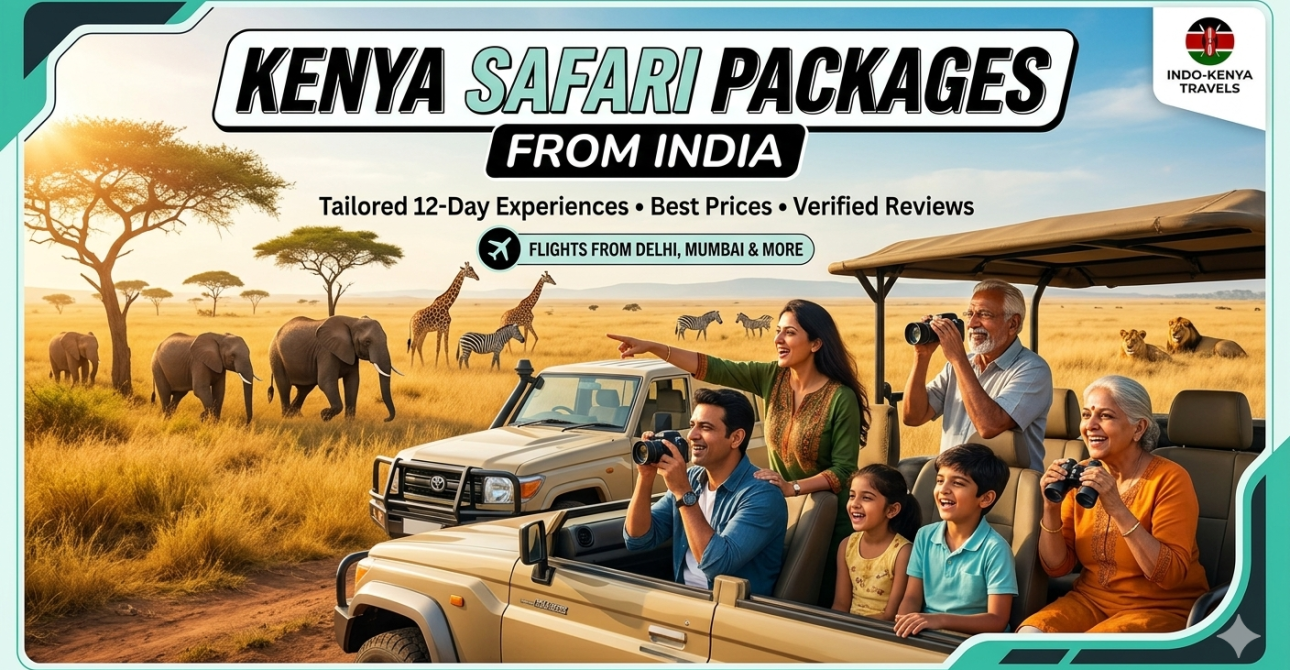
Kenya safari packages from India typically cost between INR 1,80,000 and INR 6,50,000 per person for 7 to 14 days, depending on the package type, accommodation level, and travel season. Most packages include return flights from Mumbai, Delhi, or Bengaluru, airport transfers, game drives, accommodation, park entry fees, and meals. The best time to travel is July to October for the Great Wildebeest Migration, or January to March for dry-season game viewing. Indian passport holders require a Kenyan e‑visa, obtainable via eCitizen Kenya within 24–72 hours. Top safari destinations include Maasai Mara, Amboseli, Samburu, and Tsavo.
Kenya and India share more than just a historical connection — they share a deep love for wildlife, nature, and rich cultural experiences. For decades, Indian travellers have been flying to East Africa to witness what many describe as the most spectacular wildlife show on earth. And the numbers keep growing.
If you have been researching kenya safari packages from India and feeling overwhelmed by the options, pricing, and logistics, you are not alone. Planning a safari from India involves several moving parts — visas, flights, park circuits, accommodation, and budgets. This guide breaks all of it down clearly so you can plan confidently, spend wisely, and arrive in Kenya knowing exactly what to expect.
Whether you are planning a family trip, a honeymoon, or a solo adventure, the information here will help you get the most out of your Kenyan safari in 2026.
What Are Kenya Safari Packages from India?
Kenya safari packages from India are bundled travel packages designed specifically for travellers departing from Indian cities. They combine international flights, ground transfers, game drives in national parks and reserves, accommodation (ranging from tented camps to luxury lodges), meals, and park entry fees into a single, managed itinerary.
Booking a package rather than arranging everything separately saves time, reduces stress, and often works out more cost-effective — especially when dealing with international currency exchanges, cross-border logistics, and park booking systems in Kenya.
| Package Component | What It Covers |
|---|---|
| International Flights | Return economy or business class from Indian cities |
| Airport Transfers | Nairobi pick-up and drop-off |
| Accommodation | Safari lodges, tented camps, or eco-resorts |
| Game Drives | Morning and evening wildlife drives |
| Park Entry Fees | KWS and conservancy fees |
| Meals | Full board at most safari lodges |
| Safari Guide | Licensed, English-speaking Kenyan guide |
| Beach Extension (optional) | Diani Beach, Watamu, or Malindi coast |
According to the Magical Kenya tourism board, India ranks among Kenya’s fastest-growing source markets for international tourism, driven by a rising middle class, growing disposable incomes, and increased direct flight connectivity.
Why Indian Travellers Are Choosing Kenya Safaris
Kenya is no longer just a destination for European travellers. Indian tourists are increasingly making it their top wildlife holiday choice, and there are good reasons for that.
- Multiple direct and one-stop flight options from Mumbai, Delhi, Bengaluru, Hyderabad, and Chennai to Nairobi
- Kenya’s Indian Ocean coastline — Mombasa, Diani, and Watamu — has strong cultural and culinary connections to the Indian subcontinent
- The Great Wildebeest Migration is a wildlife spectacle with no equivalent anywhere in Asia
- Kenya offers Indian vegetarian and Jain meal options at most established safari lodges when requested in advance
- Nairobi has a large Indian-origin community, making Indian travellers feel immediately comfortable
- Kenya is consistently rated among the world’s top safari destinations by TripAdvisor
- The World Travel and Tourism Council ranks Kenya among Africa’s top five tourism economies, with growing infrastructure investment making the experience smoother year on year
- Value for money is strong — the Kenyan shilling offers favourable exchange rates for Indian rupee spenders
The Kenya National Bureau of Statistics reports that Asian travellers — with India leading the segment — have become one of the fastest-growing visitor groups to Kenya’s national parks over the last three years.
Types of Kenya Safari Packages from India
Budget safari packages
Ideal for solo travellers, backpackers, and young couples looking to experience Kenya on a tighter budget. These packages typically cost between INR 1,80,000 and INR 2,80,000 per person including flights. They use comfortable but simple tented camps, shared game drive vehicles, and usually cover one or two parks such as Maasai Mara and Naivasha.
Mid-range safari packages
The most popular category for Indian families and couples. Priced between INR 2,80,000 and INR 4,50,000 per person, these packages offer well-rated permanent lodges, private or semi-private game drives, and higher-quality meals. Many mid-range lodges can accommodate vegetarian dietary requirements on request.
Luxury safari packages
For travellers who want the finest experience Kenya has to offer. These packages start at INR 4,50,000 per person and can go well above INR 8,00,000. They include exclusive private camps, butler service, private game vehicles, bush dinners, and spa facilities. Several UNESCO World Heritage affiliated luxury camps operate in the Maasai Mara ecosystem.
Beach and safari combo packages
A firm favourite with Indian honeymooners and families. These combine 4–6 nights on safari with 4–5 nights at Kenya’s Indian Ocean coast — most popular choices being Diani Beach and Watamu. Priced between INR 3,20,000 and INR 5,50,000 per person all-inclusive.
Family safari packages
Carefully structured for Indian families travelling with children. Includes child-friendly accommodation, guided bush walks, Maasai cultural visits, and flexible meal arrangements including Indian cuisine options at selected properties. Typically priced per family (four people) between INR 8,00,000 and INR 14,00,000.
Honeymoon safari packages
Kenya has become a top honeymoon destination for Indian couples. Honeymoon packages include private tented suites, romantic sundowner dinners, hot air balloon safaris over the Maasai Mara, and champagne breakfasts in the bush. Prices range from INR 5,00,000 to INR 10,00,000 per couple.
Group and wedding anniversary safari packages
A growing trend among Indian travellers is group safaris — extended family groups, friend circles, or milestone celebration trips. These are fully customised and priced based on group size, starting from INR 1,50,000 per person for larger groups.
How to Choose the Right Kenya Safari Package from India
With so many options available, a clear checklist helps you avoid confusion and book the right experience the first time.
- Set a total budget per person — include flights, insurance, visa fees, tips, and personal spending
- Decide on travel dates and cross-check against Kenya’s wildlife calendar
- Choose your safari circuit: Maasai Mara only, multi-park, or beach and safari combo
- Confirm dietary requirements — vegetarian, Jain, or halal — and check whether lodges can accommodate them
- Decide on accommodation level: budget, mid-range, or luxury
- Confirm exactly what the package includes: flights, park fees, all meals, and transfers
- Verify the operator is Kenya Tourism Board registered or affiliated with a recognised travel body
- Read recent reviews specifically from Indian travellers on TripAdvisor
- Ask for a detailed written itinerary before paying any deposit
- Purchase comprehensive travel insurance including emergency medical evacuation
Charming Safariz, Kenya’s leading safari and tour company based in Nakuru, has extensive experience working with Indian travellers. The team understands dietary needs, cultural preferences, and the specific questions Indian families ask before booking. Every itinerary is built around your specific needs — not a generic template.
Kenya Safari Package Costs from India: 2026 Price Guide
| Package Type | Duration | Estimated Cost (Per Person) | Flights Included |
|---|---|---|---|
| Budget safari | 7 nights | INR 1,80,000 – 2,80,000 | Yes |
| Mid-range safari | 10 nights | INR 2,80,000 – 4,50,000 | Yes |
| Luxury safari | 7 nights | INR 4,50,000 – 8,00,000+ | Yes |
| Beach and safari combo | 10–12 nights | INR 3,20,000 – 5,50,000 | Yes |
| Family safari (4 people) | 10 nights | INR 8,00,000 – 14,00,000 | Yes |
| Honeymoon package | 10 nights | INR 5,00,000 – 10,00,000 | Yes |
| Group safari (8+ people) | 7–10 nights | INR 1,50,000+ per person | Yes |
Additional costs to factor in:
- Kenyan e‑visa: USD 30 (approximately INR 2,500)
- Travel insurance: INR 3,000–8,000 per person depending on cover
- Safari guide and camp staff tips: USD 10–20 per person per day
- Hot air balloon safari (optional add-on): approximately USD 450–500 per person
- Personal shopping and souvenirs
According to Statista, outbound travel spending from India increased by over 22% between 2022 and 2024, with Africa emerging as one of the fastest-growing destination regions for Indian tourists seeking nature and wildlife experiences.
Step-by-Step Guide: How to Book Kenya Safari Packages from India
- Confirm your Indian passport has at least six months validity beyond your intended travel date and at least two blank pages for visa stamps.
- Apply for your Kenyan e‑visa through eCitizen Kenya at least two to three weeks before travel. The fee is USD 30 and approval typically comes in 24–72 hours. Indian passport holders qualify for the standard e‑visa.
- Decide on your preferred travel dates. For the Great Migration, book for July to October. For fewer crowds and lower prices, January to March or June are excellent alternatives.
- Choose your safari circuit. First-time visitors from India should prioritise the Maasai Mara. Experienced safari-goers often add Amboseli (with views of Kilimanjaro), Samburu (home to rare northern species), or Tsavo (Kenya’s largest national park).
- Contact Charming Safariz or another reputable Kenyan operator for a personalised quote. Always ask for a full breakdown of inclusions — do not assume park fees, airport transfers, or all meals are covered.
- Book international flights. Airlines flying India to Nairobi include Kenya Airways (via codeshare), Ethiopian Airlines (via Addis Ababa), Emirates (via Dubai), Air India, and IndiGo on select routes. IATA recommends booking at least three months in advance for peak season (July–October) to secure the best fares.
- Confirm dietary requirements with your safari operator at least four weeks before arrival. Most established lodges accommodate Indian vegetarian and Jain requests with advance notice.
- Pay your booking deposit and receive a written itinerary and confirmation from your operator.
- Purchase comprehensive travel insurance that includes emergency medical evacuation cover — this is essential, not optional.
- Pack smart: neutral-coloured lightweight clothing, a wide-brimmed hat, sunscreen (SPF 50+), insect repellent, binoculars, and a good camera with extra memory cards.
Common Mistakes Indian Travellers Make When Booking Kenya Safaris
Not booking early enough for peak season. July to October is the Migration season and lodges in the Maasai Mara sell out 6–9 months in advance. Book early or risk missing the best camps. Solution: contact your operator by January for a July–October trip.
Assuming vegetarian food is automatically available. Not all safari lodges have Indian vegetarian menus as a default. Solution: always confirm your dietary requirements in writing at the time of booking, not on arrival.
Ignoring park fee exclusions. Some package quotes do not include KWS park entry fees, which can add USD 100–200 per person per day. Solution: always ask for a fully itemised cost breakdown before paying.
Overlooking the beach extension. Many Indian travellers focus entirely on the safari and miss Kenya’s stunning Indian Ocean coast. Diani Beach and Watamu offer warm water, white sand, and excellent seafood — a natural complement to the bush experience. Solution: add at least three to four nights on the coast to your itinerary.
Packing inappropriate clothing. Bright colours like red and blue attract insects and disturb wildlife. Mornings in the Mara can be surprisingly cold (12–15°C). Solution: pack neutral-coloured, layered clothing. A light fleece is essential for early morning game drives.
Not getting travel insurance. Medical evacuation from a Kenyan national park can cost USD 15,000–25,000 without insurance. Solution: purchase a comprehensive policy that includes emergency air evacuation before you travel.
Booking without reading India-specific reviews. Experiences vary between traveller nationalities — dietary, cultural, and logistical expectations differ. Solution: search specifically for reviews from Indian travellers on TripAdvisor before booking a lodge or operator.
2026 Trends Shaping Kenya Safari Tourism from India
India is now one of Kenya’s top five international source markets, and this shift is reshaping how safari packages are designed and delivered.
More Kenyan safari operators are now offering packages with Indian meal options, Hindi-speaking local guides in some areas, and itineraries designed around Indian travel patterns — particularly longer stays of 10 to 14 days, which suit the Indian work and school holiday schedule.
Direct flight connectivity is improving. As of 2026, airlines including Air India and IndiGo have expanded their East Africa route networks, making it easier to reach Nairobi from multiple Indian cities without long layovers.
Sustainable safari tourism is growing among Indian travellers too. Conservation-linked lodges, community tourism experiences, and carbon-offset packages are increasingly requested by eco-conscious Indian visitors.
The Business Daily Africa has reported on Kenya’s government push to attract more Asian tourists through dedicated marketing campaigns, simplified visa processes, and improved infrastructure in key wildlife corridors.
Quick poll: Which Kenya safari experience is most appealing to you as an Indian traveller?
a) Great Wildebeest Migration in the Maasai Mara
b) Big Five game viewing across multiple parks
c) Beach and safari combo at Diani Beach
d) Luxury bush camp experience
Poll answer: Based on booking data and travel surveys, most Indian travellers rank the Great Wildebeest Migration (a) as their primary motivation for visiting Kenya, followed closely by the beach and safari combo ©, especially among honeymooners and families.
Frequently Asked Questions
Do Indian passport holders need a visa to visit Kenya?
Yes. Indian nationals require a Kenyan e‑visa, which is applied for online through eCitizen Kenya. The fee is USD 30 (approximately INR 2,500) and processing typically takes 24–72 hours. Apply at least two weeks before your departure date.
What is the best time of year for Indian travellers to visit Kenya on safari?
July to October is the peak safari season, coinciding with the Great Wildebeest Migration and Kenya’s dry season. January to March is also excellent — warm, dry, and less crowded than peak season. The long rains fall in April and May; prices drop but park roads can be muddy.
How long is the flight from India to Kenya?
Flights from Mumbai to Nairobi take approximately 5–6 hours non-stop on certain routes, or 8–11 hours with a stopover via Dubai, Addis Ababa, or Doha. From Delhi or Bengaluru, total travel time with a stopover is typically 9–12 hours depending on the layover.
Are vegetarian and Indian food options available on Kenya safaris?
Yes, at most established mid-range and luxury safari lodges, vegetarian and Jain meal options are available when requested in advance. Nairobi also has several Indian restaurants. Always confirm dietary requirements with your operator at booking — do not leave it until arrival.
Is Kenya safe for Indian tourists?
Kenya is a well-established safari destination with strong tourism infrastructure and a history of welcoming Indian visitors. Major wildlife areas and tourist zones are considered safe for travellers. Nairobi’s Indian-origin community is well-established and the city is familiar to many Indians. Always follow your guide’s safety instructions in game parks and stay updated on the Indian government’s travel advisory for Kenya.
What vaccinations are required before travelling to Kenya from India?
Yellow fever vaccination is required for travellers arriving from yellow fever endemic countries, and India is on that list. You must carry your yellow fever vaccination certificate when entering Kenya. Typhoid, hepatitis A, and tetanus vaccinations are also recommended. Malaria prevention is essential for most safari regions — consult your doctor about antimalarial medication before travel.
My Experience Working with Indian Safari Clients
I have had the pleasure of planning Kenya safaris for Indian travellers from Mumbai, Delhi, Bengaluru, Hyderabad, and Ahmedabad — families celebrating milestone birthdays, couples on honeymoon, and extended family groups that travel together during Diwali or summer school holidays.
One memory that stands out is a family of eight from Pune who wanted a full Kenya experience but were anxious about vegetarian food in the bush. We worked closely with two lodges in the Maasai Mara and Amboseli to pre-arrange full Indian vegetarian menus for their entire stay. By the end of the trip, the family told us it was the best holiday they had ever taken — and that the food in the bush was better than they had expected.
These small but important details make a genuine difference. Charming Safariz is Kenya’s most trusted safari and ticketing company, operating from Nakuru with deep experience serving Indian travellers and their specific needs. We do not use generic itineraries. Every trip is built from scratch around your family, your budget, and your travel style.
Key Takeaways
- Kenya safari packages from India typically cost INR 1,80,000 to INR 8,00,000+ per person depending on package type and season
- Best travel months: July to October (Great Migration) and January to March (dry season)
- Indian passport holders require an e‑visa via eCitizen Kenya — apply at least two weeks before departure
- Yellow fever vaccination certificate is mandatory for Indian travellers entering Kenya
- Always confirm vegetarian or Jain dietary requirements in writing at the time of booking
- Always ask for a fully itemised quote — park fees are not always included in the headline price
- Book at least six months in advance for peak season (July–October) to secure the best lodges
- A beach and safari combo — Maasai Mara plus Diani Beach — is the most popular Kenya package among Indian travellers
- Charming Safariz offers personalised, honest, and fully tailored kenya safari packages from India
- Comprehensive travel insurance including emergency medical evacuation is essential — not optional
Conclusion
Kenya is one of the few places in the world that genuinely exceeds expectations. The wildlife is extraordinary. The landscapes are unlike anything you will see in Asia. The people are warm and welcoming. And for Indian travellers specifically, Kenya has an added layer of familiarity — the coastal culture, the Indian-origin communities in Nairobi and Mombasa, and the growing number of operators who understand exactly what Indian families need on safari.
Planning your kenya safari package from India does not have to be stressful or uncertain. With the right information, the right operator, and the right itinerary, it becomes one of the most rewarding experiences you will ever plan for yourself or your family.
Have questions about your Kenya safari plans? Drop them in the comments below. And if you are ready to take the next step, get in touch with Charming Safariz today — we would love to build your perfect Kenya safari.
Plan Your Kenya Safari from India with Charming Safariz
Charming Safariz is Kenya’s leading safari and tour company, trusted by Indian travellers and visitors from across the world for transparent pricing, experienced local guides, and carefully crafted itineraries. From your arrival at Nairobi’s Jomo Kenyatta International Airport to your last sunrise game drive, every detail is handled with care. Contact our Nakuru office today for a free, no-obligation quote and a fully customised itinerary.
WhatsApp: +254 714 236 664
Email: enquiry@charmingsafariz.com
Office: Nakuru, Kenya