
Quick View
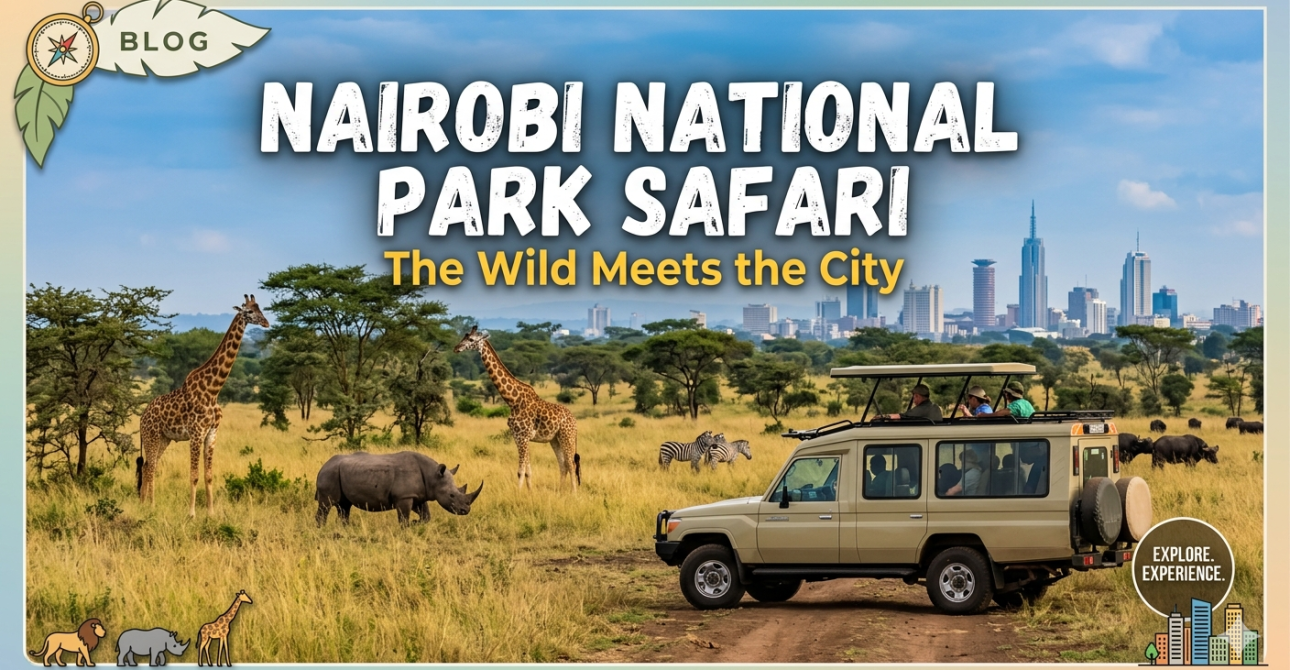
What is Nairobi National Park? Kenya’s oldest national park — established 1946 — and the only wildlife park in the world located within a capital city. Situated just 8 km from Nairobi’s CBD, it covers 117 km² of open grassland, acacia woodland, and riverine forest bordering the city skyline.
What wildlife can I see? Four of the Big Five: lion, leopard, buffalo, and black rhino (one of Kenya’s largest populations). Also cheetah, hippo, giraffe, zebra, wildebeest, hyena, and over 400 bird species. Elephant is the only Big Five member absent.
What are the 2026 entry fees? Non-residents: USD 80 (low season) / USD 100 (high season) per adult. Kenyan citizens: KES 430 per adult. EAC citizens: KES 1,000 per adult. Residents: KES 675. Children under 5: free. All payments are cashless — M‑Pesa, Visa/Mastercard, or eCitizen only.
Opening hours: Daily 6:00 AM to 6:00 PM, year-round.
Distance from Nairobi CBD: Approximately 8 km — 15 to 30 minutes by road. The main entrance (Banda Gate) is on Langata Road.
Best time to visit: July to October and January to March for the best wildlife concentration. The park is productive year-round, making it ideal for pre-flight or post-arrival game drives.
Name another city in the world where you can watch a lion stalk prey with skyscrapers visible in the background. You cannot. That is what makes Nairobi National Park such a genuinely remarkable place — and why a Nairobi National Park safari remains one of the most talked-about wildlife experiences in East Africa, year after year.
Eight kilometres from Nairobi’s city centre, behind a perimeter fence on three sides and an open boundary to the south, lies a 117 km² park that has been home to wildlife since 1946. It was Kenya’s first national park. Today it holds the country’s largest black rhino population accessible to tourists, resident lion prides, leopards, cheetahs, hippos, giraffe, and over 400 bird species — all visible during a morning game drive before a business meeting or airport check-in.
Whether you are a Nairobi resident who has never made the short drive to the gate, a first-time visitor to Kenya with limited time, or an international tourist adding a half-day wildlife experience to your city itinerary, this guide gives you everything you need for 2026. Real fees, honest activity breakdowns, and step-by-step advice for a genuinely memorable visit.
What Is a Nairobi National Park Safari?
A Nairobi National Park safari is a wildlife game drive conducted within Nairobi National Park — a Kenya Wildlife Service-managed reserve located 8 km south of Nairobi’s central business district. The park covers 117 km² of open grass plains, scattered acacia woodland, riverine forest, gorges, and seasonal dams. Its southern boundary is unfenced, allowing wildlife to migrate freely between the park and the wider Kitengela plains.
The park was gazetted in 1946, making it Kenya’s oldest national park. It is one of the world’s most distinctive urban wildlife reserves — wild animals roaming open savannah with Nairobi’s skyline visible across the northern fence. The contrast of city infrastructure and raw bush, visible in a single photograph, has made the park internationally famous.
A Nairobi National Park safari can be completed in as little as 3 hours during a half-day morning game drive, or extended into a full day using the park’s network of numbered game-viewing circuits and picnic sites. The park is open 365 days a year, from 6:00 AM to 6:00 PM.
According to Kenya Wildlife Service, Nairobi National Park is one of the most visited parks in Kenya’s national system and holds critical breeding populations of black rhino and other wildlife that contribute directly to national conservation targets.
Nairobi National Park Safari: Key Facts at a Glance
| Detail | Information |
|---|---|
| Location | 8 km south of Nairobi CBD, Langata, Nairobi County |
| Park size | 117 km² (45 sq miles) |
| Established | 1946 — Kenya’s oldest national park |
| Wildlife highlights | Black rhino, lion, leopard, cheetah, buffalo, hippo, giraffe, zebra, 400+ bird species |
| Big Five present | 4 of 5 — lion, leopard, buffalo, black rhino (no elephant) |
| Opening hours | Daily 6:00 AM – 6:00 PM, 365 days |
| Main gate | Banda Gate, Langata Road |
| Best time to visit | Year-round. Peak: July–October and January–March |
| Minimum visit time | 3 hours (half-day game drive) |
| Payment method | Cashless only — M‑Pesa, Visa/Mastercard, or eCitizen pre-payment |
Why Every Kenyan Should Do a Nairobi National Park Safari
Kenya has extraordinary wildlife destinations — Maasai Mara, Amboseli, Tsavo, Samburu. But most of them require significant travel time, money, and planning. Nairobi National Park is different. Here is why it belongs on every Nairobian’s list:
- Kenya’s only urban national park. There is no other place on earth quite like this — open savannah, free-roaming wildlife, and a capital city skyline in the same frame. It is a globally unique experience.
- Over 70 black rhinos. The park holds one of the highest concentrations of black rhino accessible to tourists in Kenya. Rhino sightings are consistent, particularly in the early morning.
- No long drive required. From Karen, Langata, or South C, the gate is 10–20 minutes away. No overnight packing, no long-distance travel, no complicated logistics.
- Ideal for visitors with limited time. Transit passengers with a 6–8 hour JKIA layover can complete a morning game drive and be back at the airport by 10:30 AM. No other safari destination in Kenya offers this.
- Consistent year-round wildlife. Unlike seasonal parks where timing is critical, Nairobi National Park offers reliable predator sightings throughout the year.
- Affordable for Kenyan citizens. At KES 430 per adult, it is one of the most affordable wildlife experiences in the country for Kenyan citizens and residents.
- Outstanding birdwatching. Over 400 species recorded — pelicans, secretary birds, ostriches, fish eagles, kingfishers, and dozens of forest species in the Mbagathi riverine belt.
- Excellent for school groups. Subsidised student rates and organised KWS educational programmes make the park one of the best environmental education resources for Nairobi schools.
Magical Kenya consistently recommends Nairobi National Park as a top first-stop experience for visitors arriving in the country — an accessible, high-quality introduction to Kenya’s extraordinary wildlife.
Types of Nairobi National Park Safari Experiences in 2026
Half-Day Morning Game Drive
The most popular format — and the best one for most visitors. Gates open at 6:00 AM and the early morning hours are when lions, cheetahs, and leopards are most active. A half-day morning game drive typically runs from 6:00 AM to 11:00 AM. This is ideal for JKIA transit visitors, Nairobi residents on a weekend, and anyone wanting a quality wildlife experience without committing a full day. Charming Safariz organises half-day Nairobi National Park game drives with vehicle, guide, and hotel/airport transfers included — contact us for 2026 pricing.
Full-Day Game Drive
A full-day safari covers habitats that half-day visitors miss — the deep riverine forest along the Mbagathi River, the open southern boundary plains, and the seasonal dams where wildlife gathers at midday. Full-day visitors should pack a lunch and use one of the park’s picnic sites (Kingfisher, Hippo Pools, or Hyena Dam). Your entry ticket is single-use — exiting midday to buy food requires purchasing a second entry ticket at full price.
Nairobi Safari Walk
A separate KWS-managed fenced attraction at the Banda Gate area — a 2 km elevated boardwalk through several habitat zones where lions, leopards, cheetahs, white rhinos, colobus monkeys, and other animals are kept in spacious naturalistic enclosures. Entry is USD 25 for non-residents, KES 300 for Kenyan citizens (revised October 2025). Open 8:00 AM to 5:00 PM. All payments via the KWSPay system on eCitizen. The Safari Walk is the best option for families with young children and school groups who want guaranteed close-up wildlife encounters.
Nairobi Animal Orphanage
Located adjacent to the Safari Walk, the Animal Orphanage rehabilitates injured and orphaned wildlife. Visiting gives you insight into KWS conservation work and a close look at recovering animals. The combined Nairobi Package — covering Nairobi National Park, the Safari Walk, and the Animal Orphanage — costs USD 105 for non-resident adults (KES 1,750 for residents) and is excellent value for visitors wanting all three in one day.
Guided Walking Safari (Park Interior)
KWS offers guided walking safaris in the park’s riverine forest and bush areas for adult visitors wanting a foot-level wildlife experience. Conducted with armed KWS rangers, advance booking through the KWS Nairobi office or eCitizen is required. Walking safaris offer a fundamentally different experience from a vehicle drive — reading animal signs, moving quietly through the bush, and perceiving the landscape at ground level.
How to Plan Your Nairobi National Park Safari Correctly
A Nairobi National Park visit is simple to arrange, but a few details make a real difference to your experience. Use this checklist:
- Decide between self-drive, a full safari operator package, or a KWS ranger-guided option
- Pre-pay your entry fees via eCitizen Kenya the evening before your visit — no cash is accepted at the gate
- Book a 4x4 safari vehicle if you do not have one — standard saloon cars struggle on some park tracks, especially after rain
- Plan to arrive at Banda Gate by 6:00–6:30 AM for the best predator activity and photography light
- Pack a lunch if doing a full-day visit — exiting midday requires purchasing a second entry ticket
- Carry binoculars — the open plains make spotting lions and rhinos easier from a distance
- Carry sufficient water for a full game drive in Nairobi’s climate
- Review KWS park rules: remain in your vehicle at all times except at designated picnic and walking safari areas
- If doing the Safari Walk, book the Nairobi Package on eCitizen for combined entry value
- For school groups, contact KWS at least two weeks ahead to arrange student rates and educational group entry
Nairobi National Park Entry Fees and Costs in 2026
The 2026 fee structure reflects KWS revised tariffs effective from October 2025. All fees are per person per day, valid for 24 hours of uninterrupted stay. No cash is accepted — payment is via M‑Pesa, Visa/Mastercard, or eCitizen pre-payment only.
2026 Entry Fees Per Person Per Day
| Visitor Category | Adult Fee | Child / Student Fee |
|---|---|---|
| Non-Resident — Low Season | USD 80 | USD 40 |
| Non-Resident — High Season | USD 100 | USD 35 |
| African Citizen (non-EAC) | USD 25–40 | USD 10–20 |
| Kenyan Citizen | KES 430 | KES 215 |
| EAC Citizen (Kenya, Tanzania, Uganda, Rwanda, Burundi, South Sudan) | KES 1,000 | KES 500 |
| Kenya Resident (valid work permit) | KES 675 | KES 340 approx. |
| Children under 5 years | Free of charge | |
Fees are per person per day (24-hour validity, single-entry). Student rates require prior KWS approval — apply at least two weeks before your visit. Always verify the latest rates with Kenya Wildlife Service.
Nairobi Package (Combined: Park + Safari Walk + Animal Orphanage)
| Visitor Category | Adult | Child / Student |
|---|---|---|
| Non-Resident | USD 105 | USD 55 |
| African Citizen | USD 55 | USD 20 |
| Kenya Resident | KES 1,750 | KES 950 |
| EAC Citizen | KES 1,300 | KES 700 |
Safari Walk Entry (Separate Ticket)
| Category | Fee |
|---|---|
| Non-Resident Adult | USD 25 |
| Kenyan Citizen Adult | KES 300 |
| EAC Citizen Adult | KES 300 |
| Kenya Resident Adult | KES 405 |
| Children under 5 | Free |
Additional Costs to Budget For
| Item | Estimated Cost |
|---|---|
| Safari van hire with driver-guide (half day, from operator) | USD 80–160 per vehicle |
| Private vehicle entry fee (under 6 seats) | KES 300 per day |
| Transport from CBD to Banda Gate (Uber/Bolt) | KES 700–1,500 depending on traffic |
| Picnic lunch (self-catered) | Your own cost — no restaurant inside the main park |
Step-by-Step Guide: How to Book a Nairobi National Park Safari in 2026
- Decide your format. Half-day morning game drive (ideal for transit visitors and quick Nairobi residents), full-day drive, or the Nairobi Package including the Safari Walk and Orphanage. If you want a vehicle and guide provided, contact Charming Safariz for a quote.
- Create or log into your eCitizen account. Go to eCitizen Kenya. Registration takes under 5 minutes with your ID or passport number. Use the same account you use for government services.
- Select National Park Entry and choose Nairobi National Park. Enter your visit date, visitor category, and the number of adults and children in your group. Select your ticket type — standard entry or Nairobi Package.
- Pay digitally. Pay via M‑Pesa, Visa/Mastercard, or eCitizen Wallet. Download your digital receipt and save it to your phone. This is your gate pass.
- Book a safari vehicle if needed. If you do not have a 4x4, book a safari van with driver-guide through Charming Safariz. Vehicle hire for a half-day game drive runs approximately USD 80–160 inclusive of the driver.
- Plan your park circuit. The park has numbered tracks. The southern plains near the open boundary are best for predators at dawn. The Hyena Dam, Hippo Pools, and Kingfisher circuits are excellent for mid-morning. The Mbagathi riverine forest is ideal for birds and leopards.
- Arrive at Banda Gate by 6:00 AM. Present your digital receipt and ID or passport at the gate. Morning is the single most important factor for quality sightings — lions and cheetahs are most active at first light.
- Follow all KWS park rules. Remain in your vehicle at all times except at designated picnic and walking safari areas. Maintain a safe distance from all animals. No animal sounds, clapping, or banging on vehicles. No littering.
Common Mistakes to Avoid on a Nairobi National Park Safari
Arriving after 9 AM and missing predator activity
Lions and cheetahs are most active at dawn. Mid-morning arrivals still see wildlife, but the difference between a 6:30 AM start and a 9:00 AM start for predator sightings is consistently significant.
Arrive at Banda Gate no later than 6:30 AM. Pre-pay fees on eCitizen the evening before to avoid gate processing delays in the morning.
Trying to pay cash at the gate
Nairobi National Park is fully cashless. Visitors expecting to pay KES at the window find they cannot enter — causing delays and frustration, especially on busy weekends.
Pre-pay via eCitizen using M‑Pesa or Visa/Mastercard the day before. If you have trouble with eCitizen, a KWS ranger at the gate can assist with card payment on-site.
Exiting the park midday for lunch and expecting free re-entry
Your entry ticket is single-use. Exiting the park — even briefly for food — requires purchasing a new full-price ticket to re-enter. This surprises many visitors and effectively doubles their cost.
Pack a lunch and use one of the park’s designated picnic sites: Kingfisher, Hippo Pools, or Hyena Dam. Stay inside the park to maximise your time and your ticket value.
Using a standard saloon car on rough park tracks
Some park tracks — particularly after rain — are difficult for low-clearance vehicles. Saloon cars can get stuck or fail to access the most productive areas of the park.
Use a 4x4 vehicle, or book a purpose-built safari van with driver through Charming Safariz. Hire vehicles navigate all park tracks comfortably in any season.
Treating Nairobi as “just a transit stop” and skipping the park
International visitors with a morning in Nairobi before a flight frequently skip the park entirely. A 3‑hour half-day game drive with a 6:00 AM entry puts you back at JKIA by 10:30 AM — easily fitting an afternoon flight while delivering a genuinely memorable wildlife experience.
Contact Charming Safariz for an airport-transfer-combined-with-safari package. We collect you from your hotel, conduct a 3‑hour morning game drive, and deliver you to JKIA in time for your afternoon flight — seamlessly and at a fixed price.
Skipping the Safari Walk for families with young children
Families with small children sometimes find a full vehicle game drive difficult if wildlife is not immediately visible. Young children lose interest during long open-plain drives without close sightings.
Book the Nairobi Package to combine the game drive with the Safari Walk. The walk’s fenced 2 km boardwalk guarantees close-up encounters with big cats, white rhinos, and colobus monkeys — perfectly paced for children of all ages.
2026 Trends and Updates for Nairobi National Park Safaris
Major fee increase for non-residents. Non-resident adult fees rose from USD 43 (2025) to USD 80–100 in 2026 — an increase of approximately 86–133%. While significant, the park remains substantially cheaper than Maasai Mara (USD 200 per adult) or Amboseli (USD 90). Kenyan citizen rates held relatively steady at KES 430 per adult.
Full cashless payment now strictly enforced. The KWS cashless system — integrating eCitizen, M‑Pesa, and Visa/Mastercard — is fully operational and mandatory at all gates. No exceptions. Pre-booking via eCitizen is now the most efficient and reliable approach for all visitors.
Urban expansion pressure on wildlife corridors. The park’s unfenced southern boundary remains under pressure from Kitengela residential development. Wildlife corridors enabling seasonal animal movement between the park and the Athi-Kapiti ecosystem are subject to active conservation advocacy. UNESCO World Heritage Centre and conservation bodies closely monitor ecological connectivity around the park.
Growing domestic tourism and school visits. According to Kenya National Bureau of Statistics, domestic park visits — including organised school educational trips to Nairobi National Park and the Safari Walk — have grown consistently. KWS has actively expanded educational programming for Nairobi-area schools.
Safari circuit integration as a starting point. Charming Safariz and other Kenya operators increasingly position Nairobi National Park as the opening leg of multi-day safari circuits — a morning game drive in the park, then driving directly to Lake Nakuru, Amboseli, or the Maasai Mara the same day. This makes Nairobi a productive safari starting point, not just a transit city.
a) Black rhino in the open grassland — one of Kenya’s most endangered and iconic animals
b) A lion pride with Nairobi’s skyline visible behind them
c) A cheetah hunting on the open park plains
d) The extraordinary diversity of over 400 bird species
Leave your answer in the comments below.
Poll answers: All four are compelling reasons to visit. For conservation significance, a) the black rhino is the standout — with 70+ individuals, Nairobi National Park offers some of Kenya’s most reliable rhino viewing. For the most iconic and surreal safari photograph, b) a lion with Nairobi’s skyline is genuinely unforgettable. For predator drama and raw speed, c) watching a cheetah hunt on open plains rivals anything in the Mara. And for dedicated birdwatchers, d) 400+ species within 8 km of a capital city is simply extraordinary.
Frequently Asked Questions About Nairobi National Park Safaris
My Experience at Nairobi National Park
I have organised Nairobi National Park safaris through Charming Safariz for years, and the park still manages to surprise me. I have sat in a vehicle while a male lion crossed the track five metres from the bonnet, Nairobi apartment blocks visible above the acacia canopy behind him. I have watched a mother cheetah lead three cubs through open grass, the city’s skyline shimmering in the distance. It does not get old.
What I find most striking is how many Nairobi residents have never been inside. I have met people who have lived in Langata for over a decade, within three kilometres of Banda Gate, who have never once driven through. The proximity seems to work against the park somehow — people assume it will be there when they finally get round to it, and keep not getting round to it.
My honest advice for anyone planning a visit: get there at 6:00 AM, no later. Drive the southern plains near the open boundary first — that is where lions and cheetah hunt at first light. Bring binoculars. Pack a lunch so you do not have to exit midday. And give yourself the full morning without rushing. The park is only 117 km² but it holds more genuine wildness than its size suggests, if you approach it with patience and an early start.
Key Takeaways
- A Nairobi National Park safari is the only wildlife game drive in the world conducted within a capital city — 8 km from Nairobi’s CBD, open daily 6:00 AM to 6:00 PM, 365 days a year.
- The park holds four of the Big Five (lion, leopard, buffalo, black rhino), cheetah, hippo, giraffe, zebra, wildebeest, and over 400 bird species across 117 km².
- 2026 entry fees: USD 80–100 per adult for non-residents (low/high season), KES 430 for Kenyan citizens, KES 1,000 for EAC citizens, KES 675 for residents. Children under 5 are free. All payments are cashless only.
- Pre-pay entry fees via eCitizen Kenya before your visit. No cash is accepted at any KWS gate under any circumstances.
- The combined Nairobi Package (park + Safari Walk + Animal Orphanage) costs USD 105 for non-resident adults and delivers excellent full-day value.
- Arrive at Banda Gate by 6:00–6:30 AM for the best predator sightings and photography conditions.
- Entry tickets are single-use — exiting midday requires a new ticket. Pack lunch and use a designated picnic site.
- Charming Safariz, based in Nakuru and the best tour and travel company in Kenya for customised safari packages, organises half-day and full-day Nairobi National Park safaris with vehicle, guide, and airport transfers included.
Conclusion
A Nairobi National Park safari is one of the simplest and most rewarding wildlife decisions you will ever make. The gate is minutes from the city. The wildlife is reliable. The cost for Kenyan citizens is genuinely accessible. And the experience of watching a lion or cheetah move through open grassland against a city skyline is something that exists nowhere else on earth.
Whether you are a Nairobi resident who has kept meaning to go, an international visitor with a morning before a flight, or a family looking for an accessible wildlife day out, the park delivers something memorable every time — if you show up early and give it your full attention.
The team at Charming Safariz in Nakuru is ready to help you plan a Nairobi National Park safari that fits your schedule — from a simple half-day morning drive to a customised Kenya safari circuit starting at Banda Gate and ending at the Mara. No pressure, no hidden fees, just honest expert advice from people who know this park well.
Request your free, no-obligation quote today and let us design the right Nairobi safari for you.
Have you visited Nairobi National Park? Leave a comment below with your best sighting or your tips for other visitors. Your experience helps everyone plan a better trip.
Contact Charming Safariz
Charming Safariz is the best tour and travel company in Kenya for customised safari packages, day trips, family holidays, group tours, and air ticketing. We organise Nairobi National Park half-day and full-day safaris, airport transfer combinations, and multi-day Kenya circuits — all with transparent pricing and genuine local expertise.
Contact our Nakuru office today for a free, no-obligation quote and a customised itinerary built around your schedule and budget.
WhatsApp: +254 714 236 664
Email: enquiry@charmingsafariz.com
Office: Nakuru, Kenya
Sources and References
- Kenya Wildlife Service – Nairobi National Park Entry Fees, Rules, and Conservation Information
- Magical Kenya – Official Kenya Tourism Board: Nairobi National Park Destination Guide
- UNESCO World Heritage Centre – Kenya’s Natural Heritage and Urban Wildlife Conservation
- World Travel and Tourism Council – Kenya Tourism Growth and Domestic Travel Trends
- eCitizen Kenya – KWS Digital Park Entry Fee Payment Portal
- TripAdvisor – Nairobi National Park Visitor Reviews and Activity Ratings
- Kenya National Bureau of Statistics – Domestic Tourism and National Park Visitor Data
- Nation Africa – Kenya Conservation, Park Fees and Tourism News
- Business Daily Africa – Kenya Park Fee Revisions and Tourism Industry Reports